
How to Balance Work and Family Without Burning Out
Finding a way to balance work and family isn't some unicorn you chase; it's a real, tangible skill built on intentional choices. It all comes down to knowing what truly matters, drawing hard lines in the sand, taking control of your schedule, and fiercely protecting your own well-being. This guide is designed to cut through the fluff and give you a realistic plan that actually works.
The Real Struggle of Juggling Work and Family Life
Does your calendar feel like a cruel joke, packed so tight there's no room left to breathe? You’re in good company. The pressure to kill it at work while being a loving, present parent or partner has never been higher. It’s no surprise that 60% of Americans admit they have a hard time disconnecting from their jobs, which effectively erases the line between the office and the living room.
This constant tug-of-war is exhausting. It creates a nasty cycle of stress, guilt, and burnout. Feeling like you’re being pulled in a million different directions isn't just in your head—it’s the daily reality for countless people.
Moving Beyond the Myth of Perfect Balance
Let's get one thing straight: the goal isn't some perfectly static, 50/50 split of your life. That's a recipe for failure. Real balance is fluid. It’s about consciously deciding, day by day, where your energy is best spent. It’s about being all-in, whether you're leading a team meeting or reading a bedtime story.
This guide provides a framework to help you find that focus. We'll dig into four key areas:
- Defining Your Priorities: Pinpointing what's truly non-negotiable at work and at home.
- Creating Firm Boundaries: Learning to build walls around your personal time.
- Mastering Your Schedule: Shifting from reacting to your week to designing it with purpose.
- Protecting Your Well-Being: Treating self-care like the essential appointment it is.
A Real-World Example of Change
I once coached a marketing director named Sarah who was completely stuck. She was working every weekend, drowning in guilt, and felt like she was failing at everything. We focused on two strategies from this guide: a non-negotiable "end-of-day" ritual and proactively blocking out family time on her calendar.
The change was incredible. Within a month, she went from frantically checking emails at 10 PM to being completely present for her kids' bedtime stories. Her experience really drove home how crucial open dialogue is, which is something we explore further in our guide on effective co-parenting strategies for modern families.
My biggest realization was that balance wasn't about finding more time; it was about protecting the time I already had. – Sarah, Marketing Director
By the time you finish this guide, you’ll have a clear, actionable plan to do the same. You'll be equipped to build a life that feels both incredibly successful and deeply fulfilling.
What Does "Balance" Actually Mean to You?
Before you can find work-life balance, you have to define what it actually looks like for you. It’s easy to get caught up in the picture-perfect ideals we see on social media or try to copy the work habits of a successful colleague. But that's a recipe for burnout.
Your version of balance is deeply personal. It’s built around your values, your family’s needs, and your career goals—not someone else's. The first step is getting brutally honest about what truly matters.
Figure Out Your Non-Negotiables
Think of your non-negotiables as the handful of things that hold your life together. They are the activities, relationships, and routines that, when protected, make you feel grounded, energized, and like yourself. When they slip, everything else starts to feel off-kilter.
Not sure what they are? Grab a notebook and spend a few minutes thinking about these questions:
- What gives you energy? Think about work and home. What activities leave you feeling refreshed instead of drained? (Maybe it’s digging into a challenging project, a morning run, or just reading a book to your kids before bed.)
- What makes a "good week"? When you look back on a really great week, what are the standout moments? (Family dinners with no phones in sight, crushing a big deadline, or a long hike on Saturday morning often make the list.)
- What are your deal-breakers? What, if it were consistently missing, would throw you completely off balance? (For many parents, it’s missing bedtime tuck-ins, having zero time for exercise, or never getting a date night.)
Jot these down. This isn't just a feel-good exercise; this list becomes the bedrock of your entire strategy. These are the priorities you'll build your schedule around, not the other way around.
Work and Family: Two Sides of the Same Coin
True balance isn’t about robbing Peter to pay Paul. It’s about creating a life where both your professional and personal priorities get the attention they deserve. The best way to do this is to get specific about what your non-negotiables look like in both areas.
Seeing them side-by-side makes it crystal clear where your values lie and helps you spot potential conflicts before they happen.
| Category | My Work Non-Negotiables | My Family Non-Negotiables |
|---|---|---|
| Daily Rituals | Leaving the office by 6 PM sharp, no exceptions. | Eating dinner together as a family at least four nights a week. |
| Weekly Goals | Two hours of completely uninterrupted "deep work" on Tuesdays. | A dedicated one-on-one "date" with each kid over the weekend. |
| Boundaries | No checking work emails between 7 PM and 8 AM. | Weekends are 100% meeting-free so we can have family adventures. |
| Health | Taking a full hour for lunch and a walk, away from my desk. | Getting 7-8 hours of sleep so I can be a present, patient parent. |
Think of this as your personal blueprint. It's the map you'll use to build a schedule that serves your whole life, not just your job title.
The Uncomfortable but Necessary Time Audit
Okay, you know what you want your life to look like. Now it’s time for a reality check on where your time is actually going. A time audit is, without a doubt, the most eye-opening thing you can do.
Yes, it sounds tedious. But tracking your time for just one week will reveal some startling truths about your habits. You’ll find hidden time-wasters and uncover pockets of opportunity you never knew existed. This isn't about judging yourself—it's about gathering cold, hard data so you can make smarter decisions.
A time audit moves you from a vague feeling of being overwhelmed to a clear, data-driven understanding of your day. It’s the diagnosis you need before you can write the prescription.
Here’s a simple way to start. Use a notebook, a spreadsheet, or an app like Toggl Track. For seven days, log what you’re doing in 30-minute chunks.
| Time | Monday Activity | Tuesday Activity | Wednesday Activity |
|---|---|---|---|
| 7:00 AM | Woke up, scrolled phone | Gym session | Woke up, got kids ready |
| 7:30 AM | Getting kids ready | Shower, commute prep | Family breakfast |
| 8:00 AM | Commute, listened to podcast | Responded to emails | Scrolled social media |
| 8:30 AM | Morning meeting | Deep work block | Team stand-up call |
At the end of the week, tally it all up. Create categories like Work (meetings, deep work, email), Family (meals, playtime, homework), Personal (exercise, hobbies, sleep), and Chores/Admin. Be brutally honest about how much time went to low-value tasks like mindless scrolling or meetings you didn't really need to be in.
A Real-World Example of Finding "Lost" Time
I once coached a project manager, Alex, who felt like he was constantly drowning. After his time audit, he was floored. He discovered he was spending six hours a week in status meetings where he was basically a silent observer. He was also losing nearly an hour every single night to aimless social media scrolling after putting the kids to bed.
Armed with that data, he finally felt empowered to decline two of those weekly meetings and delegated his portion of a third. He replaced the nightly scrolling with a book he'd been wanting to read. Just like that, he reclaimed almost seven hours a week—time he now uses for family dinners and a new hobby, all while feeling more rested. That’s what happens when you stop guessing and start measuring.
Building Boundaries That Actually Work
Once you know what your real priorities are, it's time to build the guardrails that protect them. Boundaries aren't about shutting people out; they're about protecting your energy and your time so you can be fully present for the things—and people—that truly matter. A vague idea like "I should work less" is a recipe for failure. What you need are specific, enforceable rules for yourself and others.
This is non-negotiable, especially if you work from home. When your office is your living room, the physical separation is gone, so you have to create a mental one. The best way I’ve found to do this is with a consistent "shutdown ritual" at the end of each workday.
Creating Your End-of-Day Shutdown Ritual
A shutdown ritual is just a simple routine that tells your brain the workday is over. Think of it as your mental commute home. It’s what helps you shift gears from "work mode" to "family mode" without dragging all that professional stress along with you.
Here are a few rituals that work well:
- The 15-Minute Tidy: Spend the last 15 minutes of your day clearing your desk, closing all those browser tabs, and jotting down a to-do list for tomorrow.
- The Log-Off and Walk: Shut down your computer completely (no cheating!) and immediately head out for a 10-minute walk.
- The Sound Signal: Pick a specific song or a short podcast to play when you're wrapping up. When it's over, your workday is, too.
The specific actions you choose are less important than the consistency. This small habit creates a clean break, preventing work from seeping into your precious evening hours. Creating this separation is a critical first step, something we explore further in our guide on how to do a digital detox.
Communicating Your Boundaries Professionally
Of course, setting boundaries is only half the battle. You also have to communicate them, and many of us worry about sounding lazy or uncommitted. The trick is to be clear, confident, and frame your boundaries in terms of productivity and focus, not refusal.
So, instead of a blunt "Don't bother me after 6 PM," try a more professional script like this:
"To make sure I'm fully recharged and productive for the team, I disconnect completely from 6 PM until 8 AM. If something is urgent, please text me, and I'll get back to you as soon as I can."
This approach works because it clearly states your availability, defines what an emergency looks like, and ties your boundary back to your commitment to doing great work.
Hard vs. Soft Boundaries: A Practical Comparison
Not all boundaries need to be written in stone. Knowing when to be rigid and when to be a little flexible is the key to creating a system that actually lasts.
Some boundaries need to be absolute (hard boundaries), while others can have a little wiggle room (soft boundaries). This table breaks down the difference.
| Boundary Type | Definition | Work Example | Family Example | Best For |
|---|---|---|---|---|
| Hard Boundary | A non-negotiable rule with zero exceptions. | Never accepting work calls on a Saturday, period. | Device-free dinners every single night. | Protecting your most critical non-negotiables, like health and core family time. |
| Soft Boundary | A firm guideline that allows for occasional, defined exceptions. | Checking email once at 8 PM for urgent client matters only. | Allowing screen time during a long car trip. | Maintaining flexibility for important but less critical areas of your life. |
Using a mix of both types allows you to protect what’s sacred without feeling completely boxed in by the realities of your job and family life.
The struggle to set these boundaries is real, and it's a major reason why burnout now affects nearly half of all workers. The lines between work and home have become incredibly blurred. In some regions, the numbers are stark: 63% in the UK and 61% in Singapore report burnout. And even with the rise of remote work, 45% of employees find themselves working more hours than they want to. This data, from a comprehensive Cigna Global report, shows just how essential effective boundaries are for protecting your well-being.
When a new request comes your way, this flowchart can help you decide whether it aligns with your boundaries and is worth your energy.
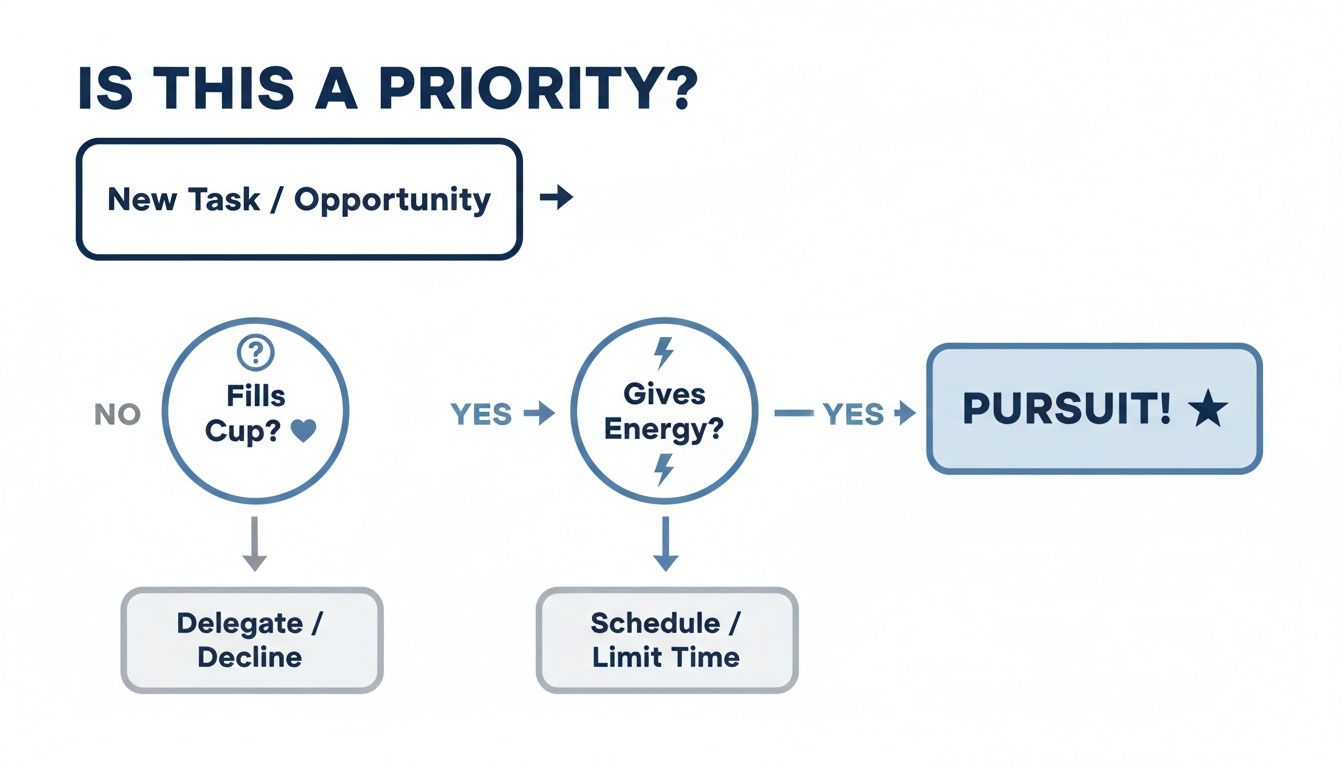
Ultimately, it helps you focus on a simple question: Does this energize me or drain me? Answering that honestly is the best way to protect your most valuable resource—your own personal energy.
Mastering Your Schedule with Smart Systems
A balanced life isn’t something you just find; it's something you have to consciously build. The most powerful tool you have for building it is your calendar, but only if you're the one in the driver's seat. Instead of letting your schedule run you ragged, you need to design it with real intention.
This means shifting from a reactive mindset—where you’re constantly putting out fires—to a proactive one where your priorities are already built into your day. It’s the difference between hoping you’ll have time for family dinner and making sure it happens, no matter what.
Time Blocking Your Way to Sanity
One of the best ways I’ve found to take back control is time blocking. This goes way beyond a simple to-do list. It’s the practice of giving every minute of your day a specific job. You carve out concrete blocks of time for focused work, family activities, exercise, and yes, even essential downtime.
When you time block, you aren't just slotting in meetings. You're scheduling your focus. For instance, you might block off 9-11 AM for "Deep Work on Project X" and 6-7 PM for "Device-Free Family Dinner." That simple act turns a vague goal into a non-negotiable commitment on your calendar.
By giving every hour a purpose, you cut down on decision fatigue and shield your most important activities from the constant flood of incoming requests. Your calendar becomes a fortress for your priorities.
This proactive approach is something we see reflected on a national scale. Take Italy, which leads the OECD's work-life balance rankings. Only 3% of Italian employees work 50+ hours a week, largely thanks to family-first policies that support working parents. The US, on the other hand, ranks 29th. Here, 10% of workers put in excessive hours, and there's no national paid parental leave. It just goes to show that structural support—whether it's national policy or a well-designed calendar—is critical for preventing burnout.
From Delegation to Teamwork at Home
Getting a handle on your schedule isn't just about what you do; it's also about what you don't do. Learning to delegate is a superpower for anyone juggling work and family, but it has to happen in both parts of your life. At work, it means trusting and empowering your team. At home, it means creating a real sense of shared responsibility.
This isn’t about just offloading chores you don't want to do. It’s about building a household team where everyone pitches in. Not only does this lighten your own load, but it also teaches kids valuable life skills and a sense of ownership.
Here’s a practical way to think about it:
| Age Group | Appropriate Tasks | The Goal |
|---|---|---|
| Ages 4-6 | Putting away toys, feeding a pet, setting napkins on the table. | Building basic habits of helpfulness and routine. |
| Ages 7-9 | Making their own bed, helping with meal prep, emptying the dishwasher. | Developing responsibility for their own space and contributing to the family unit. |
| Ages 10+ | Taking out the trash, walking the dog, preparing a simple meal one night a week. | Fostering independence and a true sense of partnership in running the household. |
This kind of system at home can be just as crucial as managing your professional calendar. Building these small, consistent actions are perfect examples of the kind of micro-habits that can transform your life by cutting down on daily friction.
A Real-Life Scheduling System
Let's make this tangible. I once worked with the Miller family—two working parents, two school-aged kids—who were drowning in scheduling conflicts and last-minute chaos. They told me they felt like they were constantly reacting to their week instead of actually running it.
They put a simple, two-part system in place that changed everything:
- A Shared Digital Calendar: Using Google Calendar, they created a dedicated "Family" calendar. Every single thing went on it—dental appointments, soccer practice, parent-teacher conferences, and date nights. It became their single source of truth.
- The Sunday Night Sync-Up: Every Sunday evening, they started spending 15 minutes together looking at the week ahead. They’d confirm who was handling school pickups, plan out dinners, and spot any potential conflicts before they could turn into stressful emergencies.
This little planning meeting completely wiped out their scheduling headaches. It gave them a clear, shared vision for the week and turned their chaotic household into a well-coordinated team. And that's really the essence of mastering your schedule: creating simple, repeatable systems that protect your time and reduce your mental load, freeing you up to focus on what actually matters.
Weaving Technology And Flexibility Into Your Life
A well-tamed calendar and the right work setup can be your secret weapons in the daily juggle of work and family. It’s not about adding a bunch of complicated software or apps, but about using a few smart tools to create a sense of calm amidst the chaos.
This really boils down to two things. First, using simple, everyday tech to get your family logistics in order. Second, learning how to confidently ask for the flexibility you need at work. This is more possible than ever, especially since the hybrid work revolution has completely changed what a "normal" workday looks like.
Let Simple Tech Do The Heavy Lifting
Think of the right apps as a shared family brain. They keep everyone on the same page and take some of the mental load off of you—no more trying to remember every single appointment and to-do list item. The goal here is simplicity, not complexity.
Here are the kinds of tools that have the biggest, most immediate impact:
- Shared Calendars: This is non-negotiable. An app like Google Calendar or Cozi creates one central hub for everything. Soccer practice, work deadlines, dentist appointments, date nights—it all goes in one place, which instantly kills those frustrating scheduling conflicts.
- Team-Based Task Lists: Don't laugh, but project management tools like Trello or Asana are fantastic for home life. Create a "Household Chores" board or a "Summer Vacation Plan" to assign tasks and see what’s getting done. It makes everyone feel like part of the team.
- A Central Communication Channel: A dedicated family group chat in an app like WhatsApp or Telegram is a lifesaver. It keeps all the quick updates, shopping lists, and "I'm running 5 minutes late!" messages in one spot, so you're not digging through texts and emails.
The trick is to pick one or two that work for your family and actually stick with them. The whole point is to make life easier, not to add another system you have to manage.
Top Tech Tools For Balancing Work And Family
Here's a quick look at some of the best tools out there for managing schedules, tasks, and family communication. These are the apps that can make the daily hustle feel a whole lot more manageable.
| Tool Category | App Examples | Key Feature For Balance | Best For |
|---|---|---|---|
| Shared Calendars | Google Calendar, Cozi | Centralized scheduling with color-coding for different family members. | Preventing double-bookings and ensuring everyone knows the weekly plan. |
| Task Management | Trello, Asana, Todoist | Visual boards and shared lists for household projects and chores. | Delegating tasks and tracking progress on family goals transparently. |
| Communication | WhatsApp, Telegram | Dedicated group chats for quick updates and shared information. | Centralizing family logistics and reducing scattered communication. |
| Meal Planning | Paprika, Mealime | Recipe organization and automated grocery list creation. | Saving time on weekly meal prep and reducing dinner-time stress. |
Choosing the right combination of these can feel like finally getting an assistant you desperately needed.
How to Ask For The Flexibility You Need (And Get It)
Getting more flexibility at work—whether that’s a hybrid schedule, different hours, or going fully remote—often hinges on a single, well-planned conversation. You have to frame it as a business proposal, not a personal favor.
Before you even think about talking to your boss, start gathering proof of your value. Track your productivity, pull together a list of your successful projects, and document your reliability. This immediately changes the conversation from "I need this" to "This is why I've earned it."
When you're ready for the chat, go in with a clear plan.
- Start with your value: "I'm fully committed to my role and to delivering great results for our team."
- State your request clearly: "I'd like to propose a hybrid schedule where I work from home on Tuesdays and Thursdays."
- Tie it to a business benefit: "I've found I can do my best deep-focus work without office interruptions. I'm confident this will allow me to be even more productive on my key projects, which benefits everyone."
- Offer a trial run: "How about we try this for 90 days? We can track my output and review the results together to make sure it's working well for the team."
When you walk into that meeting as a strategic partner instead of an employee asking for a handout, you change the entire dynamic. You’re not just solving a personal problem; you’re offering a way to improve focus, productivity, and even retention.
This proactive, professional approach makes it incredibly hard for a good manager to say no. It turns your need for balance into a win-win situation.
Why Self-Care Is Your Most Productive Habit

Here's a hard truth: you can't pour from an empty cup. Too often, we treat self-care like a reward we get only after every single thing on our to-do list is crossed off. The problem? That list is never-ending.
The real game-changer is seeing self-care for what it is: the fuel that keeps your engine running. It’s not selfish or a luxury. It’s essential maintenance for your life.
Ditching Guilt for Practical Self-Care
Parental guilt is a powerful force. It whispers that any moment you spend on yourself is a moment you’re stealing from your kids or your job. But that constant pressure to be "on" is a fast track to exhaustion.
Let’s be clear: practical self-care doesn't always mean a spa day. It’s about weaving small, restorative moments into the fabric of your day. Think of it as strategic recharging.
- Five-Minute Mindfulness: Got a few minutes between calls? Close your eyes and just breathe. There are some fantastic apps for this; check out our guide to the top 10 mental health apps for 2025 to find one that works for you.
- Scheduled Movement: Put a 30-minute walk with a friend on your calendar and treat it like a non-negotiable meeting. You get exercise, social time, and fresh air all at once.
- Protected Hobby Time: Carve out just 10-15 minutes an evening for something you love that isn’t work or a chore. Read a chapter of a book, sketch, or just listen to music.
Recognizing Burnout Before It Takes Over
Think of self-care as your early-warning system for burnout. If you know what to look for, you can act before you hit a wall.
| Early Warning Sign | Description | Proactive Self-Care |
|---|---|---|
| Persistent Irritability | You find yourself snapping at small things with family or colleagues. | Schedule a solo coffee break to decompress and reset your mood. |
| Mental Fog | You feel unfocused and making simple decisions feels impossible. | Make it a priority to get an extra hour of sleep for a few nights. |
| Loss of Motivation | Activities at work or home that you used to enjoy now feel like a chore. | Re-engage with a hobby that gives you a genuine sense of accomplishment. |
This isn't just a personal strategy; it's a global one. Countries like New Zealand consistently top the Global Life-Work Balance Index because they build well-being into their culture with shorter workweeks and generous leave. It proves that when you prioritize personal time, life satisfaction goes way up.
I coached a client who started with just ten minutes of reading a book alone each night. She said that small act of claiming time for herself transformed her patience and focus more than any productivity hack ever did.
In the end, learning when to rest is just as crucial as learning when to hustle.
Frequently Asked Questions About Balancing Work and Family
1. I’m completely overwhelmed. Where do I even start?
The single most effective first step is a one-week time audit. Track where your hours are actually going. This data moves you from a vague feeling of being overwhelmed to a clear understanding of where your time is being wasted. It's the diagnosis you need before you can find a cure.
2. How can a single parent possibly achieve balance?
For single parents, balance relies on two pillars: a strong support system and ruthless prioritization. Lean on your "village"—friends, family, and community groups—for practical help. At work, communicate your needs clearly to advocate for predictable flexibility. Most importantly, schedule non-negotiable personal time, even if it's just 15 minutes, to prevent burnout.
3. My boss expects me to be available 24/7. How do I push back?
Address this proactively, not in the heat of a late-night email. Frame the conversation around productivity. Explain that you deliver your best work when you have time to fully recharge. Propose a clear communication boundary, such as, "To ensure I'm focused and productive, I fully disconnect after 7 PM. For any true emergencies, please text me."
4. Is 'work-life integration' better than 'work-life balance'?
One isn't inherently better; they are different philosophies. Balance is about creating clear separation between your professional and personal life. Integration involves a more fluid blend, like taking a family call during work hours and finishing a report after the kids are asleep. Choose the approach that genuinely reduces your stress, not the one that sounds trendier.
5. How do I deal with the guilt of missing a family event for work?
Acknowledge that guilt is a normal response, but don't let it consume you. Remind yourself that balance is measured over the long term, not by one unavoidable conflict. The best antidote is proactive planning: explain the situation to your family and immediately schedule a high-quality, device-free activity to reconnect.
6. What if my partner and I have different ideas of what 'balance' means?
This requires an intentional conversation, not a rushed argument. Set aside dedicated time to discuss your individual non-negotiables. What does an ideal week look like for each of you? The goal is to create a shared family vision and agree on a practical system for chores, childcare, and personal time that feels fair to both partners.
7. Is it possible to find balance in a very high-pressure job?
Yes, but it requires extreme intentionality. In high-stakes careers, balance is less about working fewer hours and more about maximizing the impact of your non-work time. You must be militant about time-blocking, delegate relentlessly (both at work and at home), and fiercely protect your scheduled downtime.
8. How often should I review my work-life balance system?
Your system should evolve as your life does. I recommend a quick quarterly check-in to see what's working and what isn't. Plan a more in-depth review annually or whenever you experience a major life change, such as a promotion, a new child, or a move.
9. What’s a quick trick to de-stress when work follows me home?
Create a "transition ritual." This is a simple, symbolic act that signals to your brain that the workday is over. It could be changing out of your work clothes, taking a five-minute walk around the block before entering your house, or listening to a specific song on your commute. This small buffer helps you shed work stress so you can be fully present at home.
10. My company culture celebrates overworking. How can I create change?
Lead by example. While it can feel risky, demonstrating that you can be a top performer without working 80-hour weeks is powerful. Set and maintain your boundaries, take all of your vacation time, and log off at a reasonable hour. When others see your success, it challenges the "busyness as a badge of honor" narrative and can inspire a healthier culture.
At Everyday Next, we're committed to providing insights that help you thrive in every aspect of your life. Explore more practical guides on personal development, finance, and technology at https://everydaynext.com.
Previous Post
Next Post










Pingback: When to Start Maternity Leave Timing and Planning Guide
Pingback: Family Meal Planning on a Budget | Free Worksheet