
Quantum Computing Practical Applications: From Theory to Industry Impact
People often talk about quantum computing as if it's something from a science fiction movie, decades away from being useful. The reality is much more interesting. We're already seeing quantum computing practical applications emerge in finance, drug discovery, and logistics, thanks to a clever approach that blends quantum and classical computers.
While the massive, error-free quantum computers of the future are still being built, today's machines are far from useless. They're solving real, complex problems right now—the kinds of optimization and simulation puzzles that bring even our best supercomputers to a crawl.
What Are the Practical Applications of Quantum Computing Today?
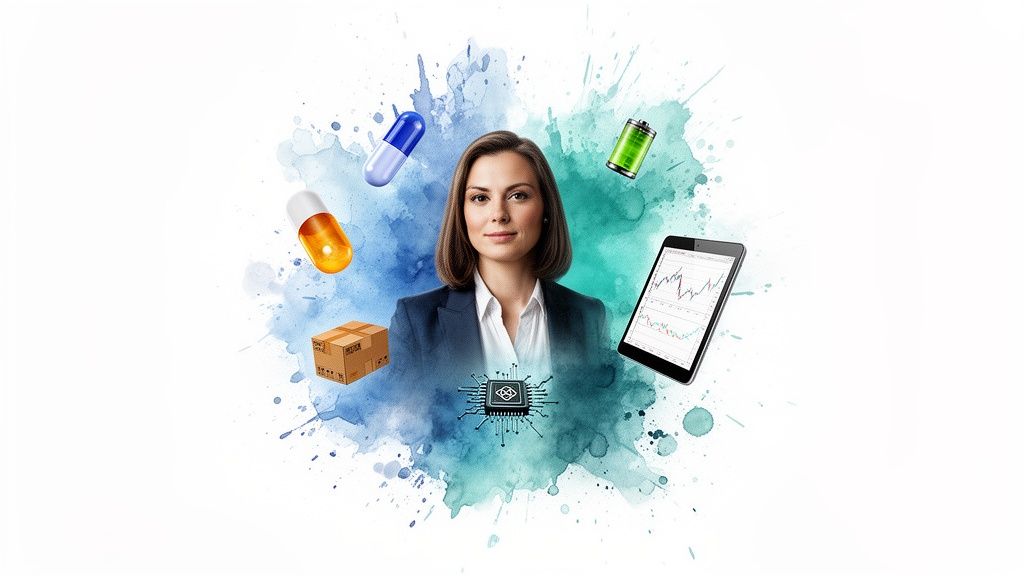
Let's ground this in what's happening today. Quantum computing is moving out of the research lab and into the business world, making a real difference in a few key industries.
We're currently in what experts call the NISQ era, which stands for "Noisy Intermediate-Scale Quantum." In simple terms, this means our current quantum processors are powerful enough to tackle specific jobs but are still a bit fragile—they're sensitive to environmental "noise" and don't have a massive number of qubits just yet.
Because of these quirks, the smartest way to use them is with a hybrid approach. It’s a team effort:
- A complex problem gets split up.
- The toughest, most computationally draining parts go to the quantum processor.
- A classical supercomputer handles the rest.
By working together, this hybrid duo can find answers faster and more efficiently than either machine could on its own.
The Growing Market Confidence
This shift from theory to tangible results is attracting serious attention and investment. The quantum computing market is expected to grow at a compound annual growth rate (CAGR) of 30% from 2023 to 2030. That’s not just hype; it's a clear signal that major companies and investors believe quantum is ready to deliver real value.
This isn't a distant promise; it's happening now. Companies are already running hybrid quantum algorithms to balance financial portfolios, simulate how molecules behave for drug discovery, and untangle complex global supply chains.
The progress isn't just about building bigger machines. It’s about being smart and finding the right problems where even today's imperfect quantum computers give us an edge. To see how quickly the hardware and software are evolving, check out our guide on recent quantum computing breakthroughs.
Quantum Applications At a Glance
So, where is all this happening? The table below gives a quick snapshot of the industries where quantum computing is starting to gain traction, the specific challenges it's helping solve, and some real-life companies pioneering these efforts.
| Industry | Problem Solved | Real-World Example |
|---|---|---|
| Pharmaceuticals | Molecular simulation for drug discovery | Boehringer Ingelheim partners with Google Quantum AI to accelerate R&D. |
| Finance | Portfolio optimization and risk analysis | BBVA uses quantum algorithms to gain an advantage in currency arbitrage. |
| Materials Science | Designing new materials and catalysts | JSR Corporation works with IBM to develop advanced semiconductor materials. |
| Logistics | Route and supply chain optimization | Volkswagen pilots quantum routing for public transit in Lisbon. |
| Cybersecurity | Developing post-quantum encryption | NIST is standardizing new cryptographic algorithms to resist future quantum attacks. |
As you can see, the activity is spread across several critical fields, each at a different stage of its quantum journey. Now, let's dive into what this looks like on the ground.
From Classical Bits to Quantum Qubits
To get a real feel for what quantum computers can do, it helps to first understand why they "think" so differently from the laptop or phone you're using right now. The magic isn't just about raw speed; it's a completely different way of processing information, moving from the black-and-white world of classical bits to the strange, probabilistic world of quantum qubits.
Think of a classical bit as a light switch. It's either on (1) or off (0). That’s it. This simple binary system is the foundation of every digital device we use today.
A quantum bit, or qubit, is more like a dimmer switch. It can be fully on, fully off, or—and this is the important part—some combination of both at the same time. This mind-bending property is called superposition.
Superposition: The Power of "And"
Imagine flipping a coin. While it’s spinning in the air, it’s not really heads or tails—it's a blur of both possibilities. Only when it lands (when we "measure" it) does it collapse into one definite state.
A qubit in superposition is a lot like that spinning coin. It holds the potential for both 0 and 1 at once, which lets a quantum computer explore a huge number of potential solutions simultaneously. This is where the exponential power comes from, especially for certain types of problems.
A quantum computer with just 300 interacting qubits could theoretically explore more possible states than there are atoms in the known universe. This unbelievable computational space is what makes quantum computing such a big deal for complex simulations and optimization problems.
Entanglement: A Spooky Connection
The other key idea is entanglement, which Albert Einstein famously called "spooky action at a distance." When you entangle two qubits, their fates become linked, no matter how far apart they are.
If you have a pair of these entangled qubits and measure one as "up," you instantly know its partner is "down." This perfect correlation gives us a powerful way to link information across a quantum processor, enabling calculations that would otherwise be impossible. It’s like having two magic coins that are guaranteed to land on opposite faces, every single time.
For a deeper dive into these foundational concepts, you can explore our full guide explaining quantum computing in simple terms. Grasping these basics makes it much clearer why certain real-world applications are a perfect fit for quantum machines.
Quantum Computing vs Classical Computing: A Direct Comparison
To put it all in perspective, the table below highlights the fundamental differences between these two computing worlds. It's not about one being a faster version of the other; they are entirely different tools built for entirely different jobs.
| Feature | Classical Computing | Quantum Computing |
|---|---|---|
| Basic Unit | Bit | Qubit |
| State | Represents either a 0 or a 1. | Can represent 0, 1, or both simultaneously (superposition). |
| Processing | Processes information sequentially, one calculation at a time. | Explores many possibilities at once due to superposition. |
| Core Principles | Based on classical physics and binary logic. | Based on quantum mechanics, including superposition and entanglement. |
| Error Rate | Very low and stable due to mature technology. | Higher and more sensitive to "noise" (decoherence). |
| Best For | Everyday tasks like email, web browsing, and data storage. | Solving specific complex problems like optimization, simulation, and factoring. |
In the end, quantum computers aren't here to replace the classical machines we rely on. The real vision is for them to work together. Quantum processors will act as specialized accelerators, tackling the kinds of impossibly complex challenges that our current computers would never be able to solve. This hybrid approach is what will drive the most practical applications of quantum computing for years to come.
Where Quantum Computers Are Already Making an Impact
Let's move from the mind-bending theory to where the rubber meets the road. How can this technology solve problems that leave even today's fastest supercomputers spinning their wheels? The goal isn't to replace your laptop or smartphone. Instead, it's about tackling specific, incredibly hard challenges where the unique way qubits work gives them an unbeatable edge. And this isn't just science fiction; real companies are putting this to the test right now.
Think of it this way: a classical computer is like a light switch—it's either on or off, a 1 or a 0. A quantum computer is more like a dimmer switch, able to explore the entire range of possibilities in between.
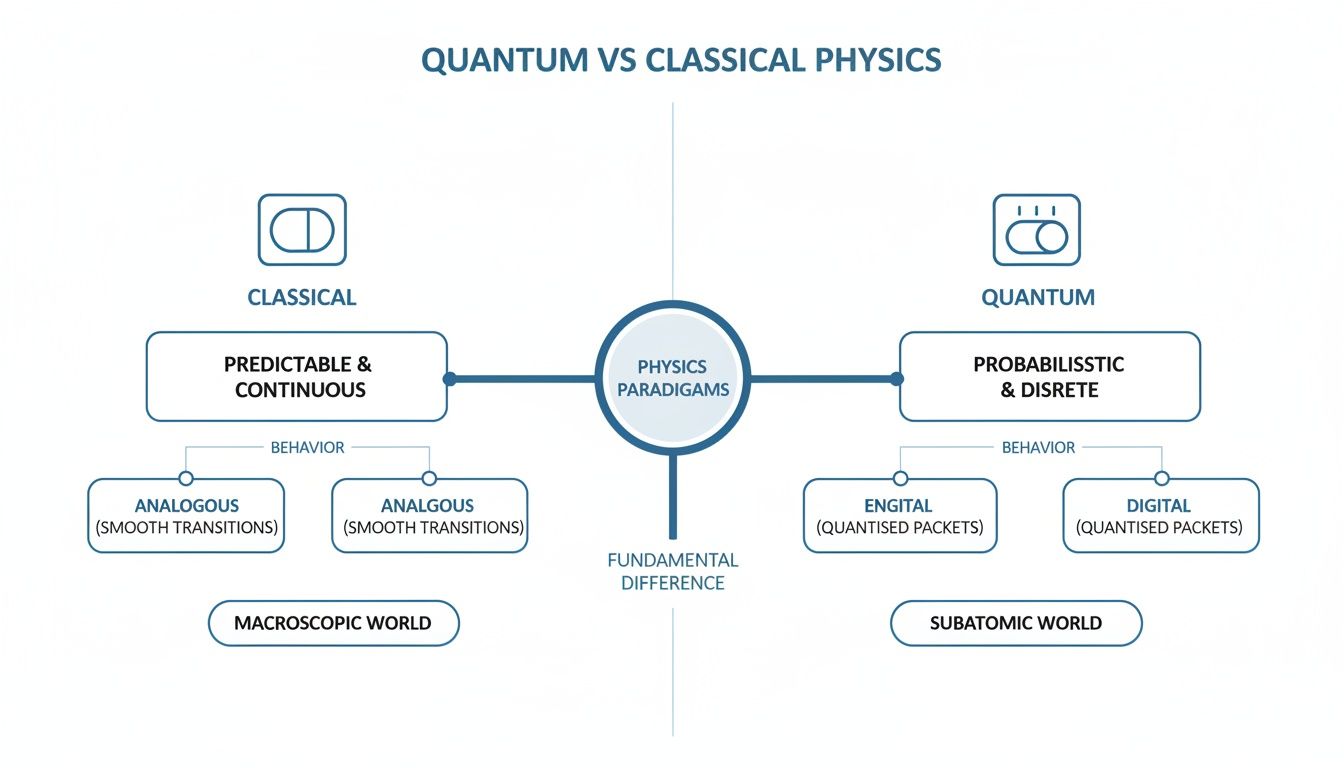
This fundamental difference—exploring a vast landscape of possibilities at once versus plodding down a single path—is what unlocks its power across so many industries.
Accelerating Drug Discovery and Healthcare
Creating a new drug is a brutally slow and expensive slog. Scientists have to figure out how millions of potential molecules might behave inside the human body, a simulation task so demanding it can overwhelm even the biggest supercomputers.
The problem is that classical computers don't "speak" the same language as molecules. Molecules are quantum systems, through and through. To simulate them properly, you need a machine that operates by the same rules.
Quantum computers are tailor-made for this. They can model molecular interactions with a precision that’s simply impossible for classical machines. This means researchers can get a much clearer picture of a drug's effectiveness—and its side effects—long before it ever gets to a lab.
Real-World Example: Pharmaceutical giant Boehringer Ingelheim is working with Google Quantum AI to run these kinds of molecular simulations. This collaboration aims to model the mechanisms of action for new drug candidates, a clear sign that the industry is taking this technology seriously to tackle complex human diseases.
The implications here are enormous:
- Faster Drug Development: Companies can zero in on the most promising compounds, potentially shaving years off the R&D timeline.
- Personalized Medicine: Further down the road, it could be possible to design drugs tailored to a person's specific genetic code.
- New Disease Treatments: This opens up entirely new avenues for tackling complex illnesses like Alzheimer's, cancer, and cystic fibrosis.
Optimizing Finance and Investment Strategies
The financial world runs on incredibly complex math—calculating risk, weighing probabilities, and optimizing outcomes. Quantum computing offers a whole new toolbox for these jobs, promising more speed and accuracy in a sector where the fintech revolution is already moving at lightning speed.
One of the clearest quantum computing practical applications in finance is portfolio optimization. The classic challenge is finding the perfect blend of assets to get the best return for the lowest risk. With thousands of stocks and a whirlwind of economic factors, the number of possible combinations is mind-boggling.
A quantum algorithm can survey that entire landscape of possibilities at once. It can pinpoint optimal investment strategies much faster than classical methods like Monte Carlo simulations, which have to grind through the scenarios one by one.
Real-World Example: Multiverse Computing, a Spanish quantum software firm, worked with the Bank of Canada to model cryptocurrency adoption. By using a quantum-inspired approach to simulate financial network behavior, they demonstrated the tech's power to untangle complex, real-world economic systems and inform policy decisions.
Designing Next-Generation Materials
The hunt for new materials is what drives innovation in everything from better batteries and more efficient solar panels to the lightweight alloys used in aerospace. The bottleneck has always been predicting a material's properties before you create it, which means understanding how its atoms interact at a quantum level.
This is another area where classical computers just can't keep up. But for a quantum computer, modeling those atomic-level physics is its native language.
This allows scientists to:
- Design new catalysts that dramatically reduce the energy needed for industrial processes, like making fertilizer.
- Invent novel electrolytes for batteries that store more power and last longer.
- Develop room-temperature superconductors, a holy grail that could completely change how we transmit energy.
Real-World Example: The partnership between materials company JSR Corporation and IBM is a great example. They're using quantum computation to hunt for new photoresist materials essential for manufacturing the next generation of semiconductors, directly pushing the entire electronics industry forward.
Streamlining Logistics and Supply Chains
Global supply chains are basically giant, nightmarishly complex optimization problems. You’ve probably heard of the "Traveling Salesperson Problem"—finding the shortest possible route that hits a list of cities. As you add more stops, the number of possible routes explodes exponentially, making it an unsolvable puzzle for a classical computer.
Quantum optimization algorithms, however, are built for this. They can sift through a staggering number of routing options to find the best one, saving companies a fortune in time, fuel, and headaches.
Real-World Example: Volkswagen has already dipped its toes in these waters, using a quantum algorithm to optimize the routes for a fleet of public buses in Lisbon. This proof-of-concept demonstrated the potential to reduce traffic congestion and wait times in complex urban environments.
We're watching quantum computing’s journey from a lab curiosity to a commercial tool speed up dramatically. We’re seeing a real shift, with many experts believing 2026 will be a pivotal year when the technology starts moving from research potential to practical products. This progress is being driven by better hardware and smarter, AI-powered software. The ecosystem is growing, and it could be generating tens of billions in revenue by the mid-2030s. The biggest gains are expected in chemicals, life sciences, finance, and mobility—fields where quantum's unique advantages really shine. You can find more on this transition at the U.S. Data Science Institute.
The Impact of Quantum on AI and Machine Learning
When you start to blend two of the most powerful technologies out there—quantum computing and artificial intelligence—the possibilities for what we can discover just explode. This fusion has sparked a whole new field: Quantum Machine Learning (QML).
Let's be clear, QML isn't about throwing out classical AI. It’s about building powerful hybrid systems where each technology does what it does best. Think of a quantum processor as a specialist, tackling the ridiculously complex calculations that would bring a normal computer to its knees, effectively supercharging the AI models we already rely on.
The real magic is how quantum computers navigate massive, high-dimensional spaces. A classical AI chews through data points one by one, but a quantum algorithm, thanks to superposition and entanglement, can look at a whole landscape of information all at once. This unique ability lets it spot faint patterns and connections that are completely invisible to even the best classical machines.
Supercharging AI Model Training
One of the most exciting, near-term uses for quantum in this space is optimizing the monster AI models we see today. Training a huge neural network is basically a hunt for the perfect settings among a mind-boggling number of options. It's a classic optimization problem, and a very hard one.
This is where quantum algorithms can really shine by exploring that vast space of possibilities far more efficiently. The payoff could be huge:
- Faster Training: We could slash the time and energy it takes to train complex AI models.
- Smarter Models: By finding ideal setups that classical methods might overlook, we can build models that perform much better.
- Better Predictions: The models could get much better at making accurate predictions when they encounter new, real-world data.
This could make AI in critical fields like medicine and finance far more dependable. To really appreciate what's coming, it helps to have a good handle on the broader field of Artificial Intelligence.
Unlocking New Capabilities in Data Analysis
The ability to process truly gigantic datasets is another game-changer. Imagine trying to find the one right answer hidden in data with billions of variables. A quantum computer can essentially weigh a huge number of combinations simultaneously, giving it a massive speed advantage for certain machine learning jobs.
This has direct consequences for solving tough problems. In fraud detection, for example, a QML system could analyze global transaction patterns in almost real-time. It could flag sophisticated fraud rings that are designed to look like normal activity—something that often fools classical systems.
QML can also revolutionize feature mapping, which is how an AI model figures out which pieces of input data are most important. By translating data into a quantum state, new algorithms can uncover complex relationships that lead to models with much deeper insight.
A key goal of QML is to create a true "quantum advantage," where a hybrid system can solve a commercially relevant problem significantly faster or more accurately than the best classical computer alone. While we're still in the early stages, progress is accelerating.
The Hybrid Approach: A Glimpse into the Future
It’s important to remember that the future is hybrid. For the foreseeable future, quantum computers won't work alone. They'll act as specialized co-processors, working right alongside the GPUs and CPUs we use now.
Picture this: a classical computer handles all the data prep and deploys the final model, while the quantum processor is called in to do the heavy lifting—the core optimization or pattern-finding task.
This team-based approach lets us start tapping into quantum capabilities now, without having to wait for a perfect, error-free quantum computer. Companies are already figuring out how to weave quantum-inspired algorithms and hybrid models into their workflows to get an edge. The link to AI is particularly strong, as we're already seeing with the business applications of generative AI. By bringing these fields together, we're really setting the stage for the next great leap in computing.
Preparing for a Post-Quantum World

While we often talk about what quantum computers can build, one of their most immediate applications is a defensive one. It turns out the very power that lets a quantum machine model a new drug could also be used to shatter the foundations of modern digital security.
Think about it: our world runs on encryption. The algorithms protecting your bank account, your private messages, and sensitive state secrets all rely on math problems so tough that today's best supercomputers would need billions of years to crack them.
A large, fault-tolerant quantum computer could change all that. An algorithm designed for these machines, known as Shor's algorithm, could theoretically solve these problems in just a few hours or days. This would leave widely used encryption standards like RSA and ECC completely exposed.
The Race to Build Post-Quantum Cryptography
This isn't just a hypothetical problem. The threat has triggered a global race to develop new cryptographic standards that are safe from both classical and quantum computers. This new field is called Post-Quantum Cryptography (PQC).
The idea behind PQC isn't to use quantum weirdness for encryption. Instead, it’s about finding entirely new types of mathematical problems that are hard for any computer to solve, quantum or not. It's about future-proofing our data.
The U.S. National Institute of Standards and Technology (NIST) has been at the forefront of this, running a multi-year competition to find and standardize the best PQC algorithms. After years of intense scrutiny, they’ve selected the first wave of winners, a huge step toward securing our digital future.
People in the industry have started calling this transition "Y2Q," drawing a parallel to the massive Y2K bug preparations. It’s a fitting comparison, as this will require a fundamental overhaul of security in every sector, from finance to healthcare.
The scale of this challenge is hard to overstate. Every single device, server, and piece of software using encryption will eventually need an upgrade. For a deeper look into the evolving security landscape, you can read more about the cybersecurity challenges of 2025 and beyond.
The "Harvest Now, Decrypt Later" Threat
So, if these powerful quantum computers are still years away, why the urgency? The answer is a simple and chilling strategy: "harvest now, decrypt later."
Adversaries can easily intercept and store massive amounts of encrypted data today. They just have to sit on it, waiting for the day they get their hands on a quantum computer powerful enough to break the encryption.
This completely changes the timeline. For any data with a long shelf life—think government secrets, intellectual property, or personal health records—the threat is already here. Anything sent over the internet today without quantum-resistant protection is already vulnerable.
A New Era of Encryption
To really grasp this shift, it helps to compare the security principles of today's systems with the new post-quantum standards.
| Cryptographic Era | Core Security Principle | Vulnerability to Quantum Attack |
|---|---|---|
| Current (Pre-Quantum) | Based on the difficulty of factoring large numbers (RSA) or solving discrete logarithm problems (ECC). | High. Shor's algorithm makes these problems solvable. |
| Future (Post-Quantum) | Based on more complex math, like lattice-based cryptography, that's hard for all known algorithms. | Low. Specifically designed to resist both quantum and classical attacks. |
Switching to PQC is not a simple patch—it’s a foundational upgrade for our entire digital society. Organizations need to start assessing their systems now, figuring out where their cryptographic weak points are, and planning their migration to these new, tougher standards. In many ways, preparing for the post-quantum world is one of the most critical jobs we face today.
Frequently Asked Questions (FAQ)
1. Will quantum computers replace classical computers?
No, probably never. Quantum computers are specialized machines designed to solve specific complex problems that are impossible for classical computers. Think of them as co-processors or accelerators. The future is hybrid, where classical computers handle everyday tasks and quantum computers tackle the most demanding calculations.
2. What is the biggest challenge holding quantum computing back?
The biggest challenge is decoherence, where qubits lose their quantum properties due to environmental "noise" like temperature fluctuations or vibrations. This leads to errors in computation. Overcoming decoherence, scaling up the number of stable qubits, and developing effective error correction are the primary hurdles for researchers.
3. How will quantum computing affect the job market?
Quantum computing will create new roles like "quantum algorithm developer" and "quantum hardware engineer." More broadly, it will transform existing jobs. Professionals in finance, chemistry, and logistics will need to become "quantum-aware" to understand how to apply this technology to solve problems in their fields, even if they don't operate the machines themselves.
4. Is it possible to invest in quantum computing today?
Yes. You can invest in large tech companies like Google (Alphabet), Microsoft, and IBM that have significant quantum research divisions. There are also publicly traded "pure-play" quantum companies like IonQ and Rigetti, though these are higher-risk. Tech-focused ETFs that include quantum companies are another option for diversifying investment.
5. Should I be worried about quantum computers breaking Bitcoin and other cryptocurrencies?
The threat is real but not immediate. The cryptography securing most cryptocurrencies is vulnerable to an attack by a powerful future quantum computer. However, the crypto community is actively working on developing and implementing "post-quantum" cryptographic standards to ensure blockchains remain secure long before such a computer exists.
6. Can I try using a real quantum computer myself?
Yes, you can. Cloud platforms like the IBM Quantum Experience and Amazon Braket provide access to real quantum hardware. These services allow developers, researchers, and hobbyists to run their own quantum algorithms and experiments, often for free or at a low cost.
7. Which countries are leading in quantum computing development?
The United States and China are widely considered the two leaders, with massive government and private investment in research and development. However, other countries like the United Kingdom, Germany, Canada, and Japan have strong, innovative quantum ecosystems and are making significant contributions to the field.
8. How can quantum computing help solve climate change?
Quantum computers can address climate change by solving complex optimization and simulation problems. For example, they could help design new materials for more efficient batteries and solar panels, discover novel catalysts to capture carbon from the atmosphere, and optimize global energy grids to drastically reduce waste.
9. What is the difference between a qubit and a classical bit?
A classical bit is the basic unit of information in computers today; it can only be in one of two states: 0 or 1. A qubit, the quantum equivalent, can exist as a 0, a 1, or a combination of both simultaneously (a state called superposition). This ability allows quantum computers to process a vast number of possibilities at once.
10. What does "quantum advantage" mean?
Quantum advantage (or quantum supremacy) is the point at which a quantum computer can solve a practical, real-world problem significantly faster or more accurately than the most powerful classical supercomputer could ever hope to. Achieving this for commercially relevant problems is the key goal of the entire quantum computing industry.
At Everyday Next, we're committed to breaking down complex topics to help you stay ahead. For more insights into the technologies shaping our world, visit us at https://everydaynext.com.

Previous Post
Next Post