
12 Powerful Edge Computing Use Cases Transforming Industries in 2026
Edge computing is rapidly moving from a niche concept to a mainstream technology that powers our daily lives. Unlike cloud computing, which processes data in centralized centers, edge computing brings computation closer to where data is created. This proximity dramatically reduces latency, enhances privacy, and enables real-time decision-making that is not always possible with the cloud alone.
This shift is creating tangible changes across nearly every industry. From the smart devices in our homes to the autonomous cars on our roads and the AI assistants on our phones, edge computing is the invisible engine driving the next wave of innovation. It is the core technology enabling systems to react instantly, without waiting for instructions from a distant server.
In this guide, we'll break down 12 of the most impactful edge computing use cases, moving beyond simple definitions to provide a strategic blueprint. You will find real-world examples, a clear analysis of the benefits and trade-offs, and actionable takeaways for each application. Whether you're a tech leader planning your next move, an investor identifying new opportunities, or simply curious about the future, understanding these practical applications is essential. This list provides the clarity needed to see how this transformative technology is reshaping industries and creating real-world value today.
1. Real-Time Financial Data Processing and Algorithmic Trading
In the world of high-frequency trading, every microsecond counts. Edge computing provides a critical advantage by processing market data directly at the network's edge, close to financial exchanges and data sources. This proximity drastically cuts latency, enabling trading algorithms to execute decisions faster than cloud-based alternatives.
By deploying powerful servers in co-location facilities near major stock exchanges, firms like Citadel Securities and Jump Trading analyze market data and execute trades with minimal delay. This setup allows their algorithms to react to market shifts in near real-time, capturing opportunities that would be missed by slower systems. This is one of the most powerful edge computing use cases as it directly translates processing speed into financial gain.
Strategic Implementation and Key Takeaways
The primary benefit is ultra-low latency, which is non-negotiable for competitive algorithmic trading. Processing data locally avoids the round-trip time to a centralized cloud, giving traders a crucial speed advantage. For those looking to dive deeper into automated trading, a comprehensive guide to algorithmic trading can be invaluable.
- Actionable Tip: Start with a hybrid model. Use edge nodes for time-sensitive trade execution and data ingestion, while leveraging the cloud for less critical tasks like historical data analysis and model training.
- Key Insight: JPMorgan Chase’s LOXM (Liquidity Optimized Execution Machine) uses edge processing to analyze vast amounts of real-time data to find the best way to execute large trades, minimizing market impact.
- Business ROI: The ROI is direct and measurable. Reduced latency leads to better trade prices (lower slippage) and the ability to capitalize on fleeting arbitrage opportunities, directly increasing profitability.
This approach is essential for firms where execution speed is a core component of their trading strategy. The rise of AI-driven finance also benefits from this model, as seen with modern robo-advisors that leverage real-time data.
2. Smart Home IoT Device Management and Automation
In the modern smart home, responsiveness and privacy are paramount. Edge computing addresses these needs by processing commands locally on devices or a central hub, eliminating the need for constant cloud communication. This local processing for smart speakers, security cameras, and lighting systems results in faster response times, enhanced privacy, and continued functionality even when the internet connection is down.
For instance, Apple HomeKit's architecture heavily relies on on-device processing via a HomePod mini or Apple TV acting as an edge gateway. Similarly, Amazon Echo devices now perform more voice command processing locally. This shift means when you ask your smart speaker to turn on a light, the command is executed instantly within your home network instead of making a round-trip to a distant server. These implementations are clear demonstrations of edge computing use cases improving everyday convenience and security.
Strategic Implementation and Key Takeaways
The core benefit here is reduced latency and increased privacy. By keeping data processing within the home network, commands are executed faster, and sensitive information, like security camera footage or voice commands, is less exposed to external networks. For a deeper understanding of how these systems connect, learning about the Matter smart home standard is highly recommended.
- Actionable Tip: Prioritize devices that support local processing or work with a local hub like the Philips Hue Bridge. This ensures core automations (like lights turning on with motion) work regardless of internet status.
- Key Insight: Nest cameras can use on-device machine learning to differentiate between a person, a package, and a vehicle, processing video locally before sending a more specific, relevant notification to the cloud and the user.
- Business ROI: For manufacturers, this approach reduces cloud infrastructure costs and data transfer fees. It also serves as a strong selling point, appealing to privacy-conscious consumers and boosting brand trust and marketability.
This model is becoming the standard for reliable and secure smart home ecosystems, creating a more seamless and resilient user experience. It ensures that the essential functions of a smart home remain dependable and private.
3. Autonomous Vehicle Decision-Making and Safety Systems
For autonomous vehicles, processing speed is a matter of safety, not just performance. Edge computing is the core technology that enables a self-driving car to make split-second decisions by processing massive amounts of sensor data directly on the vehicle. This local processing of inputs from cameras, LiDAR, and radar eliminates the potentially fatal latency of sending data to a distant cloud for analysis.
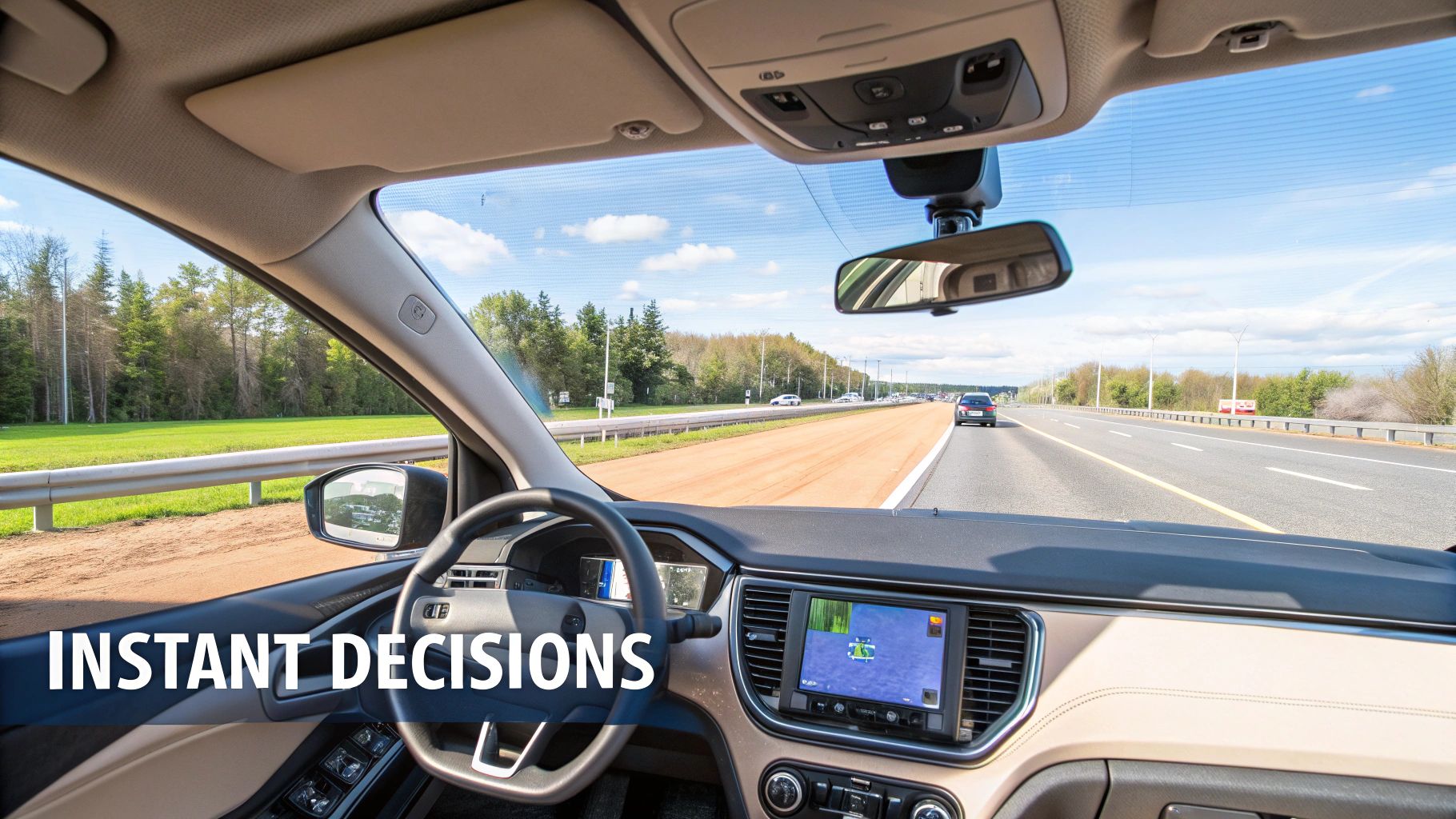
This onboard computation allows the vehicle to react instantly to a pedestrian stepping into the road or a car braking suddenly. Companies like Waymo and Cruise rely on powerful in-vehicle edge systems to navigate complex urban environments, handling all critical driving functions-acceleration, steering, and braking-in real time. These localized capabilities are one of the most critical edge computing use cases, as they are fundamental to making self-driving cars a safe and viable reality.
Strategic Implementation and Key Takeaways
The primary benefit here is instantaneous response time, which is non-negotiable for vehicle safety. By processing data locally, a vehicle can operate safely and reliably even without a constant internet connection, a crucial factor for driving through tunnels or remote areas.
- Actionable Tip: Implement hardware redundancy by using multiple, independent processing units for critical functions. If one system fails, another can take over, ensuring the vehicle remains safe.
- Key Insight: Tesla's Full Self-Driving (FSD) system uses custom-designed chips for onboard neural network processing. This highly specialized edge hardware is optimized to interpret video feeds and make driving decisions with extreme efficiency and low power consumption.
- Business ROI: The ROI is built on enhanced safety, which builds consumer trust and reduces liability. Faster, more reliable decision-making leads to fewer accidents, accelerates regulatory approval, and drives market adoption of autonomous technology.
This approach is indispensable for any company developing autonomous systems, from passenger vehicles to delivery drones and automated trucking fleets. The NVIDIA DRIVE platform is a prime example of a scalable edge AI solution that powers autonomous capabilities across multiple automotive manufacturers.
4. Industrial IoT and Predictive Maintenance
In manufacturing and heavy industry, equipment failure leads to costly downtime and production losses. Edge computing addresses this by enabling real-time monitoring of machinery health directly on the factory floor. By processing sensor data from equipment-like vibrations, temperatures, and pressures-at the edge, anomalies can be detected instantly, allowing for predictive maintenance before a catastrophic failure occurs.
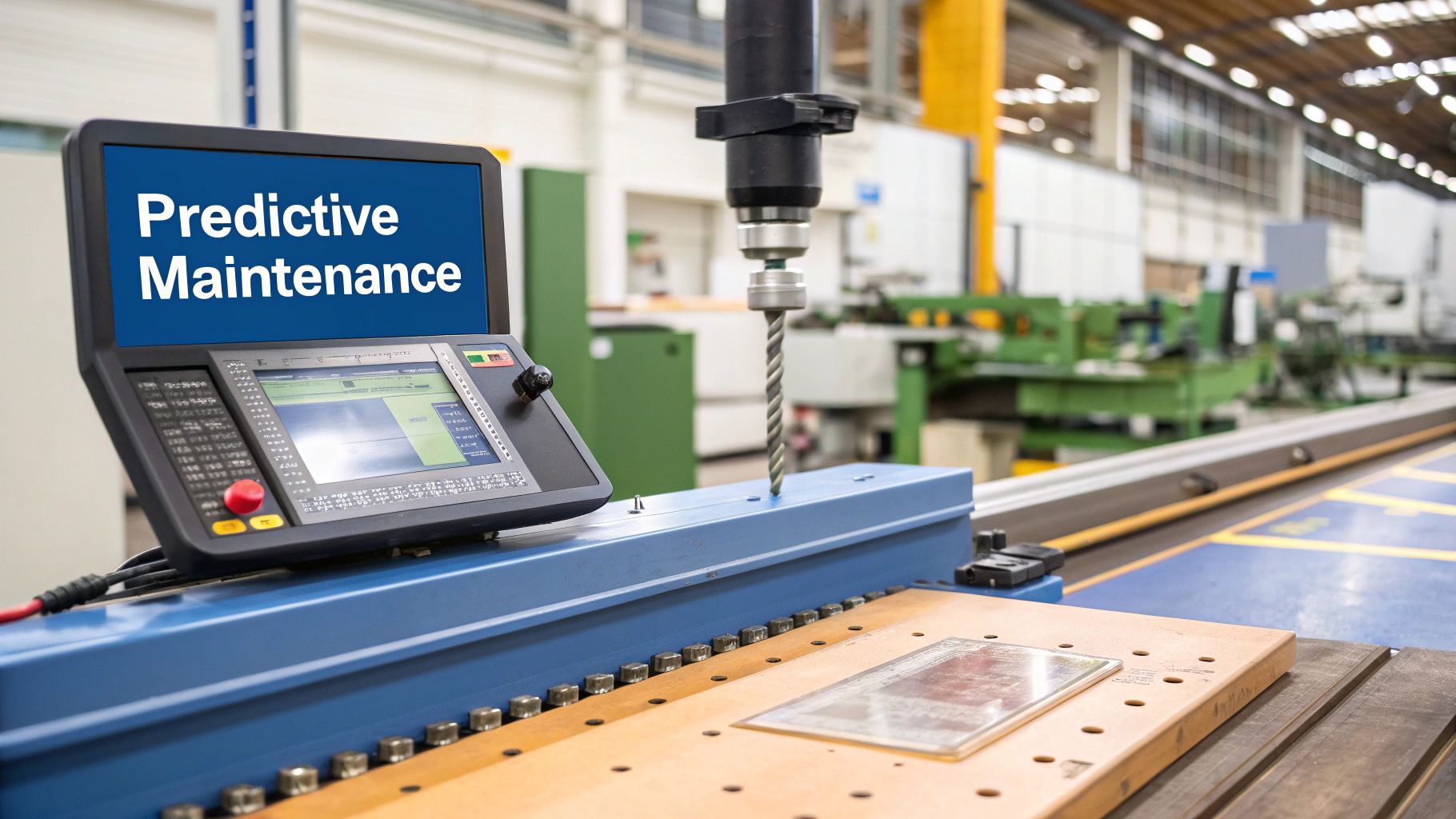
This approach minimizes data transmission to the cloud, providing the low-latency analysis required to act on potential issues immediately. Companies like Siemens use their MindSphere platform with edge devices to create a feedback loop for factory automation, while General Electric's Predix platform monitors industrial assets like turbines. This is one of the most impactful edge computing use cases as it transforms reactive repairs into proactive, data-driven maintenance strategies.
Strategic Implementation and Key Takeaways
The core benefit is maximized uptime, which is achieved by preventing unexpected equipment failures. Analyzing data locally allows for immediate alerts and automated responses, a critical capability in modern industrial automation. For those seeking a deeper understanding, a comprehensive Predictive Maintenance in Manufacturing Industry Guide offers detailed insights into leveraging these technologies.
- Actionable Tip: Begin by monitoring a single, high-value asset that has a history of failure. Establish its baseline performance metrics before deploying predictive models to ensure accuracy and build a clear escalation procedure for maintenance alerts.
- Key Insight: Schneider Electric’s EcoStruxure platform uses local edge computing nodes to analyze data from PLCs and sensors. This allows a facility to predict motor failure weeks in advance, scheduling maintenance during planned downtime instead of suffering an emergency shutdown.
- Business ROI: The ROI is realized through a drastic reduction in unplanned downtime, lower emergency repair costs, and extended equipment lifespan. By optimizing maintenance schedules based on actual need rather than a fixed schedule, businesses save on labor and spare parts.
This strategy is fundamental for industries aiming for operational excellence and efficiency, especially as automation continues to advance, as seen in the rapid growth of industrial robots.
5. Healthcare: Remote Patient Monitoring and Telemedicine
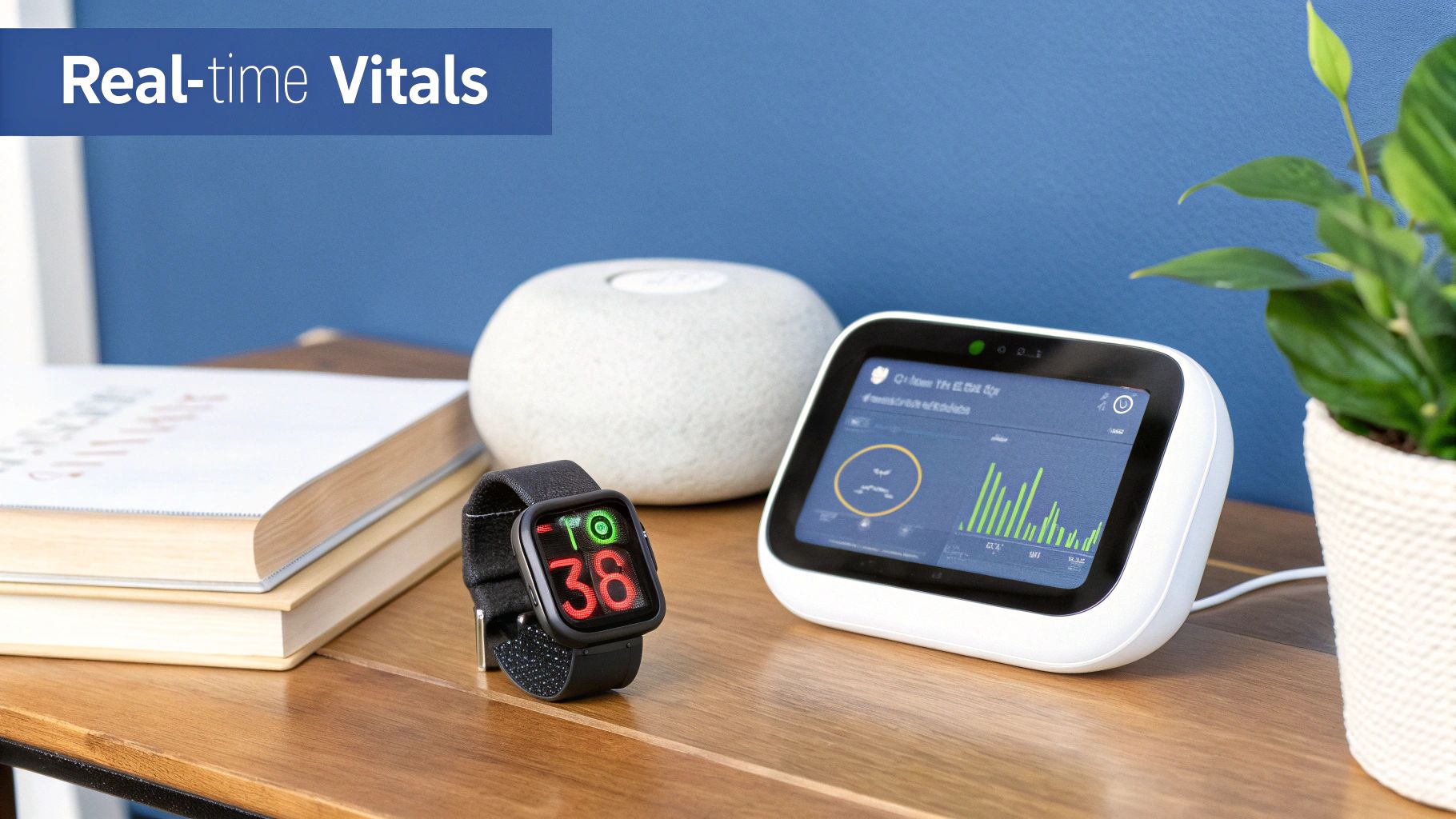
In modern healthcare, timely data can be life-saving. Edge computing revolutionizes remote patient monitoring by processing health metrics from wearables and home devices locally, right at the source. This proximity is vital for immediate analysis of critical data like ECG readings, blood glucose levels, and blood pressure, enabling real-time alerts without the delay of sending data to a centralized cloud.
Companies like Medtronic leverage this by building edge processing into connected insulin pumps, which can adjust insulin delivery in real-time based on immediate glucose readings. Similarly, the Apple Watch performs on-device analysis for features like fall detection and heart rhythm monitoring, ensuring instant alerts and enhanced privacy. This application is one of the most impactful edge computing use cases as it directly improves patient outcomes and empowers proactive care.
Strategic Implementation and Key Takeaways
The core advantage is immediate data processing and enhanced privacy. By keeping sensitive health information on a local device, edge computing helps providers meet strict HIPAA compliance standards while ensuring that critical health events trigger instant alerts. This local processing also guarantees that monitoring devices remain functional even with intermittent internet connectivity.
- Actionable Tip: Prioritize data security from the start. Ensure all edge devices and data transmissions use robust, end-to-end encryption to comply with HIPAA and protect sensitive patient information.
- Key Insight: Philips uses edge computing in its hospital patient monitoring systems to analyze vital signs at the bedside. This allows for immediate alerts and reduces the load on the central hospital network, ensuring high-priority data is handled instantly.
- Business ROI: The return on investment comes from reduced hospital readmissions, improved management of chronic diseases, and increased operational efficiency. Proactive alerts and continuous monitoring enable early interventions, which are less costly than emergency care.
This model is transforming healthcare from a reactive to a proactive system, where the synergy between local processing and AI is critical. As we see how healthcare AI is saving lives, the role of edge computing as its foundation becomes even more apparent.
6. Retail: Real-Time Inventory and Demand Prediction
In modern retail, a sold-out item is a missed opportunity. Edge computing tackles this by processing data directly within the store, using IoT sensors, RFID tags, and computer vision to monitor inventory levels in real-time. This local processing power enables instant analysis of stock, customer traffic, and purchasing patterns without relying on a distant cloud server.
Stores like Amazon Go exemplify this with their "Just Walk Out" technology, where edge devices process camera feeds to track items customers pick up. Similarly, Walmart deploys shelf-scanning robots that use on-board edge processing to identify out-of-stock products, misplaced items, and incorrect prices. These powerful edge computing use cases transform physical stores into highly responsive, data-driven environments that optimize the customer experience and boost sales.
Strategic Implementation and Key Takeaways
The core benefit is immediate operational intelligence, allowing retailers to fix inventory issues before they impact customers. By analyzing data on-site, stores can automate restocking alerts, adjust dynamic pricing based on foot traffic, and even predict demand surges for specific products throughout the day.
- Actionable Tip: Begin by deploying edge solutions for your most critical, high-turnover products. This allows you to prove the concept and demonstrate ROI quickly before scaling to the entire store.
- Key Insight: Zara (Inditex) leverages edge analytics in its stores to track which items are being tried on versus which are being purchased. This data provides near-instant feedback to its design and supply chain teams, enabling its famous fast-fashion model.
- Business ROI: The return on investment is clear. Real-time inventory management directly reduces lost sales from stockouts, minimizes overstocking waste, and improves staff efficiency by automating manual checks.
This approach is crucial for retailers aiming to blend the efficiency of e-commerce with the tangible experience of brick-and-mortar shopping. It empowers store managers to make smarter, faster decisions based on what’s happening on their sales floor right now.
7. Agricultural IoT: Crop Monitoring and Precision Farming
In agriculture, reliable internet connectivity can be a major challenge in remote fields. Edge computing resolves this by processing data from IoT sensors, drones, and machinery directly on-site. This enables real-time analysis of soil moisture, nutrient levels, and crop health without depending on a distant cloud server, allowing for immediate, data-driven decisions that boost efficiency.
Leading agricultural technology companies like John Deere and Trimble Agriculture integrate edge processing into their equipment. For instance, a smart tractor can analyze sensor data to apply fertilizer or pesticides with precision, adapting its application rates in real time as it moves across a field. This local processing is one of the most practical edge computing use cases, as it directly translates data into resource optimization and higher crop yields.
Strategic Implementation and Key Takeaways
The primary benefit is operational autonomy in areas with poor or non-existent connectivity. By processing data locally, farmers can implement precision farming techniques anywhere, ensuring timely interventions like irrigation or pest control. This decentralized approach makes advanced agricultural technology accessible and effective regardless of location.
- Actionable Tip: Start by deploying a network of soil and weather sensors in a grid pattern across a single test field to gather baseline data and validate the ROI before a full-scale rollout.
- Key Insight: Taranis uses AI-powered edge analysis on drone imagery to identify specific pest or disease outbreaks at a per-plant level, allowing for targeted treatments that reduce chemical use by up to 40%.
- Business ROI: The return on investment is clear. Precision farming reduces waste of critical resources like water, fertilizer, and pesticides, which lowers operational costs. Simultaneously, it increases crop yield and quality, directly enhancing farm profitability.
This model is vital for modernizing farming operations, ensuring sustainability and improving the food supply chain through smarter, more efficient resource management.
8. Smart Cities: Traffic Management and Public Safety
In burgeoning urban centers, edge computing is the backbone of intelligent transportation and safety systems. By processing data from traffic cameras, road sensors, and IoT devices locally, municipalities can manage traffic flow and enhance public safety in real time. This proximity eliminates the latency of sending vast video streams to a central cloud, enabling immediate responses to accidents, congestion, and public safety incidents.
Cities like Copenhagen and Singapore leverage this technology to create adaptive traffic signal systems that adjust timing based on current vehicle and pedestrian flow, not just pre-programmed schedules. This immediate analysis reduces congestion and lowers emissions. This application is one of the most impactful edge computing use cases as it directly improves the daily quality of life for millions of citizens by creating safer, more efficient urban environments.
Strategic Implementation and Key Takeaways
The core advantage is real-time responsiveness, which is critical for preventing traffic gridlock and enabling swift emergency services. Processing data locally allows traffic management centers to detect accidents or unusual congestion patterns instantly, dispatching responders faster and rerouting traffic to mitigate delays.
- Actionable Tip: Begin with a pilot program on a few key intersections or a single high-traffic corridor to demonstrate value and refine the system before a city-wide rollout.
- Key Insight: Barcelona’s smart city initiative uses edge nodes at intersections not only to manage traffic but also to monitor air quality and noise levels, creating a richer dataset for urban planning and public health decisions.
- Business ROI: For a municipality, the ROI comes from increased efficiency and safety. Reduced congestion leads to fuel savings for citizens and businesses, lower infrastructure strain, and fewer accidents. Faster emergency response times can save lives, providing immense social and economic value.
This approach is essential for cities aiming to become more sustainable and responsive. It transforms reactive traffic management into a proactive system that anticipates and solves problems before they escalate.
9. Content Delivery and Video Streaming Optimization
In the age of on-demand video, buffering is the ultimate user experience killer. Edge computing is the backbone of modern Content Delivery Networks (CDNs), which solve this problem by caching content on servers geographically close to viewers. This proximity minimizes latency, ensuring smooth, high-quality video playback and a seamless streaming experience for billions of users worldwide.
Streaming giants like Netflix and YouTube leverage this by placing edge nodes in internet exchange points all over the globe. When you stream a show, the video is delivered from the nearest server, not a distant, centralized data center. This drastically reduces the time it takes for data to travel, which is why this is one of the most widespread edge computing use cases. It enables high-resolution streaming while efficiently managing massive bandwidth demands.
Strategic Implementation and Key Takeaways
The core advantage is enhanced Quality of Experience (QoE), which directly impacts user retention and satisfaction. By minimizing buffering and delivering higher-quality video, platforms can reduce churn and increase engagement. Local caching also significantly cuts down on expensive backhaul bandwidth costs, as popular content is served from the edge instead of repeatedly being fetched from the origin server.
- Actionable Tip: Implement adaptive bitrate streaming at the edge. This allows the edge server to analyze a user's real-time network conditions and dynamically adjust the video quality, ensuring continuous playback even on fluctuating connections.
- Key Insight: Akamai, a pioneer in CDN services, uses a highly distributed network of over 400,000 edge servers. Its intelligent platform pre-positions content based on predicted viewing patterns, ensuring popular videos are already cached close to users before they even hit play.
- Business ROI: The ROI is multi-faceted. It includes lower bandwidth and data transit costs, improved customer retention due to a better viewing experience, and the ability to support a larger, more geographically diverse audience without performance degradation.
This strategy is indispensable for any business involved in video streaming, from major entertainment platforms to corporate e-learning and live event broadcasting.
10. Cybersecurity: Threat Detection and Real-Time Response
In the escalating battle against cyber threats, speed of detection and response is paramount. Edge computing shifts security from a centralized, reactive model to a distributed, proactive defense by analyzing data at the network perimeter. This approach enables immediate identification of threats like malware, DDoS attacks, and unauthorized access attempts directly where they occur, preventing them from penetrating deeper into the network.
Companies like Zscaler and Palo Alto Networks deploy edge security gateways that process network traffic locally. These devices use sophisticated algorithms and AI to spot anomalies in real-time without the latency of sending data to a central cloud for analysis. This is one of the most critical edge computing use cases as it creates a powerful first line of defense, reducing the burden on core security infrastructure and isolating threats before they can cause widespread damage.
Strategic Implementation and Key Takeaways
The core advantage is real-time threat mitigation, which drastically shortens the window of opportunity for attackers. By processing security data at the source, organizations can enforce policies and block malicious activity instantaneously. As cyber threats evolve, understanding the landscape becomes crucial; you can learn more about the future of cybersecurity and prepare for emerging challenges.
- Actionable Tip: Implement a layered security strategy. Use edge devices for immediate threat filtering and endpoint protection, while leveraging the cloud for in-depth analysis, threat intelligence aggregation, and long-term data correlation.
- Key Insight: Fortinet’s FortiGate appliances integrate AI-powered threat protection at the edge, allowing them to analyze encrypted traffic and identify novel threats on-site without compromising network performance, a task that would be too slow if routed through the cloud.
- Business ROI: The ROI is measured in risk reduction and operational efficiency. Faster threat detection minimizes potential damages from breaches, protecting data and reputation. It also reduces the volume of traffic sent to central security operations centers (SOCs), lowering bandwidth costs and analytical overhead.
This strategy is essential for any organization with a distributed network, especially in sectors like finance, healthcare, and retail where endpoint and perimeter security are non-negotiable.
11. AR/VR Applications: Immersive Real-Time Experience
For augmented and virtual reality (AR/VR) to be truly immersive, the delay between a user's movement and the corresponding update in their display (motion-to-photon latency) must be imperceptible. Edge computing makes this possible by processing vast amounts of visual and spatial data directly on or near the device, rather than sending it to a distant cloud server. This proximity eliminates the network lag that causes motion sickness and breaks the sense of presence.
Headsets like the Apple Vision Pro and Meta Quest 3 perform complex tasks such as spatial mapping, hand tracking, and 3D rendering locally. By handling this heavy computational work at the edge, these devices can deliver fluid, high-fidelity experiences that respond instantly to user actions. This local processing power is one of the most critical edge computing use cases for the future of spatial computing, enabling responsive AR overlays and believable virtual worlds without a constant, high-speed connection to the cloud.
Strategic Implementation and Key Takeaways
The core advantage is the drastic reduction in latency, which is fundamental for user comfort and a seamless immersive experience. Local processing ensures that virtual objects remain anchored in the real world in AR and that VR environments feel stable and responsive. For a deeper understanding of the technology behind these devices, exploring the architecture of modern XR platforms is a great next step.
- Actionable Tip: Optimize 3D assets and use predictive rendering algorithms. Reducing the processing load on edge devices and anticipating user head movements can further minimize latency and improve performance.
- Key Insight: Microsoft's HoloLens 2 utilizes an onboard custom Holographic Processing Unit (HPU) that acts as an AI coprocessor. This edge hardware offloads sensor data processing, enabling real-time spatial mapping and gesture recognition without taxing the main CPU.
- Business ROI: For enterprise applications like remote assistance or surgical training, reduced latency directly improves user effectiveness and safety. In consumer markets, a lag-free experience increases user adoption, engagement, and retention, driving hardware sales and app store revenue.
This on-device edge approach is essential for any AR/VR application where real-time interaction is paramount. It untethers users from powerful PCs, making sophisticated spatial computing accessible anywhere.
12. Personal AI Assistants and On-Device Machine Learning
Personal devices like smartphones and laptops are now powerful enough to run sophisticated AI models locally, thanks to edge computing. This on-device machine learning enables intelligent features to operate without constantly sending your data to cloud servers. It powers everything from instant voice recognition and predictive text to smart photo organization, providing faster responses and enhanced privacy.
For example, Apple's Siri processes many voice commands directly on an iPhone, ensuring speed and confidentiality. Similarly, Google's Pixel phones use the Tensor chip for on-device AI to improve photos in real-time. This is one of the most personal edge computing use cases, as it integrates AI directly into our daily tools, making them smarter and more responsive even when offline.
Strategic Implementation and Key Takeaways
The core advantage is privacy-centric, low-latency performance. By keeping sensitive data on the device, user privacy is significantly enhanced, while local processing eliminates network lag for a seamless user experience. For those new to the field, understanding the basics is key, and a good overview of machine learning for beginners can provide a solid foundation.
- Actionable Tip: When choosing a new device, prioritize models with a dedicated Neural Processing Unit (NPU) or AI accelerator. These chips are designed for efficient AI processing, which improves performance and extends battery life.
- Key Insight: Tesla's vehicles run their autonomous driving AI on powerful edge hardware inside the car. This is critical for making split-second decisions where relying on a cloud connection would be dangerously slow.
- Business ROI: For device manufacturers like Samsung and Apple, on-device AI creates a major competitive differentiator. Features like Galaxy AI drive hardware sales and build ecosystem loyalty by offering unique, responsive, and secure user experiences that cloud-only services cannot match.
This approach is becoming the standard for consumer electronics, as it directly improves the functionality, speed, and security of the devices we rely on every day.
Comparison of Top Edge Computing Use Cases
To provide a clearer overview, the following table compares the twelve use cases across key dimensions like implementation complexity, resource requirements, and primary benefits. This helps illustrate where edge computing offers the most significant advantages.
| Use Case | Core Problem Solved | Real-World Example | Key Benefit | Latency Sensitivity | Data Privacy |
|---|---|---|---|---|---|
| Algorithmic Trading | Millisecond market delays | Citadel Securities co-locating servers | Ultra-low latency for competitive advantage | Extremely High | High |
| Smart Home Automation | Cloud dependency, slow response | Apple HomeKit local processing | Offline functionality, faster device response | High | Very High |
| Autonomous Vehicles | Safety-critical decision delay | Waymo in-vehicle sensor processing | Instant reaction time for safety | Extremely High | High |
| Predictive Maintenance | Unplanned industrial downtime | Siemens MindSphere on factory floor | Proactive repairs, increased uptime | Very High | Medium |
| Remote Patient Monitoring | Delayed critical health alerts | Apple Watch on-device ECG analysis | Real-time alerts, HIPAA compliance | Very High | Extremely High |
| Real-Time Retail Inventory | Stockouts and missed sales | Amazon Go "Just Walk Out" tech | Instant inventory updates, better CX | High | Medium |
| Precision Agriculture | Poor connectivity in fields | John Deere smart tractors | Autonomous operation, resource savings | High | Low |
| Smart City Traffic Mgt. | Urban congestion, slow response | Barcelona's adaptive traffic signals | Reduced gridlock, faster emergency dispatch | Very High | Low |
| Content Delivery (CDN) | Video buffering and slow loads | Netflix edge servers for streaming | Smoother playback, better user experience | High | Low |
| Edge Cybersecurity | Slow threat detection | Zscaler edge security gateways | Immediate threat blocking at the perimeter | Very High | High |
| AR/VR Experiences | Motion sickness from lag | Meta Quest 3 on-device rendering | Immersive, lag-free spatial computing | Extremely High | High |
| On-Device AI | Slow AI responses, privacy risks | Google Pixel on-device photo editing | Faster, private, and offline AI features | High | Very High |
Making Sense of the Edge: Key Takeaways and Future Outlook
As we've explored across a diverse spectrum of twelve distinct applications, from the high-stakes world of algorithmic trading to the immersive experiences of augmented reality, a clear pattern emerges. The proliferation of edge computing use cases is not a fleeting trend; it's a fundamental architectural shift driven by the undeniable physics of data transmission and the growing demand for immediate, intelligent action. The centralized cloud model, while powerful for large-scale storage and deep analysis, simply cannot meet the sub-millisecond latency requirements essential for autonomous vehicles, real-time industrial robotics, or responsive AR overlays.
This journey through various industries reveals that the core value of edge computing is its ability to bring computation closer to the source of data generation. This proximity unlocks three critical benefits that reverberate through every application: speed, autonomy, and privacy. Whether it's a smart camera analyzing video feeds locally to detect a security threat or a remote patient monitor processing vital signs on-device to alert a caregiver, the principle remains the same. By avoiding the round-trip journey to a distant data center, we create systems that are not only faster but also more resilient and secure.
Strategic Imperatives for Adopting the Edge
For decision-makers, technologists, and entrepreneurs, the key takeaway is not to view edge computing as a replacement for the cloud, but as a crucial and complementary extension of it. The most successful implementations embrace a hybrid model.
Strategic Insight: The future of infrastructure is not "Cloud vs. Edge" but "Cloud and Edge." The strategic challenge lies in intelligently distributing workloads, placing latency-sensitive processing at the edge while leveraging the cloud for model training, long-term data archival, and global fleet management.
To translate this insight into action, consider the following steps:
- Identify the Latency Bottleneck: Begin by analyzing your current operations or product concepts. Where does a delay of even a few hundred milliseconds create friction, risk, or a poor user experience? This is your prime candidate for an edge solution.
- Quantify the Value of Autonomy: What is the cost of a network outage to your operations? For an industrial plant or a smart city traffic system, the ability to function independently of a stable internet connection isn't just a feature; it's a core requirement for safety and reliability.
- Assess Data Sensitivity and Sovereignty: Scrutinize the data you collect. Does it include personally identifiable information (PII), sensitive health data, or proprietary intellectual property? Processing this data locally on the edge can significantly reduce your privacy compliance burden and your security attack surface.
- Start with a Defined, High-Impact Project: Instead of attempting a massive overhaul, pilot an edge project with a clear, measurable goal. A great starting point is predictive maintenance for a single critical machine or optimizing a single retail store's inventory with real-time analytics.
The Inevitable Trajectory: An Edge-Native Future
The evolution of edge computing is mirroring the early days of the cloud. It is moving from a niche technology for specialized problems to a foundational component of modern digital infrastructure. As specialized hardware like TPUs and GPUs becomes smaller, more power-efficient, and more affordable, we will see increasingly sophisticated AI and machine learning capabilities pushed directly onto edge devices.
Mastering these concepts is no longer just an academic exercise. It's a competitive necessity. The companies and individuals who understand how to architect and deploy effective edge solutions will be the ones who build the next generation of responsive, intelligent, and trustworthy products and services. The edge is where the digital world meets the physical world, and the opportunities to create value at this intersection are just beginning to be realized.
Frequently Asked Questions About Edge Computing Use Cases
1. What is the main difference between edge computing and cloud computing?
The primary difference is the location of data processing. Cloud computing processes data in large, centralized data centers, often far from the source. Edge computing processes data locally, on or near the device where the data is generated. This proximity is key to reducing latency and enabling real-time applications.
2. Why is low latency so important for edge computing use cases?
Low latency, or minimal delay, is critical for applications where split-second decisions matter. For an autonomous vehicle avoiding a collision, a surgeon using an AR overlay, or an industrial robot on an assembly line, any delay between data collection and action can lead to catastrophic failure. Edge computing provides the near-instantaneous response required for these scenarios.
3. Does edge computing replace the cloud?
No, it complements the cloud. A typical architecture uses a hybrid model: the edge handles immediate, time-sensitive processing, while the cloud is used for heavy-duty, less time-critical tasks like training complex AI models, long-term data storage, and aggregating data from many edge devices for big-picture analysis.
4. How does edge computing improve privacy and security?
By processing data locally, edge computing minimizes the amount of sensitive information sent over the internet to the cloud. This reduces the risk of data interception during transit and limits exposure to cloud data breaches. For applications involving personal health data or private home camera feeds, this is a major advantage.
5. What is an "edge device"?
An edge device can be any piece of hardware with local computing capabilities located at the "edge" of a network. This includes IoT sensors, smartphones, gateways in a factory, in-vehicle computers in cars, smart cameras, and even powerful local servers in a retail store or branch office.
6. Can edge computing work without an internet connection?
Yes, and this is one of its most significant benefits. Because processing happens locally, many edge systems can continue to operate fully or partially even if their connection to the cloud is lost. This is crucial for applications in remote locations (like agriculture) or for critical systems that cannot tolerate downtime (like industrial controls).
7. What are the biggest challenges in implementing edge computing?
The main challenges include managing and securing a large number of distributed devices, deploying software updates across a dispersed network, ensuring physical security of edge nodes, and managing power consumption, especially for battery-operated devices.
8. How does 5G relate to edge computing?
5G and edge computing are highly complementary. 5G networks provide high-bandwidth, low-latency wireless connectivity, which is perfect for linking edge devices to nearby compute nodes (Multi-access Edge Computing, or MEC). This combination enables powerful, real-time applications that require both fast local processing and reliable, high-speed communication.
9. Which industry is benefiting the most from edge computing?
It's difficult to name just one, as the benefits are widespread. However, manufacturing (with predictive maintenance), automotive (with autonomous vehicles), and telecommunications (with CDNs and 5G) have seen some of the most mature and high-impact deployments to date. Healthcare and retail are also rapidly adopting edge solutions.
10. How do I get started with implementing an edge computing solution?
Start small. Identify a single, high-impact problem in your business that is caused by latency, connectivity, or data transfer costs. Begin with a pilot project to test the technology and demonstrate a clear return on investment (ROI). This could be monitoring one critical machine or implementing real-time analytics in a single location before scaling up.
Ready to move from theory to implementation? Keeping up with the rapidly evolving landscape of edge hardware, software, and best practices is a significant challenge. Everyday Next provides in-depth analysis, expert-led courses, and strategic guides to help you master emerging technologies like edge computing and AI. Explore our resources at Everyday Next to accelerate your learning and lead your organization into the edge-native future.
Previous Post
Next Post