10 Active Learning Strategies to Boost Retention and Mastery in 2026
In today's fast-paced world of tech, finance, and personal growth, simply consuming information isn't enough. The key to true mastery lies not in how much you read or watch, but in how deeply you engage and apply what you learn. Passive learning methods, like listening to a lecture or highlighting a textbook, often result in fleeting knowledge that fades quickly. Active learning, in contrast, transforms you from a spectator into a participant. This hands-on approach dramatically boosts information retention and accelerates practical skill development.
This guide moves beyond theory to provide a comprehensive roundup of evidence-backed active learning strategies. We will explore ten powerful techniques designed to build lasting expertise. To truly move beyond passive engagement and master new skills, learn how to prepare for high-stakes assessments like active learning for physics exams with focused, dynamic study methods.
Our goal is to give you a clear roadmap for implementing these strategies immediately. Each item in our list includes actionable steps and real-world examples tailored for professionals in investing, tech innovators, parents teaching financial literacy, and lifelong learners focused on personal development. Whether you are analyzing complex market trends, adopting new AI tools, or simply seeking to learn more effectively, these methods will equip you to make your learning stick. Let's dive into the techniques that will help you achieve your goals with greater efficiency and deeper understanding.
1. Problem-Based Learning (PBL)
Problem-Based Learning (PBL) flips the traditional learning model on its head. Instead of first learning abstract concepts and then applying them, PBL starts with an authentic, complex problem. Learners, working in groups, must grapple with the challenge, identify what they need to know, research it, and apply their newfound knowledge to develop a viable solution. This approach transforms learners from passive recipients of information into active investigators and problem-solvers.
This method is one of the most effective active learning strategies because it mirrors how we solve challenges in the real world. Whether you're an entrepreneur developing a business plan or a tech professional prototyping an AI solution, you start with a problem, not a textbook chapter. The process of inquiry and discovery makes the learning more meaningful and durable.

How to Implement Problem-Based Learning
- Present a Real-World Problem: Start with an open-ended, ill-structured problem that has multiple potential solutions. For instance, an investment club could be tasked with analyzing a struggling company's stock to decide whether to "buy, sell, or hold."
- Form Collaborative Groups: Create small, diverse teams. Different perspectives and skills are crucial for tackling complex issues effectively.
- Facilitate, Don't Lecture: Your role is to guide the process, not provide answers. Ask probing questions, point to resources, and provide scaffolding to help learners stay on track without giving away the solution.
- Debrief and Reflect: Once groups present their solutions, facilitate a debriefing session. This critical step helps learners connect their experience to broader concepts, analyze their problem-solving process, and solidify what they’ve learned.
Real-Life Example: A marketing team is tasked with reversing a decline in user engagement. Instead of being told what to do, they are given raw data and the problem statement. They must analyze user behavior, research competitor strategies, brainstorm solutions (like a new feature or campaign), and present a data-backed proposal to management. The learning happens through the act of solving the business problem itself.
PBL is particularly powerful when you need to develop practical skills and deep conceptual understanding. It's ideal for complex fields like finance, technology, and entrepreneurship where rote memorization falls short. By connecting learning directly to personal goals and real-world challenges, PBL ensures knowledge isn't just acquired; it's owned.
2. Spaced Repetition
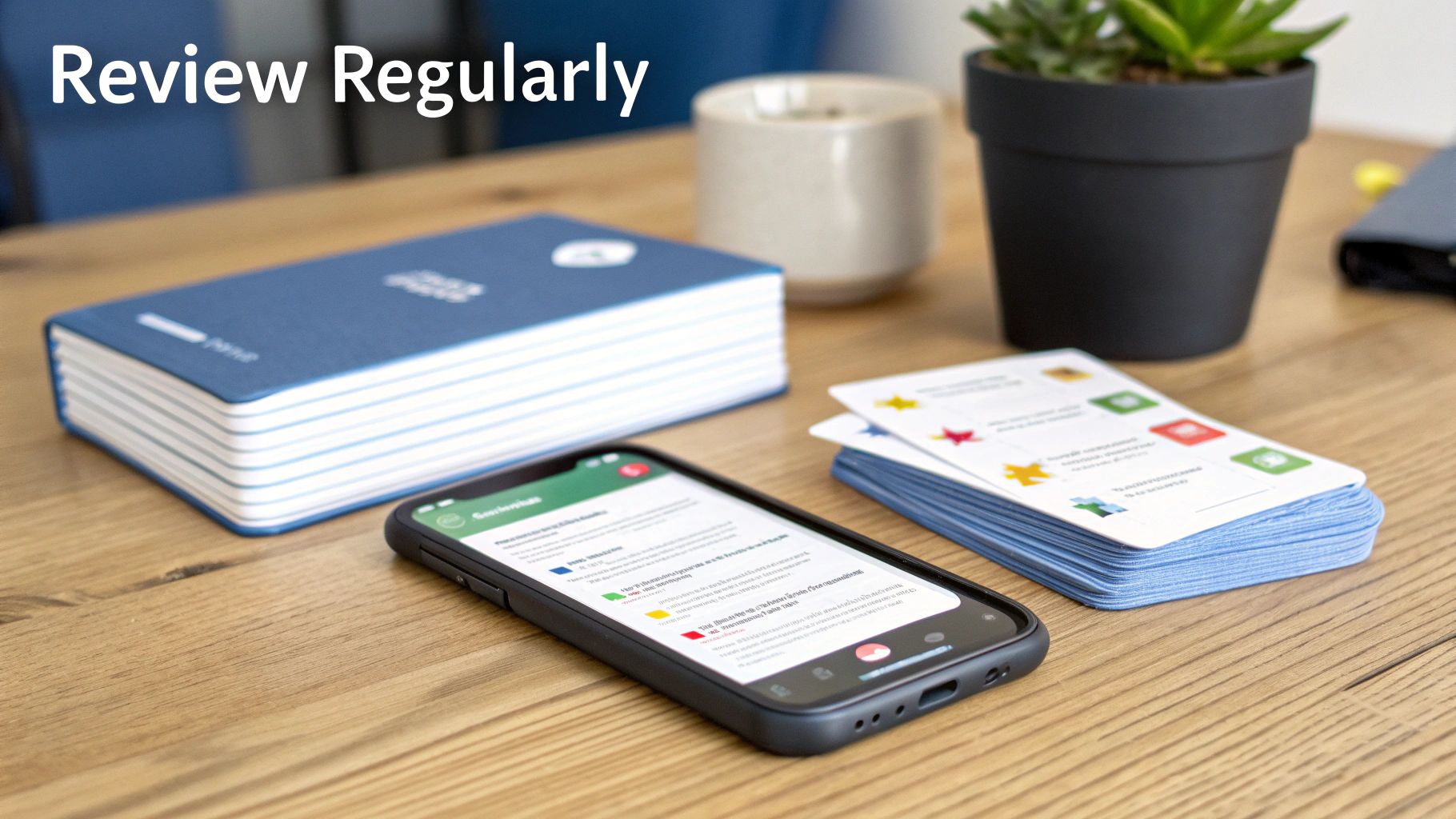
Spaced Repetition is a powerful learning technique based on the psychological principle of the "forgetting curve." Instead of cramming information in one session, this method involves reviewing it at increasing intervals over time. Each review pushes the knowledge deeper into your long-term memory, strategically interrupting the natural process of forgetting just before it happens. This approach transforms memorization from a brute-force effort into a smart, efficient process.
This method is one of the most effective active learning strategies for knowledge retention because it works with your brain's natural rhythm. For tech professionals memorizing complex AI terminology or investors learning market principles, spaced repetition ensures foundational concepts are not just learned but retained for the long haul. It makes the act of remembering an active, ongoing process rather than a one-time event.
How to Implement Spaced Repetition
- Create Atomic Learning Units: Break down complex information into small, digestible question-and-answer pairs, like digital flashcards. For example, a tech professional might create a card with "What is a neural network?" on one side and a concise definition on the other.
- Use a Spaced Repetition System (SRS): Leverage apps like Anki or Quizlet that automate the review schedule. These tools use algorithms to present cards just as you are about to forget them, optimizing your study time.
- Review Consistently: Commit to short, daily review sessions. The power of spaced repetition comes from consistency, not long, intensive study blocks. Even 15 minutes a day can produce significant results.
- Be Honest with Your Self-Assessment: When a card appears, honestly rate how well you recalled the information. Your input teaches the algorithm when to show you that specific card again, personalizing the learning curve for you.
Real-Life Example: Someone learning a new language uses the app Anki. They add new vocabulary words as digital flashcards. The app's algorithm shows them a new word frequently at first. As they correctly recall the word, the app waits longer and longer before showing it again—from one day to three days, then a week, a month, and so on, solidifying it in long-term memory with minimal effort.
Spaced Repetition is exceptionally useful for subjects that rely on a large body of foundational knowledge, such as finance, technology, or personal development frameworks. It builds a solid, reliable base of information in your long-term memory, freeing up your cognitive resources to focus on more complex problem-solving and critical thinking.
3. Peer Teaching and Reciprocal Learning
Peer Teaching and Reciprocal Learning turn the tables by empowering learners to become instructors. In this model, participants teach concepts to one another, alternating between the roles of teacher and student. This bidirectional knowledge transfer forces individuals to process, organize, and articulate information clearly, which significantly deepens their own understanding. The act of teaching is one of the most powerful ways to learn.
This approach is one of the most versatile active learning strategies because it fosters a collaborative and supportive environment. When a tech developer mentors a newcomer on a coding concept or a seasoned investor explains an asset class to their investment club, they not only share knowledge but also reinforce their own expertise. This process builds communication skills, boosts confidence, and creates a strong sense of community.
How to Implement Peer Teaching and Reciprocal Learning
- Establish Clear Expectations: Define the roles of "teacher" and "learner" for each session. Ensure everyone understands they will play both parts. For example, in a career development group, one member might lead a session on resume writing, while another leads the next on negotiation tactics.
- Provide a Framework: Give participants a simple template or structure to guide their teaching. This could include key talking points, a time limit, and a requirement for a Q&A session. This prevents sessions from becoming unfocused.
- Encourage Structured Feedback: After a teaching segment, facilitate a brief, constructive feedback loop. Ask learners what was most helpful and what questions remain. This helps the "teacher" refine their communication and ensures comprehension.
- Moderate for Accuracy and Inclusivity: As the facilitator, your role is to ensure the information being shared is accurate and that the environment remains respectful and inclusive. Gently correct any significant misconceptions and ensure all voices are heard.
Real-Life Example: In a university study group, each member is assigned a different chapter to master for an upcoming exam. During their meetings, each student "teaches" their assigned chapter to the rest of the group. This responsibility forces them to understand the material deeply enough to answer questions, solidifying their own knowledge while efficiently covering all topics for the group.
Peer Teaching is exceptionally effective for solidifying foundational knowledge and building soft skills like communication and leadership. It works well in diverse groups where members have different levels of expertise, such as tech communities, professional mentorship programs, or even parent forums, allowing everyone to contribute and learn from one another’s unique experiences.
4. Microlearning
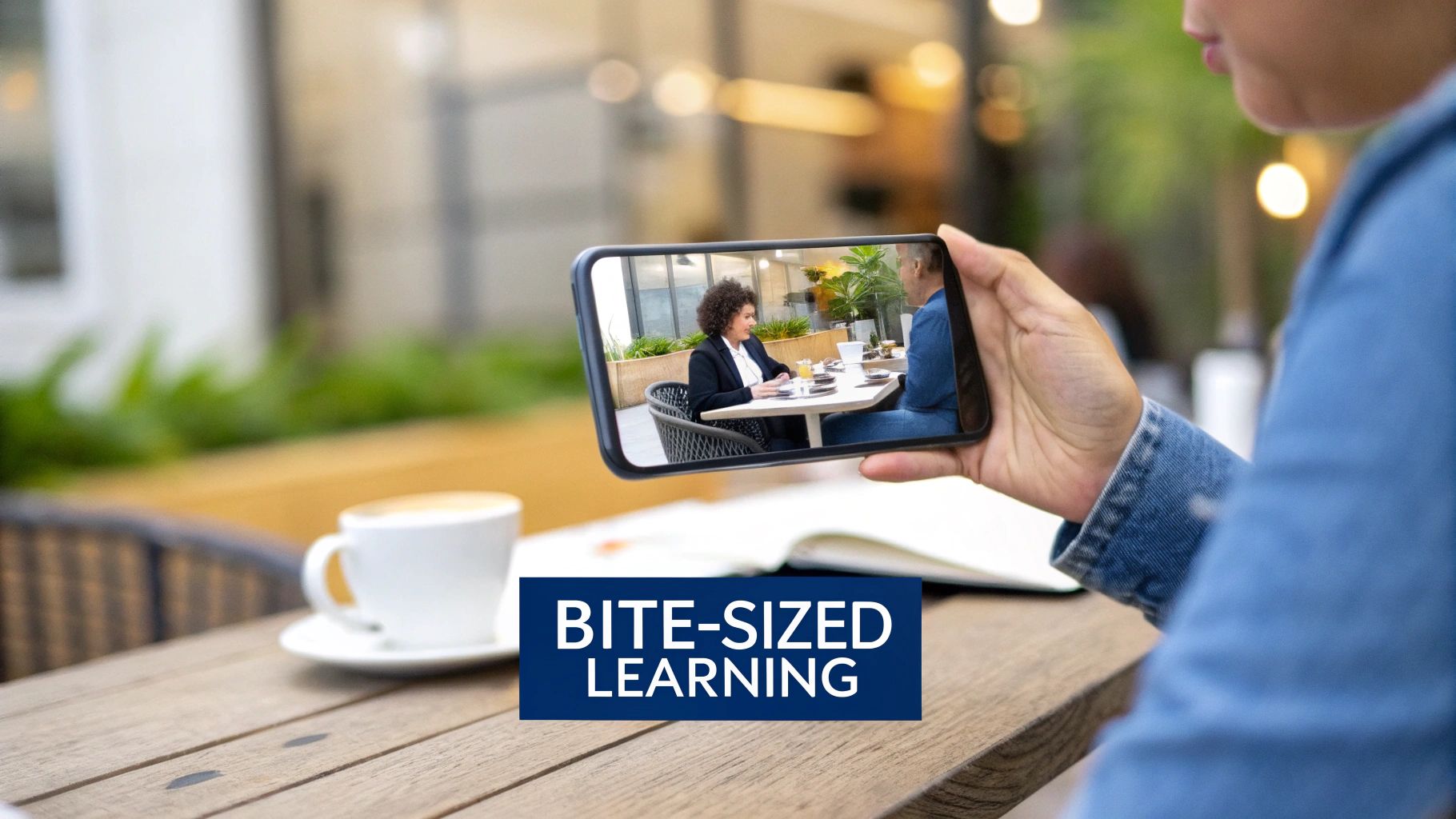
Microlearning delivers educational content in small, focused, self-contained modules designed for quick consumption and retention. This strategy breaks down complex topics into bite-sized pieces, typically lasting 5-15 minutes, making it perfect for modern learners who consume information on-demand across various devices. Instead of committing to long sessions, learners can engage with content when and where it suits them, from a morning commute to a short work break.
This approach is one of the most practical active learning strategies because it aligns with how our brains naturally process and retain information. By focusing on a single, core objective per module, it reduces cognitive load and enhances recall. For busy professionals, investors, or parents, this means learning a new tech skill or a financial concept can fit seamlessly into a packed schedule without feeling overwhelming.
How to Implement Microlearning
- Define a Single, Clear Objective: Each micro-lesson should teach one specific thing. For example, instead of a long video on "stock market basics," create separate modules for "What is a P/E Ratio?" or "How to Read a Candlestick Chart."
- Use Engaging, Mixed Media: Combine short videos, infographics, quick quizzes, and concise text to keep the content dynamic. For instance, a mobile app teaching personal development could use a two-minute video to explain a concept, followed by an interactive quiz.
- Optimize for Mobile-First: Design content to be easily viewed and navigated on a smartphone. This means using large fonts, vertical video formats, and simple, touch-friendly interfaces.
- Create Learning Pathways: While each module is self-contained, link them together in a logical sequence. A series of YouTube Shorts explaining AI concepts can be organized into a playlist that guides the learner from foundational ideas to more advanced applications.
Real-Life Example: A company rolls out new expense reporting software. Instead of a one-hour training session, the HR department creates a series of 3-minute videos: "How to Log In," "How to Submit an Expense," and "How to Track Your Reimbursement." Employees can watch the specific video they need, right when they need it, on their phone or computer, ensuring just-in-time, relevant learning.
This strategy is exceptionally effective for just-in-time learning, skill reinforcement, and introducing complex topics in a manageable way. Whether it's a corporate training platform offering quick tutorials on new software or a financial blog breaking down market events in a Twitter/X thread, microlearning makes continuous development achievable for everyone.
5. Case Study Analysis
Case Study Analysis plunges learners into real-world scenarios, requiring them to dissect complex situations and understand the decisions that led to specific outcomes. Unlike purely theoretical learning, this method uses detailed narratives of actual events, such as a company's market disruption or a family's financial planning journey, to anchor principles in reality. Learners analyze the context, identify key players, evaluate choices, and formulate their own conclusions.
This method is one of the most powerful active learning strategies because it develops analytical and decision-making skills in a controlled environment. By examining the successes and failures of others, from Tesla's innovation strategy to the 2008 financial crisis, learners can identify patterns and derive principles without facing real-world risk. It transforms abstract concepts into tangible lessons on what to do and what to avoid.
How to Implement Case Study Analysis
- Select a Relevant Case: Choose a detailed case study that aligns with the learning objectives and resonates with the audience. For entrepreneurs, a case on a startup's failure can be as insightful as a success story.
- Provide Structured Questions: Guide the analysis by providing a set of questions. For example: "What were the key decisions made?", "What were the unforeseen consequences?", and "What would you have done differently and why?".
- Encourage Group Discussion: Have learners work in small groups to discuss their findings. Diverse perspectives can uncover nuances and challenge initial assumptions, leading to a richer understanding of the case.
- Connect Insights to Personal Goals: Facilitate a final discussion that bridges the gap between the case and the learners' own lives. Ask how the lessons from a portfolio management case study could inform their personal investment strategies.
Real-Life Example: A business school class analyzes the rise and fall of Blockbuster. Students are given financial reports, timelines of key decisions (like passing on buying Netflix), and articles on market shifts. In groups, they debate the critical mistakes made by Blockbuster's leadership and identify the external threats they ignored. This helps them learn strategic lessons about innovation and market adaptation in a concrete, memorable context.
Pioneered by institutions like Harvard Business School, this method is exceptionally effective for fields where context is critical, such as finance, technology, and career strategy. It forces learners to move beyond simple answers and engage with the messy, multifaceted nature of real-world problems.
6. Deliberate Practice with Feedback
Deliberate Practice is a highly structured method of training that goes far beyond simple repetition. Popularized by psychologist K. Anders Ericsson, it involves pushing yourself just beyond your current abilities through focused, goal-oriented practice combined with immediate, actionable feedback. This process transforms learners from simply going through the motions to actively deconstructing and improving specific skill components.
This is one of the most powerful active learning strategies because it directly targets the mechanics of mastery. Whether you're a trader analyzing market patterns or a parent learning a new communication technique, improvement doesn't come from just doing the same thing over and over. It comes from identifying weaknesses, practicing with intense focus, and making targeted adjustments based on feedback.
How to Implement Deliberate Practice
- Define a Specific, Measurable Goal: Isolate a narrow aspect of the skill you want to improve. Instead of a vague goal like "get better at investing," aim for something specific, like "improve my accuracy in identifying head-and-shoulders patterns by 15%."
- Practice at the Edge of Your Ability: Your practice sessions should be challenging but not overwhelming. For a tech professional, this could mean tackling a coding challenge that requires learning a new algorithm, pushing them just outside their comfort zone.
- Seek Immediate, High-Quality Feedback: This is the most critical element. Feedback can come from a mentor, peer code reviews, objective metrics like trading backtesting results, or a performance log where you analyze outcomes against your process.
- Reflect and Refine: Use the feedback to identify errors in your technique and adjust your approach. This iterative loop of practice, feedback, and refinement is what builds expertise over time.
Real-Life Example: A chess player wants to improve their endgame. Instead of just playing full games, they use software to practice specific endgame scenarios (e.g., King and Pawn vs. King) repeatedly. After each attempt, the software provides immediate feedback on their moves. They focus intently on this single skill for 30 minutes daily, analyze their mistakes, and gradually move to more complex scenarios, leading to measurable improvement.
Deliberate Practice is indispensable for developing high-level proficiency in any complex skill. It’s ideal for fields requiring technical precision like finance, technology, and entrepreneurship, where mastery is built on a foundation of well-honed micro-skills. By focusing on purposeful improvement, this method accelerates learning far beyond what unfocused repetition ever could.
7. Discussion-Based Learning Circles
Discussion-Based Learning Circles transform passive listening into active, collaborative sense-making. Instead of a one-way flow of information from an expert, these circles create a structured environment where participants explore complex ideas, challenge assumptions, and co-construct knowledge through dialogue. The emphasis is on asking powerful questions and listening to diverse perspectives, not on arriving at a single correct answer.
This approach is one of the most powerful active learning strategies because it fosters critical thinking and communication skills simultaneously. It's a natural fit for exploring nuanced topics without clear-cut solutions, such as market trends, the ethical implications of AI, or parenting dilemmas. Participants learn as much from each other's viewpoints and experiences as they do from any single resource, making the learning deeply personal and relevant.
How to Implement Discussion-Based Learning Circles
- Establish Clear Norms: Begin by co-creating ground rules for respectful dialogue. This includes norms like "listen to understand, not just to reply," "challenge ideas, not people," and "ensure all voices are heard." This creates the psychological safety needed for authentic conversation.
- Use a Provocative Starting Point: Launch the discussion with a thought-provoking question, a controversial article, a case study, or a short video. For instance, a parent group could start by discussing an article on teenage financial literacy.
- Assign Rotating Roles: Distribute responsibility by assigning roles like a facilitator (to guide the conversation), a timekeeper, and a note-taker (to capture key insights or action items). Rotating these roles gives everyone a chance to practice different leadership and participation skills.
- Debrief and Summarize: Conclude by having the group reflect on the conversation itself. What were the key takeaways? What new questions emerged? This step solidifies learning and helps participants connect the discussion to their own goals and actions.
Real-Life Example: An office book club reads a book on leadership. Instead of just summarizing chapters, the facilitator poses open-ended questions like, "Which strategy from the book would be most difficult to implement in our company culture, and why?" Members share personal experiences, debate the author's ideas, and collectively brainstorm ways to apply the concepts to their own work, generating far deeper insights than solo reading.
Discussion-Based Learning Circles are exceptionally effective for topics that benefit from diverse viewpoints and shared experiences. They are perfect for mastermind groups, community forums, and book clubs, where the collective wisdom of the group unlocks insights that individuals might miss on their own. By prioritizing dialogue, these circles build both knowledge and community.
8. Learning by Teaching (Protégé Effect)
Learning by Teaching, often called the Protégé Effect, leverages a simple but powerful truth: the best way to understand a concept is to explain it to someone else. This strategy shifts the learner into the role of an educator, forcing them to structure their knowledge, anticipate questions, and simplify complex ideas. The cognitive effort required to organize and articulate information for others significantly deepens one's own comprehension and retention.
This method is one of the most potent active learning strategies because it creates a sense of purpose and responsibility. When you prepare to teach, you aren't just memorizing facts for yourself; you're building a mental framework strong enough to support another person's understanding. This process naturally reveals your own knowledge gaps and forces you to master the material at a much deeper level than passive consumption ever could.
How to Implement Learning by Teaching
- Identify a Topic and Audience: Choose a subject you've recently learned. It could be a new investment strategy, a coding concept, or a parenting technique. Define who you want to teach, whether it's a mentee, a peer group, or a broader online audience.
- Prepare Teaching Materials: Create a tangible asset. This could be a short blog post for your LinkedIn profile, a slide deck for your investment club, or even a quick explainer video for YouTube. The act of creating the materials is where much of the learning happens.
- Teach and Encourage Questions: Share your knowledge with your chosen audience. Actively invite questions, as they will immediately highlight areas where your understanding is weak or your explanation is unclear.
- Gather Feedback and Refine: Ask for feedback on your teaching. Did your explanation make sense? What was confusing? Use this input to refine both your teaching materials and your own understanding of the topic.
Real-Life Example: A programmer learns a new JavaScript framework. To solidify their knowledge, they write a tutorial blog post titled "A Beginner's Guide to [Framework Name]." In the process of structuring the article, creating code examples, and simplifying complex terms, they uncover gaps in their own understanding and are forced to research them. By the time the post is published, they have achieved a much deeper level of mastery.
The Protégé Effect is exceptionally effective for solidifying complex skills and abstract concepts. It is perfect for professionals building a personal brand, investors sharing insights with their community, or tech enthusiasts explaining new tools. By stepping into the role of a teacher, you transform your learning from a private activity into a valuable contribution that cements your own expertise.
9. Experiential Learning and Simulation
Experiential Learning and Simulation move beyond theoretical knowledge by immersing learners in activities that mirror real-world situations. This method is built on the principle of learning by doing, where individuals engage in hands-on experiences, reflect on the outcomes, and apply those insights to future actions. It closes the gap between knowing something in theory and knowing how to apply it in practice.
This approach is one of the most powerful active learning strategies because it provides a safe space to practice, fail, and learn without real-world consequences. Whether you're a finance enthusiast learning to trade using an investment simulator or a tech professional honing your skills in a virtual reality environment, the direct experience makes learning concrete and memorable.
How to Implement Experiential Learning and Simulation
- Select a Relevant Simulation: Choose a tool or scenario that closely mimics the real-world conditions you want to teach. For instance, an entrepreneurship course could use a business simulation game where students manage a virtual company's finances, marketing, and operations.
- Set Clear Objectives and Metrics: Define what success looks like before the experience begins. This could be achieving a certain return in a stock market simulator or successfully navigating a difficult management scenario.
- Facilitate the Experience: Guide learners through the simulation, providing support as needed but allowing them to make their own decisions and mistakes. Let the experience itself be the primary teacher.
- Structure a Debriefing and Reflection: After the simulation, lead a structured discussion. Use probing questions to help learners connect their actions to the outcomes, analyze their decision-making process, and extract key principles they can apply elsewhere.
Real-Life Example: An aspiring airline pilot spends hours in a flight simulator before ever flying a real plane. The simulator replicates various weather conditions, system failures, and emergency scenarios. This allows the trainee to practice critical decision-making and motor skills in a high-stakes, realistic environment without any actual danger. The instructor provides feedback, and the trainee can repeat scenarios until they achieve mastery.
Experiential learning is invaluable for developing practical skills where judgment and application are critical. It is widely used in fields like finance (paper trading), technology (coding hackathons), and management, as it prepares learners for the complexity and pressure of real-world decision-making.
10. Interleaving and Contextual Variation
Interleaving and Contextual Variation is an approach that directly challenges the comfort of traditional, repetitive practice. Instead of practicing one skill or studying one topic in a single block (e.g., studying only stocks for an hour), interleaving involves mixing different but related topics or skills within the same session. When combined with contextual variation, practicing in different settings or scenarios, it forces the brain to work harder to retrieve information, building much more flexible and durable knowledge.
This method is one of the most powerful active learning strategies because it trains your brain to differentiate between concepts and select the right strategy for a given problem. This is how the real world operates; you rarely encounter challenges neatly sorted by category. An investor doesn't just analyze stocks one day and bonds the next; they must compare them simultaneously to make allocation decisions.
How to Implement Interleaving and Contextual Variation
- Mix, Don't Block: Structure your learning sessions to alternate between related but distinct topics. For example, a tech professional learning a new software stack could alternate between practicing front-end coding, back-end logic, and database queries in one session.
- Vary the Context: Practice skills in different environments and under various conditions. An aspiring investor could analyze a company's financials using data from a bull market, a bear market, and a stagnant period to see how context changes the analysis.
- Embrace the Struggle: Interleaving feels harder and less productive than blocked practice in the short term. This feeling of difficulty, known as "desirable difficulty," is a clear sign that deeper, more effective learning is happening.
- Test with Novel Problems: Assess understanding by presenting new problems that require identifying the correct strategy, not just repeating a known one. Beyond simply mixing up study materials, implementing true methods of enhancing retention involves strategies such as interleaved practice.
Real-Life Example: A student studying for a math final exam practices problems from different chapters (algebra, geometry, trigonometry) in a mixed-up order, rather than doing all the algebra problems first, then all the geometry problems. This forces them to first identify the type of problem before solving it, which is exactly what they'll have to do on the exam. This builds better problem-recognition skills than studying one chapter at a time.
Interleaving is especially valuable for domains like finance, programming, and even parenting, where you must apply the right principle to a unique situation. It moves you from simply knowing information to knowing when and how to use it effectively.
Active Learning Strategies: A Comparative Overview
To help you choose the right strategy for your specific needs, this table compares the ten approaches across key factors like complexity, resource needs, and ideal use cases.
| Strategy | Primary Goal | Best For | Implementation Effort | Key Benefit |
|---|---|---|---|---|
| Problem-Based Learning | Developing problem-solving skills | Complex, real-world challenges | High | Builds critical thinking & collaboration. |
| Spaced Repetition | Long-term memorization | Factual knowledge, vocabulary | Low | Highly efficient for information retention. |
| Peer Teaching | Deepening one's own understanding | Reinforcing learned concepts in a group | Medium | Solidifies knowledge through articulation. |
| Microlearning | Just-in-time skill acquisition | Busy learners needing specific info | Low | Fits into any schedule; high engagement. |
| Case Study Analysis | Improving analytical judgment | Business, finance, strategy decisions | Medium | Connects theory to real-world outcomes. |
| Deliberate Practice | Achieving expert-level performance | Skill-based mastery (e.g., coding, trading) | High | Accelerates skill development via feedback. |
| Learning Circles | Exploring nuanced topics | Complex subjects with no single answer | Medium | Fosters deep understanding through dialogue. |
| Learning by Teaching | Achieving mastery of a concept | Solidifying complex information | Medium | The ultimate test of one's own knowledge. |
| Experiential Learning | Building practical, applicable skills | Hands-on professions (e.g., pilots, surgeons) | High | Provides a safe space to practice and fail. |
| Interleaving | Developing flexible knowledge | Subjects requiring problem identification | Medium | Prepares the brain for real-world complexity. |
From Knowing to Doing: Putting Your Learning into Action
The journey through these ten powerful active learning strategies reveals a fundamental truth: genuine knowledge isn't passively acquired, it's actively built. We've moved beyond the traditional model of listening and memorizing to a dynamic world of doing, questioning, and creating. From the collaborative problem-solving of Problem-Based Learning (PBL) to the targeted skill refinement of Deliberate Practice, each strategy offers a unique pathway to transform abstract information into tangible competence.
The core principle connecting all these methods is engagement. Instead of simply being a spectator to information, you become a participant in your own education. Whether you're breaking down complex topics into manageable chunks with Microlearning, explaining a concept to a colleague through the Protégé Effect, or navigating realistic scenarios with Experiential Learning and Simulation, you are actively forging stronger neural connections. This active involvement is what makes learning stick, turning fleeting facts into lasting wisdom.
Your First Step: Choosing a Strategy
The sheer number of options can feel overwhelming, but the goal isn't to implement all ten at once. The key is to start small and build momentum. Your ideal starting point depends entirely on your current goals and learning style.
To help you decide, consider these starting points:
- If you're a professional aiming to master a new technical skill: Begin with Deliberate Practice with Feedback. Isolate a specific component of the skill, practice it with intense focus, and seek immediate, constructive feedback from a mentor or peer.
- If you're a student preparing for comprehensive exams: Integrate Spaced Repetition and Interleaving into your study routine immediately. Use flashcard apps for key concepts and mix different subjects during study sessions to build mental flexibility.
- If you're an entrepreneur or team leader trying to solve a complex business challenge: Organize a Discussion-Based Learning Circle or a Case Study Analysis session. Leveraging the collective intelligence of your team will uncover insights that no single person could find alone.
- If you are a parent or lifelong learner wanting to make new knowledge a part of your life: Try Peer Teaching or the Protégé Effect. The next time you learn something interesting, make it a point to explain it clearly to your partner, a friend, or even your child. This simple act solidifies your own understanding immensely.
The Lasting Impact of Active Learning
Mastering these active learning strategies is more than an academic exercise; it's a critical life skill for the 21st century. In a world of rapid change, the ability to learn, unlearn, and relearn effectively is the ultimate competitive advantage. For investors, it means making more informed decisions. For tech professionals, it means staying ahead of the innovation curve. For entrepreneurs, it means building a more agile and resilient organization.
By embracing this active approach, you are not just learning faster; you are learning deeper. You are cultivating curiosity, enhancing critical thinking, and building the confidence to tackle any challenge that comes your way. The shift from passively knowing to actively doing is the most profound investment you can make in your personal and professional growth. The blueprint is here. Now, the action is yours to take.
Ready to put these principles into practice with a community of driven learners? The tools and frameworks at Everyday Next are designed to help you apply active learning strategies to your career, investments, and personal development goals. Join us to access curated resources and connect with a network dedicated to turning knowledge into action. Find your next step at Everyday Next.
Frequently Asked Questions (FAQ)
1. What is the main difference between active and passive learning?
Active learning requires learners to engage with the material through activities like problem-solving, discussion, and teaching. Passive learning, such as listening to a lecture or reading a book without interaction, involves receiving information without direct application, leading to lower retention rates.
2. Can I combine multiple active learning strategies?
Absolutely. Combining strategies is often the most effective approach. For example, you could use Spaced Repetition to memorize key terms from a Case Study you analyzed in a Discussion-Based Learning Circle.
3. How do I know which active learning strategy is best for me?
The best strategy depends on your learning goal. For memorizing facts, use Spaced Repetition. For developing practical skills, Deliberate Practice or Experiential Learning is ideal. For understanding complex, nuanced topics, try Learning Circles or Case Study Analysis.
4. Are active learning strategies only for academic settings?
No, they are highly effective for professional development, personal growth, and corporate training. Problem-Based Learning is used to solve real business challenges, and Microlearning is a staple in modern workplace training.
5. How long does it take to see results with active learning?
While some methods like Microlearning offer immediate knowledge gains, the deeper benefits of strategies like Deliberate Practice and Spaced Repetition build over time. Consistency is more important than intensity; even 15-20 minutes of focused, active learning per day can yield significant long-term results.
6. Do these strategies work for online or remote learning?
Yes, all of these strategies can be adapted for online environments. Digital tools like breakout rooms (for PBL), online forums (for Learning Circles), simulators (for Experiential Learning), and flashcard apps (for Spaced Repetition) make active learning very effective remotely.
7. What if I don't have a group to learn with?
Many strategies can be adapted for solo learners. You can practice the Protégé Effect by writing a blog post or creating a video. Deliberate Practice is often a solitary activity, and you can use online platforms for simulations and problem-solving exercises.
8. Is "hands-on" learning the same as active learning?
"Hands-on" learning is a type of active learning, but active learning is a broader category. It includes cognitive activities like analyzing, debating, and synthesizing information, not just physical tasks. For instance, a lively debate in a learning circle is active learning but may not be considered "hands-on."
9. Why does interleaving feel more difficult than traditional studying?
Interleaving creates "desirable difficulty." It forces your brain to constantly retrieve different pieces of information and identify the correct context for each problem, rather than mindlessly repeating one procedure. This struggle is what builds stronger, more flexible long-term memory.
10. How can I get feedback for Deliberate Practice if I don't have a mentor?
You can find feedback from various sources: peer reviews from a community of practice, objective data (e.g., your investment returns in a simulator), self-reflection by recording and analyzing your own performance, or using online platforms and AI tools that provide automated feedback.
Related Posts


Previous Post
Next Post