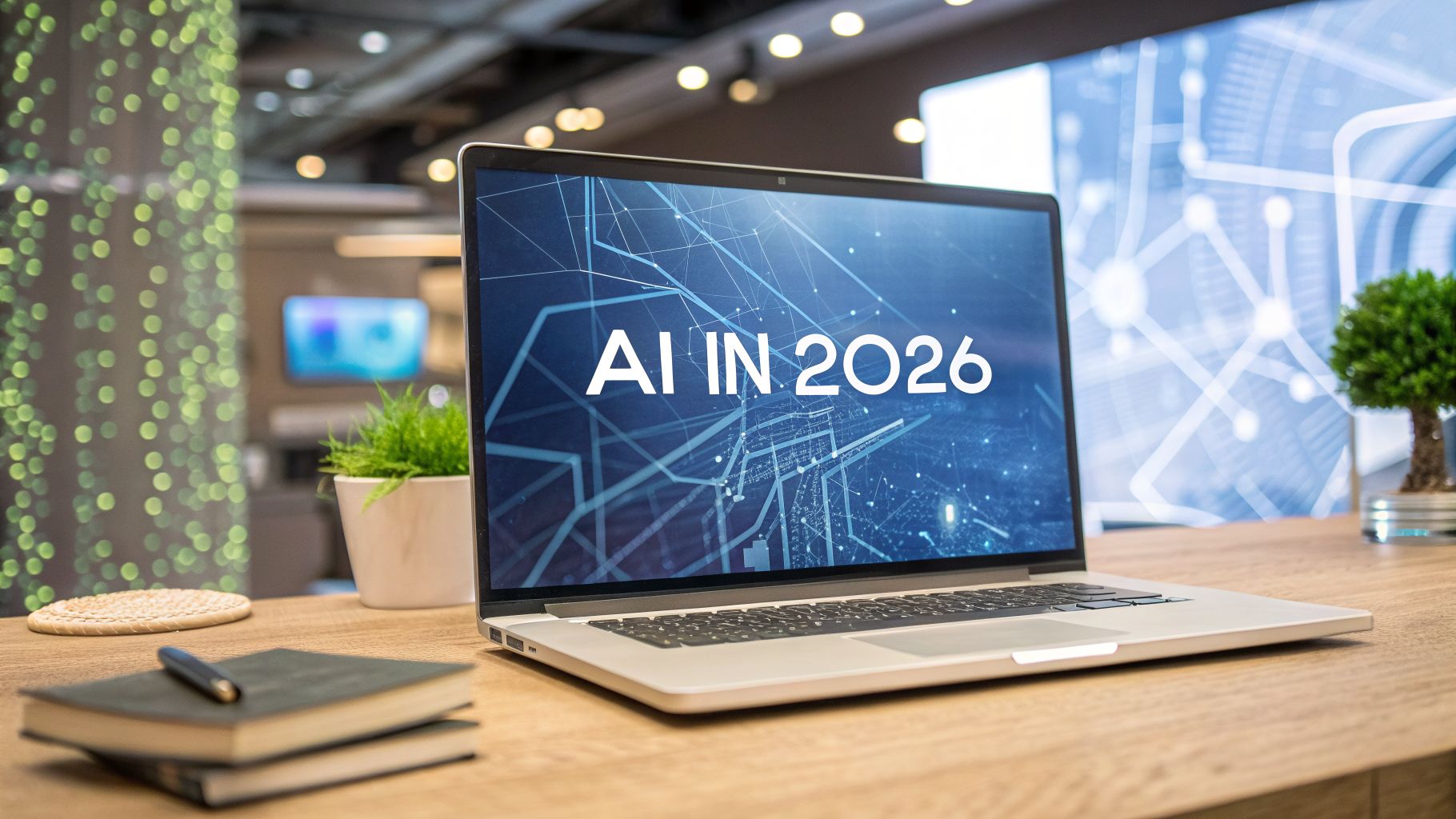
Your Definitive Guide to Understanding AI in 2026
Let's be honest, artificial intelligence—or AI—sounds like something straight out of a sci-fi movie. But in reality, it's not about sentient robots taking over. Based on my experience analyzing and working with these systems, it's about building smart software that can learn from experience, much like we do, by analyzing huge amounts of information.
This ability to learn and adapt on its own is what makes AI one of the most powerful technologies we've ever created.
What Is AI and Why Is Everyone Talking About It?
You’ve probably seen the term "AI" pop up everywhere lately. It's not just another tech buzzword; we're in the middle of a genuine technological shift. This sudden explosion of interest comes down to three things finally coming together: an ocean of available data, smarter learning algorithms, and a massive leap in computing power.
For decades, AI was a fascinating idea mostly stuck in research labs. Today, it’s a different story. With powerful processors in our pockets and cloud servers that can crunch trillions of data points, AI has moved from a theoretical concept to a practical tool. In fact, it's already the engine behind many of the apps you use every day, often without you even noticing.
The Shift From Following Orders To Learning Patterns
So, what makes AI different from the software we've used for years? It all comes down to how it "thinks." A normal computer program is rigid—it only follows the specific, step-by-step instructions a developer gives it. AI, on the other hand, learns from examples to figure things out for itself.
| Feature | Traditional Software | Artificial Intelligence (AI) |
|---|---|---|
| Logic | Follows a strict set of "if-this-then-that" rules programmed by a human. | Creates its own rules by identifying patterns and relationships in data. |
| Flexibility | Rigid. Can only perform tasks it was explicitly programmed to do. | Adaptive. Can handle new, unseen data and improve its performance over time. |
| Example | A simple calculator. It will always give "4" for "2+2" because that's its rule. | A spam filter. It learns the characteristics of junk mail from millions of examples to spot new spam messages it's never seen before. |
This learning skill is AI's superpower. It allows us to solve incredibly complex problems that are impossible to define with simple rules, from understanding messy human speech to spotting sophisticated financial fraud.
At its heart, AI is about creating systems that can perceive, reason, learn, and act on their own. We've moved from just programming computers to do a task to training them to master it.
Why Now? The Perfect Storm For The AI Boom
The idea of artificial intelligence isn't new—it's been around since the 1950s. So why is it taking over the world in 2026? Simple: the technology has finally caught up with the ambition.
The AI industry is growing at an incredible pace, creating new opportunities for investors, professionals, and businesses every day. Here’s a quick look at the numbers and what they mean for you.
| Metric | Figure (2026) | Projected Growth | Why It Matters To You |
|---|---|---|---|
| Global AI Market Size | $900 Billion | +35% CAGR | Investing: This rapid expansion signals a massive opportunity in AI-focused companies and funds. |
| AI in Business Operations | 91% Adoption Rate | Up from 50% in 2021 | Career Growth: AI skills are no longer optional. Understanding AI can boost your career, regardless of your industry. |
| Generative AI Investment | $200 Billion | 42% of all AI spend | Innovation: Businesses are betting big on AI to create new products and services, creating a new wave of startups and tools. |
These figures aren't just abstract numbers; they represent a fundamental change in how we work, invest, and innovate. The growth is real, and the time to get informed is now.
To really get a handle on the current boom, it helps to know the difference between the AI making headlines and the older automated systems you might be used to. For example, a great starting point is understanding the distinction between modern AI and rule-based chatbots. This excellent article on ChatGPT vs. Chatbots: What's the Real Difference breaks it down perfectly.
As we continue, we’ll build on these core ideas to show you exactly how AI is already shaping your world—from the apps on your phone to the tools that manage your money.
Understanding The Building Blocks of AI
To really get a handle on AI, it helps to peek under the hood at what makes it tick. Think of artificial intelligence as a big umbrella term. Underneath it, you'll find the specific technologies doing the heavy lifting, primarily Machine Learning, Deep Learning, and the one everyone's talking about, Generative AI.
They all build on each other. It's a bit like how we learn—first memorizing facts, then understanding complex ideas, and finally, being able to create something new from that knowledge.
At its core, AI is about software that uses data to learn. That's it.

Without that constant diet of data and the ability to learn from it, an AI program is just a static piece of code. Now, let’s look at how that learning actually happens.
Machine Learning: The Foundation
Machine Learning (ML) is the bedrock of most AI you encounter. It’s a process where we give a computer a goal but skip the step-by-step instructions. Instead, we feed it a ton of data and let it figure out the patterns for itself.
A perfect real-life example is your email's spam filter. From my own experience working in tech, I know that nobody programmed it with a giant list of every possible junk email. It was trained on millions of messages—some spam, some not—and over time, it learned the telltale signs of spam, like suspicious links, urgent language, or unusual formatting. Now, it sorts your mail automatically with high accuracy.
This is the key difference: Machine Learning is about teaching by example, not by command. It's like asking a chef to taste a dish a thousand times until they can recreate it perfectly, rather than just handing them a recipe. If you want to go a bit deeper on this, our Machine Learning for Beginners guide is a great place to start.
Deep Learning: The Brain
Deep Learning (DL) is a more advanced and powerful form of machine learning. It gets its power from something called artificial neural networks, which are inspired by the structure of the human brain. These networks have many layers, letting the AI learn from data in a much more sophisticated, abstract way.
A real-life example is the facial recognition feature on your smartphone. When you set it up, a deep learning model analyzes your face from multiple angles.
- Layer 1: It starts by spotting basic features like simple edges and color gradients.
- Layer 2: It combines those to identify basic shapes like the curve of your nose or the line of your jaw.
- Layer 3: It assembles those shapes into complex objects, like your eyes, nose, and mouth.
- Final Layer: Finally, it creates a unique mathematical representation of your face to unlock your phone, distinguishing you from anyone else.
This layered approach is behind some of the most impressive AI feats, from understanding spoken commands to spotting diseases in medical scans.
Key AI Concepts Compared
To tie this all together, here's a simple breakdown of how these concepts relate to each other. Each has a distinct job, but they often work in concert to create the AI tools we use daily.
| Concept | Primary Function | Analogy | Real-World Example |
|---|---|---|---|
| Machine Learning | Prediction & Classification: Learns from labeled data to make educated guesses. | A student memorizing flashcards to pass a test. | Netflix analyzing your viewing history to suggest what you should watch next. |
| Deep Learning | Complex Pattern Recognition: Uses layered neural networks to find hidden patterns in huge datasets. | A detective connecting subtle, seemingly unrelated clues to solve a complex case. | A self-driving car identifying pedestrians, traffic lights, and lane markings in real-time. |
| Generative AI | Content Creation: Uses its training to produce new, original material like text, images, or code. | An artist who has studied thousands of paintings to create their own unique masterpiece. | Asking ChatGPT to write an email or using Midjourney to generate an image from a text prompt. |
As you can see, Generative AI is the creative one in the group. It doesn't just analyze or sort information; it actually builds something new. This ability is what has grabbed the world's attention and is starting to reshape everything from marketing to software engineering.
A Brief History of AI Breakthroughs
The recent AI boom feels like it came out of nowhere, but the truth is, we're living through the payoff of decades of quiet, often frustrating, research. To really get why AI is suddenly everywhere, you have to appreciate its long and winding journey from a theoretical dream to the powerful tools we have today. This isn't just a timeline; it's a story of false starts, big wins, and incredible persistence.
The whole idea of modern AI really got started back in the 1950s. Thinkers like Alan Turing were asking the big question: "Can machines think?" This sparked a wave of optimism, and in 1956, the Dartmouth Workshop officially gave this new field its name: "artificial intelligence." The first AIs were impressive for their time, solving math problems and playing checkers, which led many to believe human-level intelligence was just a decade or so away.
From AI Winters to Major Wins
That early excitement quickly ran into a wall. The computers of the day were simply not powerful enough, and there wasn't enough data to train the ambitious models researchers had in mind. This disappointment kicked off what became known as "AI winters"—long periods where funding dried up and public interest faded. AI didn't disappear, but it went back into the labs.
Then, in 1997, a major breakthrough put AI back on the map. IBM's supercomputer, Deep Blue, beat the reigning world chess champion, Garry Kasparov. This was a huge deal. It wasn't just a game; it was proof that a machine could master a complex, strategic task that many felt was uniquely human.
The Kasparov Moment: Deep Blue didn't "outthink" Kasparov in a human sense. It won through sheer computational muscle, calculating an astonishing 200 million chess positions every single second. It was a brute-force victory that overwhelmed a human grandmaster's intuition.
The Modern AI Renaissance
The real explosion, the one we're still feeling today, began in the 2010s. Two things came together to change everything: Big Data from the internet and massive leaps in computing power, especially from graphics processing units (GPUs) that were perfect for AI math.
A key moment was in 2012 when a deep learning model called AlexNet blew away the competition in an image recognition contest. It could identify objects in photos with stunning accuracy, proving the incredible potential of neural networks.
This opened the floodgates. Suddenly, the impossible started happening. In 2016, Google's AlphaGo defeated the world's best Go player—a game far more intuitive and complex than chess. Soon after, the language models that power tools like ChatGPT started to emerge, and the pace just hasn't slowed down since.
Everything we see today, from smart AI agents to creative generators, is built on the foundation laid during those long decades of research. The future of AI in the enterprise, for instance, is a direct result of these historic wins. Each "winter" ultimately led to a new spring, bringing us to the incredible moment we're in right now.
How AI Is Already Changing Your Daily Life
If you think artificial intelligence is still a futuristic fantasy, you might want to look again. It’s not some far-off concept anymore; AI is already deeply integrated into the tools you use every single day. You might not always notice it, but it’s there, making things smoother and smarter from morning to night.

From Your Morning Commute to Your Evening Entertainment
Here are some real-life examples you probably encounter daily:
- Navigation Apps: Ever wonder how Google Maps or Waze knows about a traffic jam before you even see it? That's AI. These apps constantly crunch real-time traffic data, accident reports, and road closures. They aren't just giving you the shortest path; they're predicting the fastest one, and they’ll reroute you in a heartbeat if conditions change.
- Streaming Services: When Netflix or Spotify suggests a new show or song you instantly love, that’s machine learning at work. They analyze your viewing and listening habits, compare them to millions of other users with similar tastes, and make uncannily good recommendations.
- Social Media Feeds: The "For You" page on TikTok or your Instagram feed feels so addictive because AI is curating it just for you. It learns what you watch, like, and share, then serves up more of the same to keep you engaged.
- Smart Home Devices: Your Alexa or Google Home isn't just a speaker. It uses a form of AI called natural language processing (NLP) to understand what you’re saying. That’s how it can play a specific song, set a timer, or tell you the weather—it's been trained on vast amounts of human language to interpret your commands.
Making Work and Finances Smarter
AI’s impact goes well beyond your personal life. At work, it’s quickly becoming a go-to partner for getting things done. AI assistants can now sort your inbox, write summaries of long email chains, and even draft replies, giving you back precious hours in your day.
In the world of investing, AI is a game-changer. Robo-advisors like Betterment and Wealthfront use algorithms to build and manage your investment portfolio based on your financial goals and risk tolerance. They can automatically rebalance your investments and make trades with a speed and efficiency that’s simply not humanly possible, often for a fraction of the cost of a human advisor.
AI in finance isn't just about speed; it's about precision. These systems can analyze market data, financial reports, and news sentiment on a scale no human can match, identifying subtle trends and potential risks that might otherwise go unnoticed.
Real-Life AI Application Comparison
It’s also important to realize that not all "AI" tools are the same, even if they seem to do similar things. Let’s compare a basic grammar checker with a modern AI writing assistant to see the evolution.
| Tool | How It Works | What It Delivers (Real-World Impact) |
|---|---|---|
| Traditional Grammar Checker (e.g., built-in spellcheck) | Follows a fixed set of grammatical rules to spot obvious errors like spelling mistakes or subject-verb disagreement. | It acts like a simple proofreader. It will catch "teh" but often misses the fact that a sentence is confusing, tonally inappropriate, or poorly phrased. |
| AI Writing Assistant (e.g., Grammarly, Jasper) | Uses machine learning and deep learning to analyze the context, style, and intent of your writing, drawing on millions of documents. | It’s more like a writing coach. It doesn't just fix errors; it suggests ways to improve clarity, tone, and flow. It can even rewrite entire sentences to be more impactful for your specific audience. |
This difference highlights how far AI has come. It's moved beyond just following rigid rules to developing a much deeper, more contextual understanding. It’s no longer just about correcting you; it's about helping you create and communicate better. If you want to bring more of these tools into your routine, our guide on how to use AI in daily life is packed with practical tips.
The Rise of Generative AI and Smart Agents
While machine learning forms AI’s analytical brain, it's another branch that has truly captured our collective imagination: Generative AI. This is the creative engine behind tools like ChatGPT and Midjourney. Instead of just analyzing existing information, it actually creates something new from scratch.
Think of it this way: you have an expert apprentice who has read nearly every book, article, and website ever published. When you ask them to write a marketing email or draft some code, they don't just find and copy an example. They synthesize all that knowledge to produce a completely original piece of work. That’s the magic of Generative AI.

This creative ability is far more than a novelty; it's a massive business opportunity. The market for Generative AI is exploding, with major players like OpenAI, Microsoft, and Anthropic all pushing the boundaries.
The Next Leap Forward: AI Agents
As powerful as today's Generative AI is, the next evolution is already here: AI agents. Think of an agent as a step up from a creative assistant to a proactive project manager. While a tool like ChatGPT responds to one command at a time, an AI agent can take a high-level goal and run with it autonomously.
Here's a real-life example:
Instead of just asking an agent to find flights to Tokyo, you tell it, "Plan my 5-day trip to Tokyo next month, staying under a $2,000 budget for flights and hotels." The agent could then:
- Research: Scan flight databases for the best deals within your dates.
- Compare: Cross-reference hotel booking sites for well-reviewed hotels in convenient neighborhoods.
- Reason: Filter options based on your budget constraint and maybe even past preferences if it knows them.
- Act: Present a few complete packages (flight + hotel) for you to choose from.
- Execute: Upon your approval, book everything using your saved payment information.
This shift from a reactive tool to a proactive partner is a huge deal. Agents are designed to handle complex, multi-step tasks that require planning, reasoning, and using other digital tools on your behalf.
Comparing Generative AI and AI Agents
Understanding the difference between these two concepts is key to seeing where the future is headed. One is a creator; the other is a doer.
| Technology | Core Function | Analogy | Real-World Example |
|---|---|---|---|
| Generative AI | Creates content based on a single, direct prompt. | An expert writer who can draft an article for you on command. | Asking ChatGPT to "Write a professional-sounding email to my boss requesting a day off." |
| AI Agent | Completes a task by executing a series of autonomous actions. | A personal assistant who manages your entire schedule and books your appointments. | Telling an agent, "Find a 30-minute slot on my calendar next week for a meeting with Jane Doe and book it." The agent then checks both calendars, finds a mutual time, sends the invite, and confirms. |
The race to build the most capable models for these roles is incredibly intense. To get a sense of the rapid progress, a recent comparison of top models like Claude 3.5 Sonnet vs GPT-4o shows just how quickly their real-world skills are advancing.
The Real-World Impact on Productivity
With AI agents, the goal is to shift from telling the computer what to do to telling it what you want to achieve. This fundamental change promises to offload significant mental work, freeing us up for more strategic and creative thinking.
A business owner could have an agent manage inventory by monitoring sales data and automatically reordering stock. A project manager could rely on an agent to track team progress, flag potential delays, and draft weekly status reports—all without being asked. For a deeper look at this fast-moving space, check out our practical guide explaining AI agents.
The emergence of Generative AI and smart agents signals a new, more collaborative relationship with technology. They are becoming less like tools we use and more like extensions of our own minds, set to redefine how we work, create, and solve problems.
Navigating The Risks and Ethics of AI
For all the good artificial intelligence can do, we can't ignore the serious challenges it brings to the table. The very things that make AI so powerful are also what introduce some pretty significant risks. Getting a handle on these issues is the only way we can build a future where this technology actually helps everyone, safely and fairly.
Let's start with one of the most immediate issues: data privacy. The large models powering today's AI are trained on absolutely massive amounts of information, much of which is scraped from the open internet. This means your personal details, photos, or old forum posts can get absorbed into the system, creating a real mess if that data gets misused or spit back out unexpectedly. Every time you chat with an AI, you’re feeding it more data, which makes understanding its privacy policy more critical than ever.
The Problem of Algorithmic Bias
Another huge ethical minefield is algorithmic bias. Think of it this way: an AI is like a student, and its training data is the textbook. If that textbook is filled with old, biased information reflecting our society’s worst prejudices, what do you think the student will learn? The AI will simply learn and then automate those same biases.
This isn't just a theoretical problem. It has serious consequences in the real world:
- Real-Life Example (Hiring): In 2018, it was revealed that an experimental AI recruiting tool showed bias against women. Because it was trained on a decade's worth of resumes submitted to the company—most of which were from men—the AI taught itself that male candidates were preferable. It penalized resumes that included the word "women's" and downgraded graduates of two all-women's colleges.
- Real-Life Example (Healthcare): A widely used US healthcare algorithm was found to be less likely to refer Black patients than white patients with the same level of need for extra care programs. The AI used past healthcare costs as a proxy for health needs, failing to account for the fact that less money is often spent on Black patients due to systemic inequalities.
The real danger of AI isn't some sci-fi robot apocalypse. It's much quieter and more insidious: AI can act as a massive amplifier for our own hidden biases, making our systems less fair, not more, all while looking impartial.
Ensuring Human Oversight and Responsible AI
The answer isn't to ditch AI altogether. It's to build it responsibly, and that starts with putting human oversight front and center. We can't just set these powerful tools loose and cross our fingers. In fact, the more "human" and correct an AI seems, the more dangerous it can be, because we start to trust it even when we shouldn't.
One of the quirks of generative AI is its tendency to "hallucinate"—that is, to state completely wrong information with total confidence. If you want to go deeper on this, our guide on the Top 10 AI Detectors & How Reliable They Are is a great place to start.
Ultimately, building safe AI is a team sport. Companies like Meta are working on safety frameworks, and governments are finally starting to draw up regulations. Developers have a responsibility to be transparent and accountable. For the rest of us, our job is to stay curious but critical, always questioning the output and demanding better from the tools we use.
Frequently Asked Questions About AI
Here are answers to the 10 most common questions people have about artificial intelligence.
1. Will AI take my job?
The consensus among experts is that AI is more likely to change your job rather than eliminate it. While AI will automate repetitive tasks, it also creates new roles focused on developing, managing, and collaborating with AI systems. The key will be to cultivate uniquely human skills like strategic thinking, creativity, emotional intelligence, and complex problem-solving.
2. How is AI different from a regular computer program?
A regular program follows a strict set of pre-written instructions (an algorithm). An AI, specifically one using machine learning, learns from data. Instead of just following a recipe, it's like a chef who has tasted thousands of dishes and can now create new ones. It identifies patterns, makes predictions, and adapts its behavior over time.
3. Is AI dangerous?
The danger of AI isn't a robot uprising but more practical, immediate risks: algorithmic bias perpetuating social inequalities, privacy violations through data misuse, and the potential for creating convincing misinformation (deepfakes, fake news). This is why ethical guidelines, transparency, and human oversight are critical.
4. How can I use AI in my daily life right now?
You already are! AI powers your Netflix recommendations, Google Maps traffic predictions, and email spam filters. For more direct use, you can start using tools like ChatGPT to help draft emails or brainstorm ideas, Midjourney to create images from text, or Google Gemini to summarize articles and answer complex questions.
5. What's the difference between Artificial Intelligence, Machine Learning, and Deep Learning?
Think of them as nesting dolls:
- Artificial Intelligence (AI) is the broadest concept of creating machines that can simulate human intelligence.
- Machine Learning (ML) is a subset of AI where machines learn from data to make predictions.
- Deep Learning (DL) is a subset of ML that uses complex "neural networks" with many layers to solve highly complex problems, like image recognition and natural language processing.
6. Does AI actually "think" or "understand"?
No, not in the human sense. Current AI does not possess consciousness, self-awareness, or feelings. It is an incredibly sophisticated pattern-matching engine. When an AI like ChatGPT "understands" your question, it's actually processing statistical relationships between words to generate a probable and coherent response, not comprehending meaning like a person does.
7. What is an AI "hallucination"?
An AI hallucination occurs when a model generates information that is factually incorrect, nonsensical, or completely fabricated but presents it with absolute confidence. This happens because the AI's goal is to produce plausible-sounding text, not to verify truth. It's essentially a word-prediction engine, not a knowledge database. Always fact-check critical information.
8. Is my data safe when using AI tools?
This is a major concern. When you interact with many AI services, especially free ones, your data (the prompts you enter) is often used to train future versions of the model. It's crucial to read the privacy policy of any AI tool. As a best practice, avoid entering sensitive personal, financial, or proprietary company information into public AI platforms.
9. What is the difference between "weak" AI and "strong" AI?
- Weak AI (or Narrow AI) is what we have today. It is designed and trained for a specific task (e.g., playing chess, driving a car, or answering questions). It is incredibly powerful within its narrow domain but lacks general intelligence.
- Strong AI (or Artificial General Intelligence – AGI) is a theoretical form of AI that would possess human-like intelligence, consciousness, and the ability to understand, learn, and apply its intelligence to solve any problem. AGI does not yet exist.
10. How can I start learning more about AI?
The best way to start is to get hands-on. Experiment with the tools yourself. Use ChatGPT, Gemini, or Claude to see their capabilities and limitations. Ask them to perform tasks, from simple to complex. For more structured learning, websites like Coursera, edX, and Khan Academy offer excellent free and paid introductory courses on AI and machine learning fundamentals.
At Everyday Next, we're committed to bringing you clear, actionable insights into the technologies shaping your world. Stay ahead of the curve by exploring more of our guides and analyses at https://everydaynext.com.
Related Posts

Previous Post
Next Post