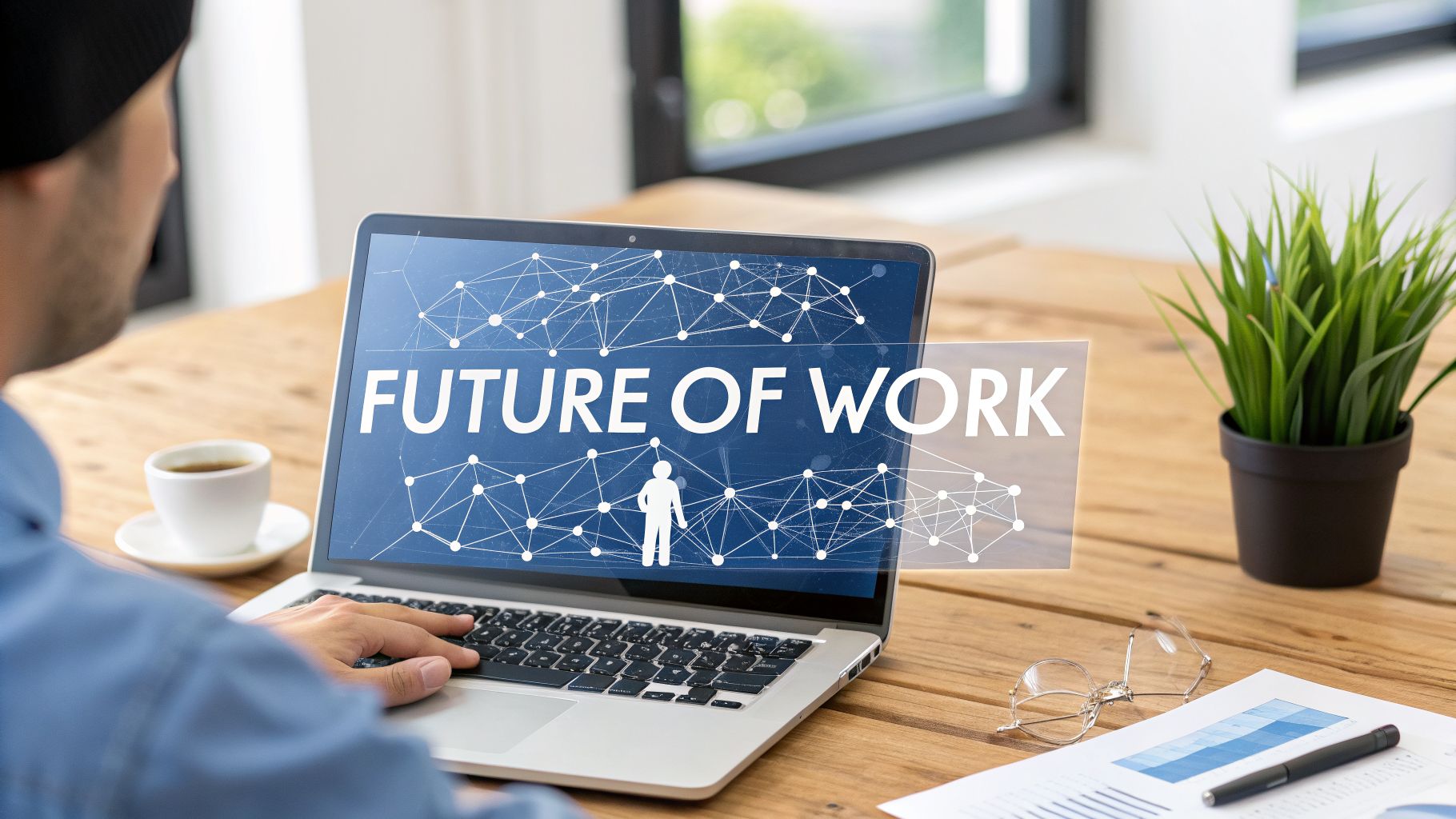
AI and the Future of Work: Your Practical Guide to Thriving in 2026
The dialogue around AI and the future of work is a story of evolution, not extinction. While headlines often fixate on job losses, the reality is that for every role AI displaces, many more are created and countless others are transformed for the better. For most professionals in 2026, AI is not a competitor but a co-pilot, an intelligent assistant that handles tedious tasks, freeing us up to be more strategic, creative, and ultimately, more human at work.
This guide provides an expert-driven, practical look at how AI is reshaping the professional landscape. Authored by our team of workplace strategists and technology analysts, it offers first-hand insights and actionable advice to help you navigate this transition with confidence.
The Reality of AI in Today's Workplace
Talk about artificial intelligence often swings between two extremes: a utopian future of automated leisure or a dystopian one of mass unemployment. The truth, as it unfolds in workplaces today, is far more nuanced and practical.
Rather than a wholesale replacement of the workforce, AI is triggering a profound job augmentation. It's automating the repetitive, data-heavy parts of our jobs, allowing us to shift our focus to high-value activities like strategic planning, creative problem-solving, and building meaningful relationships—skills that remain uniquely human.
From Displacement to New Opportunities
Think of AI not as a self-driving car that makes you redundant, but as the world's most advanced GPS. It processes vast amounts of data, suggests optimal routes, and automates navigation, but you remain the driver, making the critical decisions and steering toward the destination.
Yes, certain roles heavy on predictable administrative work or data entry are at high risk of automation. However, macroeconomic studies consistently point to a net growth in jobs. This isn't wishful thinking; it's a trend supported by extensive research.
The numbers tell a compelling story. A landmark analysis by the World Economic Forum projects that while AI might displace 85–92 million jobs by 2030, it is also expected to create 97–170 million new ones. Goldman Sachs adds that generative AI will impact approximately 300 million full-time jobs, with a significant wave of career transitions expected between 2026–2028.
This timeline illustrates how an initial phase of disruption is set to be followed by a larger wave of new opportunity creation.

The key takeaway is that the current period of displacement is paving the way for a much larger phase of job creation. This makes the next few years a critical window for professionals to adapt, upskill, and position themselves for the new roles emerging.
A Snapshot of AI's Impact on the Workforce
This table provides a high-level summary of AI's dual role in the job market, outlining the key trends every professional should understand.
| Impact Area | Key Trend | What This Means for You |
|---|---|---|
| Job Displacement | Routine, repetitive, and data-heavy tasks are being automated first. | If your role is highly predictable, it's time to build your strategic, creative, and interpersonal skills. |
| Job Augmentation | AI is becoming a "co-pilot" in fields like coding, writing, design, and analysis, boosting productivity. | Learn to use AI tools relevant to your field. Think of them as power-ups that handle grunt work and enhance your capabilities. |
| Job Creation | New roles are emerging, such as AI trainers, prompt engineers, AI ethics officers, and AI system managers. | Monitor these new job titles. They provide a clear roadmap for where the demand for talent is heading. |
Ultimately, the future of work is not about competing against AI—it's about collaborating with it.
The core challenge isn't a lack of work, but a mismatch in skills. The jobs of the future will require us to work with AI, not against it.
To navigate this landscape, it's vital to distinguish between related concepts. People often use 'automation' and 'AI' interchangeably, but their differences have significant career implications. Our guide on automation vs. AI and understanding the key differences breaks this down, helping you identify which tasks are being automated versus which are being truly transformed by intelligence.
Which Jobs Will Change Most and How Soon

The evolution of jobs due to AI is not a single, monolithic event but a series of currents moving at different speeds across various industries. To understand which roles will evolve, it's essential to grasp what current AI excels at: pattern recognition, data processing at scale, and executing predictable, rules-based tasks.
This is precisely why some roles are undergoing transformation right now, while others are just beginning to feel the effects.
Real-Life Example: The Augmented Paralegal
A paralegal's role offers a perfect illustration of job augmentation. A few years ago, a significant part of their job involved manual document review—sifting through thousands of pages of discovery for a single case. Today, an AI tool can perform this task in minutes, flagging relevant documents with superhuman accuracy.
This doesn't make the paralegal obsolete; it makes them more powerful. Their time is freed from tedious review to focus on high-value work: assisting with case strategy, conducting client interviews, and drafting complex legal arguments. These are tasks that require empathy, critical judgment, and creative thinking—quintessentially human skills.
High-Impact and High-Growth Job Families
We are witnessing a major reshuffling of responsibilities. As AI handles more predictable work, human talent is gravitating toward roles demanding a different, more advanced skill set. The table below contrasts the job families facing the most significant change with those set for explosive growth.
| Job Family Facing Change | Why It's Changing | Job Family Set for Growth | Why It's Growing |
|---|---|---|---|
| Administrative & Office Support | AI can schedule, process emails, and manage data efficiently. | AI & Machine Learning Specialists | They build, train, and maintain the AI systems that power businesses. |
| Routine Customer Service | Chatbots and virtual assistants can handle common queries 24/7. | Human-Machine Interaction Designers | They design intuitive and user-friendly interfaces for AI tools. |
| Data Entry & Basic Analysis | AI excels at processing, categorizing, and summarizing information. | AI Ethics and Governance Officers | They ensure AI is used responsibly, fairly, and in compliance with regulations. |
| Repetitive Manufacturing & Assembly | Robots perform physical tasks with high precision and consistency. | Prompt Engineers & AI Trainers | They specialize in communicating with and teaching AI systems to perform specific tasks. |
This pattern repeats across sectors. A marketer now uses AI to generate dozens of ad copy variations, allowing them to focus on overarching brand strategy and audience connection. An accountant uses AI to automate transaction logging and flag anomalies, elevating their role to that of a strategic financial advisor.
The core principle is clear: If a task is predictable and data-driven, AI will likely automate it. If it's dynamic, creative, and requires deep human judgment, AI will augment it.
A Realistic Timeline for Change
This evolution is not happening overnight. Based on our 2026 analysis, the changes are rolling out in distinct phases.
- Happening Now (Immediate Impact): Roles in content creation, basic coding, data entry, and customer support are already in the midst of a major shift. Professionals in these fields are learning to use AI as a daily partner to enhance productivity.
- Next 2-5 Years (Acceleration): We will see deeper AI integration into professional fields like law, medicine, and finance. AI will evolve from a "helper" to a core tool for medical diagnostics, financial risk assessment, and complex legal research. Concurrently, industrial automation will accelerate, a trend already visible in places like China's rapidly expanding industrial robot production.
- 5+ Years (Systemic Change): As AI capabilities mature, they will begin to handle more complex, multi-step problem-solving. This will force a fundamental rethinking of job categories and educational curricula, placing an unprecedented emphasis on lifelong learning and adaptability.
Understanding this timeline is the first step toward proactive career planning. It shifts the focus from anxiety to action, highlighting where you should invest your time and energy to remain valuable.
Your Action Plan for the New Job Market

The shifts in the workplace are not a cause for panic, but they are a definitive call to action. Thriving in the age of AI is not about competing with machines; it's about building a personal toolkit of skills that AI either cannot replicate or can make more powerful.
This doesn't mean everyone must become a data scientist. It means creating a personal upskilling roadmap that transforms uncertainty into a tangible plan for career growth.
Mastering Human-Centric Skills
As AI automates routine analytical work, our uniquely human abilities become our greatest professional assets. These are the skills that build relationships, solve complex problems, and drive innovation.
- Critical Thinking & Complex Problem-Solving: AI is excellent at answering questions, but a human is needed to ask the right questions. This involves evaluating information (including AI-generated output) for bias, making strategic decisions with incomplete data, and navigating ambiguity.
- Creativity & Originality: While AI can generate impressive text and images, true creativity involves connecting disparate ideas in novel ways. This skill is about brainstorming, experimentation, and developing a unique perspective that adds value.
- Emotional Intelligence (EQ) & Collaboration: The ability to read a room, manage interpersonal dynamics, and connect with others is crucial for leadership, teamwork, and client management. An AI cannot build trust or demonstrate genuine empathy in a difficult negotiation.
Building Your Technical and AI Literacy
In 2026, "tech-savvy" no longer means being a programmer. It means understanding the tools of your trade and knowing how to leverage them effectively. This is where you learn to work with AI.
The goal isn't to out-compete AI on its terms (data processing) but to become an expert operator and strategist who guides its power. Think of it as moving from being a passenger to a pilot.
A crucial part of your action plan is understanding the nuances of how AI is used in the job market, such as knowing why generic cover letters fail AI analyzers. This practical AI literacy provides a direct competitive advantage.
Here are a few practical steps:
- Get Comfortable with Data: You don't need a Ph.D. in statistics, but you should understand the basics of data interpretation. Knowing the difference between correlation and causation helps you critically evaluate AI-generated insights.
- Master AI Tools for Your Job: If you’re a marketer, experiment with AI for copywriting. If you're a project manager, ask it to draft a project plan. Start small by using tools like ChatGPT or Microsoft Copilot for one task each week.
- Learn Basic Prompt Engineering: This is the skill of communicating effectively with an AI. Learning to provide clear instructions, context, and constraints is the key to getting high-quality, relevant results.
Cultivating Adaptive Skills for a Changing World
This last category is arguably the most important because it enables all other learning. The half-life of technical skills is shrinking, meaning what's valuable today might be less so in five years. Your ability to adapt is your ultimate career insurance.
Future-Proofing Your Career: Adaptive vs. Fixed Skills
| Skill Type | Adaptive Skills (Growth-Oriented) | Fixed Skills (Static) |
|---|---|---|
| Focus | How to learn, unlearn, and relearn. | Mastery of a specific software or rigid process. |
| Mindset | Curiosity and comfort with ambiguity. | A need for certainty and resistance to change. |
| Example | Learning the principles of communicating with AI. | Mastering a single software version that will soon be outdated. |
The most important adaptive skills are:
- Learnability: A proactive commitment to continuous learning. It involves actively seeking new information, being open to feedback, and having the discipline to improve your skills.
- Resilience: The ability to bounce back from setbacks. As industries and job roles evolve, there will be challenges. Resilience helps you view these as learning opportunities, not failures.
Developing these skills is a long-term project. For immediate impact, focus on the skills that will make your resume stand out in today's AI-filtered job market.
How Companies and Leaders Can Adapt to AI

Integrating AI is not a simple technology upgrade; it is a fundamental test of leadership and organizational culture. The most effective leaders view AI not as a cost-cutting tool, but as a catalyst for innovation and growth. This requires a strategic shift from a short-term replacement mindset to a long-term transformation mindset.
Data shows this shift is underway. As AI adoption accelerates, an estimated 75% of companies are planning to integrate these tools within the next few years. Crucially, while 41% of employers anticipate some role reduction, a much larger 77% are focused on reskilling their existing teams. The winning strategy is clear: reinvent how people work, don't just replace them.
Fostering a Culture of Continuous Learning
To adapt successfully, leaders must cultivate a workplace where continuous learning is the norm and experimentation is encouraged. This means creating an environment where employees feel psychologically safe to experiment with AI, ask questions, and even fail without penalty.
Practical steps include:
- Redesign Workflows: Don’t just layer AI onto outdated processes. Use this as an opportunity to rethink how work gets done. Identify repetitive tasks that AI can handle, freeing your team for higher-level strategic thinking.
- Invest in Upskilling: Proactively address skills gaps before they become a crisis. Offer training that ranges from basic AI literacy for all employees to specialized programs for teams managing AI systems.
- Lead by Example: When leaders openly use AI tools and discuss their own learning journey, it sends a powerful message that this transformation is a shared priority.
Real-World Example: A Manufacturing Transformation
Consider a mid-sized manufacturing company struggling against highly automated competitors. The easy path was to lay off experienced assembly line workers and purchase new robots. Instead, the leadership team chose a transformative path.
They invested heavily in a retraining program, teaching their existing workforce to operate, monitor, and maintain the new robotic systems. The results were astounding. Productivity soared, and product defects plummeted. More importantly, job satisfaction and employee retention increased. The workers now held more engaging, higher-skilled jobs, and the company gained a sustainable competitive advantage. This is a transformation mindset in action.
Comparing AI Strategy Mindsets: Replacement vs. Transformation
A company's framing of its AI strategy has profound implications for its people and long-term success. The choice between a "replacement" and a "transformation" mindset is one of the most critical decisions a leader will make in this decade.
| Strategic Focus | Replacement Mindset (Short-Term) | Transformation Mindset (Long-Term) |
|---|---|---|
| Primary Goal | Reduce immediate labor costs by automating tasks. | Increase overall capability and drive innovation. |
| View of Employees | As cost centers to be optimized or eliminated. | As assets to be developed and empowered. |
| Investment Priority | Technology to replace human functions. | Training and upskilling programs for staff. |
| Long-Term Outcome | Short-term efficiency gains, potential loss of morale and institutional knowledge. | Sustainable growth, higher employee engagement, and a more resilient, adaptable workforce. |
A replacement mindset asks, "How can AI do what my employees do, but cheaper?" A transformation mindset asks, "How can AI help my employees do things we've never been able to do before?"
This distinction is crucial in areas like recruitment. It's tempting to use the best AI interview tools merely to screen candidates faster. A transformative approach uses them to augment human judgment, reduce bias, and improve the candidate experience. As AI becomes more integral to business, it raises fascinating new possibilities—some even explore how AI could become the HR for AI agents in the enterprise.
Investing in the AI-Driven Future of Work
Through an investor's lens, the intersection of AI and the future of work represents one of this generation's most significant opportunities. While investing in foundational AI model developers is an obvious play, a more sophisticated strategy looks beyond the headlines to the second-order effects.
This is the classic "picks and shovels" approach. During a gold rush, the most consistent fortunes were made not by the prospectors, but by those selling tools, supplies, and services. The same logic applies to the AI revolution.
Identifying Key Investment Themes
A savvy investment strategy looks beyond mega-cap tech stocks to the essential infrastructure and services that the entire AI ecosystem relies on.
- Education and Corporate Training: The massive global skills gap is not just a challenge; it's a colossal market opportunity. Companies providing EdTech platforms, professional certifications, and corporate upskilling programs are indispensable. They are building the workforce of the future, making them a direct investment in the new economy's most critical bottleneck.
- Specialized AI Software (SaaS): Look for businesses using AI to solve specific, high-value problems in niche industries. This includes AI-driven software for legal tech, medical diagnostics, or supply chain optimization. These companies often possess deep domain expertise, giving them a durable competitive advantage.
- Human-Computer Interaction (HCI): As AI becomes ubiquitous, the interface between humans and machines becomes paramount. Companies creating more intuitive and seamless interaction methods—through hardware, software, or novel user experiences—are positioned for substantial growth.
The most resilient investments will be in companies that aren't just using AI, but are actively enabling the workforce to adapt to it. Their success is tied to the broader economic transition itself.
Evaluating Companies on Their AI Strategy
When vetting a potential investment, look past the AI buzzwords on their website. A company's true long-term potential can be gauged by its commitment to internal transformation. A robust internal upskilling program, for instance, is a strong signal of forward-thinking leadership that is future-proofing its talent.
This table contrasts a company with superficial AI integration versus one with a deep, strategic approach.
Investment Profile Comparison
| Characteristic | Weak AI Integration (Higher Risk) | Strong AI Integration (Lower Risk) |
|---|---|---|
| Workforce Strategy | Focuses on using AI to replace staff and cut costs. | Invests heavily in upskilling and retraining programs. |
| Product Strategy | Adds a "chatbot" or AI feature as an afterthought. | Redesigns core products and services around AI capabilities. |
| R&D Focus | Purchases off-the-shelf AI solutions with little customization. | Builds or customizes proprietary AI to solve unique business problems. |
| Financial Signal | Sees AI primarily as a way to reduce operational expenses. | Views AI as a driver for new revenue streams and market expansion. |
A company's dedication to developing its people is a powerful indicator of its long-term health. It shows that leadership understands their most valuable asset is not just their technology, but the people who know how to leverage that technology effectively.
Ultimately, investing in the AI and future of work is a bet on adaptation and empowerment. By identifying companies that equip, train, and support the modern workforce, you can uncover opportunities that are less obvious but built to last. For those wanting to dig deeper, our guide on how to invest in the next AI stock boom offers more insights for spotting high-growth companies in the AI space.
Frequently Asked Questions About AI and Work
The rapid pace of AI development raises critical questions about our careers, job security, and the future of work. Here are direct, practical answers to the most common concerns.
Will AI Take My Job?
It is far more likely that AI will change your job than take it. Think of AI less as a replacement and more as a powerful new assistant. The routine, repetitive parts of your day—the tasks that consume time and energy—are what AI excels at. This frees you to concentrate on uniquely human strengths: complex problem-solving, creative strategy, and building genuine relationships. While some roles centered on predictable tasks are at risk, the vast majority of jobs will be augmented, not automated away. The key is to embrace AI as a collaborative partner.
What Are the Most Important Skills to Learn?
To remain essential, focus on a balanced skill set across three key areas:
- Technical Literacy: You don't need to become a coder, but you must be comfortable using the AI tools relevant to your field. This includes learning basic prompt engineering—the art of giving clear, effective instructions to an AI.
- Human-Centric Skills: Leadership, empathy, creative collaboration, and persuasion are now premium skills precisely because they are difficult for AI to replicate. These are the abilities that drive innovation and get things done.
- Adaptability and Learnability: The most vital skill may be the ability to learn continuously. The pace of change is accelerating. A mindset of curiosity, resilience, and a commitment to acquiring new skills is your best career insurance.
Do I Need to Worry About AI if I Am Not in a Tech Field?
You should be aware, not worried. AI's impact is not confined to tech; it is spreading across every industry. A lawyer uses AI to analyze thousands of documents in minutes. A doctor uses it to identify patterns in medical scans. A designer uses it to generate initial concepts. Even a plumber might use an AI-powered app for smarter scheduling. The goal isn't to become a tech expert, but to understand how these new tools can make you more effective in your chosen field.
How Can I Start Preparing for These Changes Right Now?
Be proactive. Don't wait for a formal training program.
- Start Small: Identify one or two repetitive tasks in your daily work. Use a free tool like Google's Gemini or ChatGPT to see if you can do it faster.
- Make It a Habit: Dedicate one hour a week to learning. Follow experts on LinkedIn, read an article, or watch a tutorial about AI in your industry. Small, consistent efforts compound over time.
Is It Too Late to Switch to a Career in AI?
Not at all—in fact, you are right on time. The demand for people who can work with AI is exploding, and there is a significant talent shortage. You don't have to be a Ph.D. research scientist. A new category of "AI-adjacent" roles is emerging, including AI Product Manager, AI Ethics Officer, AI Implementation Specialist, and Prompt Engineer. Your experience in healthcare, finance, or marketing is a huge asset. Combining that domain knowledge with new AI skills is a powerful and sought-after combination.
Will AI Increase or Decrease Wages?
Early data suggests both. We are seeing a growing wage premium for roles that require in-demand AI skills, with some studies showing salary bumps of 8% or more. Conversely, wages for jobs composed of easily automated tasks will likely face downward pressure. This widening gap creates a clear financial incentive for professionals to invest in upskilling and adapting to the new tools of their trade.
How Will AI Affect the Hiring Process?
AI is already transforming hiring. Companies use AI-powered Applicant Tracking Systems (ATS) to screen resumes and automated video platforms for first-round interviews. To succeed, you must be strategic:
- Optimize Your Resume: Tailor your resume for each application, using keywords from the job description to pass the AI filter.
- Showcase AI Literacy: Clearly list the AI tools you have used and demonstrate your understanding of their application in your field.
- Prepare for AI Assessments: Be ready for online simulations or tests that use AI to evaluate your problem-solving skills in real-time.
What Are Some Practical AI Tools I Can Try Today?
The best way to demystify AI is through hands-on experience. Here are some excellent, user-friendly tools:
| Tool Category | Example Tools | Common Use Cases |
|---|---|---|
| Writing & Brainstorming | ChatGPT, Google Gemini | Drafting emails, generating ideas, summarizing articles, writing code snippets. |
| Image Creation | Midjourney, DALL-E 3 | Creating custom visuals, concept art, social media graphics, presentation slides. |
| Meeting & Note Summarization | Otter.ai, Fireflies.ai | Transcribing meetings, identifying action items, creating summaries. |
| Integrated Office Suites | Microsoft 365 Copilot, Google Workspace AI | Assisting with tasks within documents, spreadsheets, and presentations. |
Start by exploring the AI features now being integrated into the software you use daily.
Are There Ethical Concerns with AI in the Workplace?
Yes, and they are significant. Key ethical challenges include:
- Algorithmic Bias: AI systems trained on biased historical data can perpetuate and even amplify discrimination in hiring, promotions, and performance reviews.
- Data Privacy and Monitoring: The use of AI for employee monitoring raises serious questions about privacy, trust, and workplace culture.
- Fair Transition for Workers: As roles are displaced, there is an ethical imperative for companies and governments to support affected workers through robust reskilling programs and social safety nets.
Responsible organizations are addressing these issues by establishing ethics boards, demanding transparency in their AI systems, and prioritizing fairness.
Will AI Lead to a Four-Day Work Week?
It's a real possibility, but not a guarantee. The logic is that if AI drives a massive increase in productivity, we could achieve the same output in less time, making a shorter work week economically viable. However, technology is only one part of the equation. This would also require a significant shift in corporate culture, economic incentives, and public policy. While some companies are experimenting with it, a widespread four-day work week is likely still some years away.
At Everyday Next, we believe that understanding the future is the first step toward building it. We provide daily insights into the tech, finance, and personal development trends that shape your world, helping you make informed decisions for your career and life. Explore our latest articles at https://everydaynext.com to stay ahead of the curve.
Previous Post
Next Post
Previous Post

Next Post