Your Guide to Choosing the Best AI Detector
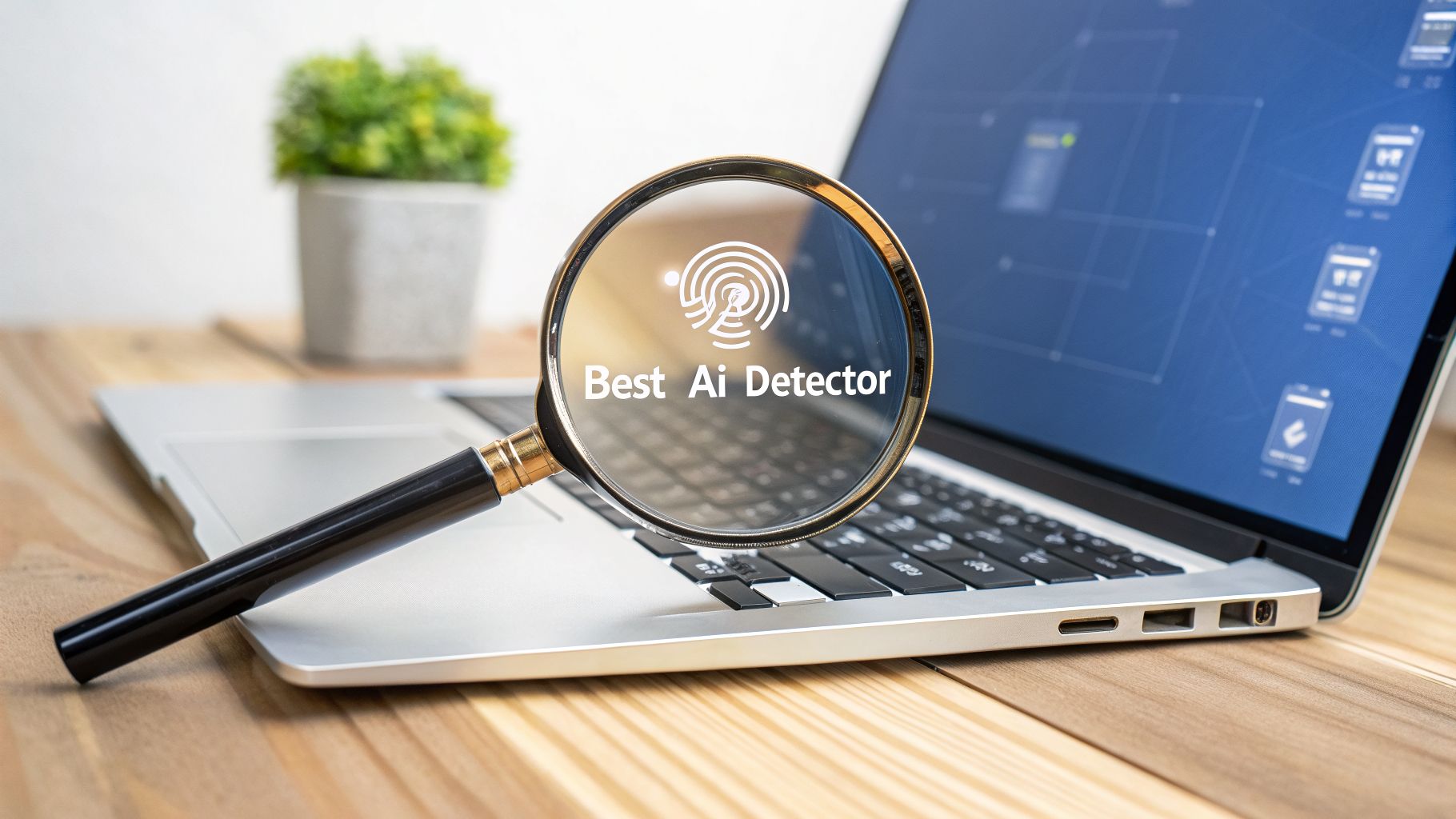
An AI detector is a tool that tries to figure out if a piece of text was written by a person or a machine. Think of it as a kind of digital forensics for writing. In a world where AI can generate an essay or article in seconds, these tools help us spot the difference between human creativity and machine-generated content.
As someone who has tested dozens of these tools in a professional capacity—for editing client work, auditing content for SEO, and experimenting with AI's creative limits—I've seen firsthand what works, what doesn't, and where the real value lies. This guide is built on that direct experience.
What Is an AI Detector and Why Is It Essential

The explosion of generative AI has created a serious challenge: how can we trust that the digital content we read is authentic? An AI detector tackles this head-on by scanning text for the subtle giveaways of machine writing. These often include overly perfect grammar, repetitive sentence structures, and a certain lack of a human "voice."
But these tools aren't just for playing "gotcha." They've become critical for maintaining trust and integrity online. As you learn artificial intelligence, you’ll quickly see that understanding its detection is just as important as understanding its creation.
For a few key groups, having a reliable way to check for AI writing isn't just nice—it's essential. Each faces unique problems that these tools are designed to solve.
Who Needs These Tools the Most
In schools, for instance, the line between using AI as a research buddy and letting it write an entire paper has become incredibly blurry. This has led to what many are calling a crisis of academic trust. Teachers need a way to ensure students are actually learning and developing critical thinking skills, not just getting good at writing prompts.
An AI detector isn't about policing students. It’s about preserving the value of genuine effort. It should be a signal to start a conversation about originality and ethics, not a final verdict.
For businesses and anyone creating content for the web, the stakes are just as high. The internet is already being flooded with low-effort, AI-spun articles, fake reviews, and automated spam. An AI detector helps protect a brand's reputation and ensures its content is genuinely helpful, which is exactly what search engines like Google want to see.
To put it simply, different people need these tools for very different reasons. Here’s a quick look at who benefits the most.
Who Needs an AI Detector and Why
| User Group | Primary Use Case | Key Benefit | Real-Life Example |
|---|---|---|---|
| Educators & Institutions | Verifying the originality of student submissions. | Upholding academic integrity and fostering genuine learning. | A professor at a large university uses an AI detector integrated into their LMS to flag essays that lack personal analysis, prompting one-on-one discussions with students about their research process. |
| Content Marketers & SEOs | Auditing content to avoid Google penalties for unhelpful content. | Maintaining content quality and protecting search rankings. | A digital marketing agency runs all freelance articles through an AI detector to ensure the content has a unique human voice before publishing, protecting the client's brand authority. |
| Publishers & Editors | Screening freelance and user-submitted content for authenticity. | Ensuring authenticity and protecting brand credibility. | An online magazine editor uses a detector to vet hundreds of submissions, quickly identifying and rejecting pieces that are clearly machine-generated and lack original insight. |
| Journalists & Researchers | Checking sources and combating misinformation campaigns. | Verifying information and increasing trustworthiness in reporting. | A political journalist scans a flood of social media posts during an election, using a detector to spot patterns of automated bot activity spreading a specific narrative. |
Ultimately, what this all means is that understanding and using an AI detector is no longer a niche skill. It's becoming a fundamental part of navigating a digital world where the lines between human and machine are getting harder to see every day.
Understanding the Booming AI Detection Market
It’s no surprise that AI detectors are popping up everywhere. They’re a direct answer to the flood of AI-generated content we're all seeing, and their sudden popularity reflects a real, growing need to tell human work apart from machine-made text. This isn't just a passing trend; it's a fundamental shift in how we approach digital information.
The numbers are stunning. The global market for AI detectors was valued at just USD 453.2 million in 2024. But projections show it climbing to an incredible USD 5,226.4 million by 2033, with a compound annual growth rate (CAGR) of 31.6% starting in 2025. You can see the full breakdown in the Grand View Research report.
What’s Driving This Massive Growth?
This explosive growth isn't happening in a vacuum. It’s a direct response to some very real, everyday problems that people and organizations are facing.
- Academic Integrity: Schools and universities are on the front lines, creating strict policies to combat AI plagiarism and ensure students are actually learning.
- Content Authenticity: Businesses are struggling to protect their reputations from a wave of fake AI-written reviews and low-quality blog posts.
- Misinformation Control: For news outlets and social media platforms, flagging synthetic content is now critical to stopping the spread of false information.
These concerns show that the need for AI detection is here to stay. The opportunities created by the generative AI revolution have brought an equal and opposite need for tools that can verify what’s real.
A Global Rush for Authenticity
The demand for AI detectors is truly a worldwide issue, even if the primary motivation varies from place to place. It highlights a universal challenge: how do we know what we’re reading was written by a person?
North America is currently leading the charge, mostly because its huge education sector had to react quickly to the widespread use of AI writing tools. The push to maintain academic standards has made detectors a must-have for thousands of institutions.
Meanwhile, other parts of the world are catching up fast.
- Europe: Regulations like the EU AI Act, which emphasize transparency, are pushing companies to adopt detectors to stay compliant and prove their content is authentic.
- Asia-Pacific: This region's booming e-learning and digital marketing sectors are creating a huge appetite for tools that can verify content at scale.
At the heart of it all is a simple truth: as AI becomes a bigger part of our work, the tools to check that work become just as important. This market isn't just growing—it's becoming a permanent part of our digital lives.
From a university trying to protect its academic reputation to a business trying to safeguard its customer reviews, the practical uses are crystal clear. The boom in the AI detector market is simply a reflection of our collective need to hold on to authenticity and trust online. This is about more than just catching cheaters; it's about protecting the value of real human ideas and creativity.
How AI Detectors Actually Work
Ever heard a musician who plays every single note with flawless precision, yet the music feels completely empty? That’s a good way to think about how AI detectors analyze text. They aren't looking for meaning or emotion; they're scanning for the statistical fingerprints of a machine.
At their core, these tools work by spotting patterns that show up far more often in AI-generated writing than in anything a person would naturally produce. They rely on a few key methods, each with its own pros and cons. Once you understand them, it's easy to see why no detector is ever 100% accurate.
Statistical Feature Analysis
The most fundamental technique is statistical feature analysis. Think of it like a crime scene investigator dusting for fingerprints that only an AI would leave behind. It breaks down the text to measure a couple of key characteristics.
These tools are looking for two things: perplexity and burstiness. Perplexity is just a fancy word for how predictable the writing is. AI text often defaults to very common, almost cliché word choices, which gives it low perplexity. Burstiness, on the other hand, is all about sentence length variety. Humans tend to write in bursts—a few short sentences followed by a long, complex one. AI, however, often produces sentences that are eerily similar in length.
- Strength: It’s pretty good at catching text from simpler AI models that churn out generic, cookie-cutter content.
- Weakness: Newer AI models are much better at faking human-like sentence variety, making them harder to flag with this method alone.
Machine Learning Classifiers
A more sophisticated approach uses machine learning (ML) classifiers. This works a lot like a spam filter in your email, but it's trained to catch AI writing instead of junk mail. These models are fed enormous databases filled with thousands of examples of both human-written and AI-generated text. If you're curious about the nuts and bolts, our guide on machine learning for beginners is a great place to start.
Through this training, the model learns to spot the subtle, almost invisible signatures of each writing style. It identifies patterns in vocabulary, grammar, and sentence structure that are far too complex for simple statistics. When you feed it a new article, it calculates the probability that the text matches the "AI" profile it learned.
The growing demand for these tools is creating a significant market, driven by specific industry needs across different regions.

As you can see, the market's expansion isn't just a number—it's a direct response to the real-world challenges posed by AI-generated content.
A classifier-based AI detector isn't "reading" or "understanding" your text. It's just performing a highly advanced pattern-matching game, concluding that, "This piece looks a lot more like the thousands of AI examples I was trained on."
Digital Watermarking
The third method, digital watermarking, flips the script. Instead of trying to detect AI writing after it’s been created, this approach embeds an invisible signature directly into the text as it's being generated.
Think of it like a secret code woven into the very fabric of the text—maybe a specific, imperceptible pattern of punctuation or word choices. It's completely invisible to a human reader but easily spotted by a tool designed to look for it. The catch is that this requires AI developers like OpenAI and Google to build the watermarking system into their models from the start.
Here’s a quick breakdown of how these three methods stack up:
| Detection Method | How It Works | Primary Limitation |
|---|---|---|
| Statistical Analysis | Measures text predictability and sentence variety (perplexity & burstiness). | Can be fooled by advanced AIs or simple human edits. |
| ML Classifiers | Trained on massive datasets to recognize complex writing patterns. | Its accuracy is completely dependent on the quality and diversity of its training data. |
| Watermarking | Embeds a hidden, machine-readable signal directly in the text. | Requires AI companies to implement it, and the watermark can be broken by editing. |
In the end, most modern AI detectors use a hybrid model, combining statistical checks with ML classifiers for the most reliable results. But it's a constant cat-and-mouse game. As AI models get better at sounding human, detectors have to get smarter, too. That’s why, for now, nothing beats a healthy dose of human judgment.
Comparing the Best AI Detector Tools
Trying to pick the right AI detector can feel like wading through a sea of marketing claims. Dozens of tools are out there, each one promising pinpoint accuracy. But the truth is, the "best" tool really depends on who you are and what you need it for. A teacher's priorities are worlds away from a publisher's, and neither one needs the same thing as someone just checking their own work.
So, instead of just rattling off a list of names, let's take a practical look at the top contenders. We'll compare them based on what actually matters: how accurate they are, what they cost, who they're built for, and what makes each one stand out from the pack.
A Head-to-Head Comparison
To help you cut through the noise, you need to see how these tools stack up directly against each other. This table gives you a clear, side-by-side view of the leading options, making it easier to spot which one might be the right fit for your daily routine.
It's so important to remember this: no AI detector is foolproof. Think of them as a powerful signal, not a final verdict. The AI writing models they're trying to catch are getting smarter every day, so accuracy is always a moving target.
Top AI Detector Tool Comparison
A feature-by-feature comparison of the top AI detection tools on the market.
| Tool Name | Accuracy Claim | Pricing Model | Best For | Key Feature |
|---|---|---|---|---|
| Turnitin | 98%+ (low false positives) | Institutional Subscription | Educators & Academic Institutions | Integrates right into Learning Management Systems (LMS) and is fine-tuned to avoid falsely accusing students. |
| Originality.ai | 99% | Pay-as-you-go credits | Content Marketers & SEO Agencies | It’s a triple threat: AI detector, plagiarism checker, and readability scorer all in one dashboard. |
| GPTZero | 98% | Freemium (with paid tiers) | Writers, Students, & General Use | The "Writing Report" is fantastic, giving you a sentence-by-sentence breakdown of what looks human and what doesn't. |
| Copyleaks | 99.1% | Subscription & API Access | Businesses & Enterprise | Its powerful API lets you plug AI detection into your own software, and it works with over 30 languages. |
As you can see, each tool is designed with a specific user in mind. Choosing the right one means matching its strengths to your needs.
How Results Can Vary in the Real World
Here's where things get tricky. A tool's advertised accuracy and its real-world performance can be two very different things. I've seen the same paragraph get wildly different scores from different detectors, and it's because they all have their own secret sauce—a unique algorithm trained on a unique set of data.
Let’s run a quick experiment. I'll take a classic AI-generated paragraph and see how a few different tools might react.
Sample AI Text: "The symbiotic relationship between mycorrhizal fungi and plant roots is a cornerstone of terrestrial ecosystems. This mutualistic partnership facilitates enhanced nutrient uptake, particularly phosphorus, for the plant, while the fungus receives carbohydrates synthesized through photosynthesis. This intricate exchange profoundly influences plant health, biodiversity, and soil structure."
Now, let's see the results:
- Detector A (like GPTZero): It screams 96% AI-generated. The formal tone, heavy-duty vocabulary ("symbiotic," "mutualistic"), and perfectly even sentence structure are dead giveaways for its algorithm.
- Detector B (a random free tool): This one might hedge its bets and say 55% Likely AI. It can get confused by technical terms, mistaking them for sophisticated human writing instead of a common AI pattern.
- Detector C (like Originality.ai): This one comes back with 100% AI. Its model is specifically trained to recognize the tell-tale "flavor" of text from models like GPT-4, picking up on the predictable flow and lack of any real human voice.
This little test proves why you can't always trust a single, free tool, especially when the stakes are high. Your best bet is to use a reputable, paid AI detector or, better yet, check your text against two different tools to see if the results line up. For a deeper dive into your options, this review of the 12 best AI content detection tools of 2026 is a great place to continue your research.
Ultimately, picking a tool is a balancing act between cost, accuracy, and your specific needs. And while you're focused on detection, don't forget to check out other AI tools for productivity that can help you improve your own work. By understanding the landscape and trying a few options, you'll find the right detector to protect your integrity and keep your content authentic.
The Limitations and Ethical Concerns of AI Detectors
Let's get one thing straight about AI detectors: they are not foolproof. Far from it. While these tools are quickly becoming a necessary part of our digital toolkit, we have to be brutally honest about what they can and can't do.
Right now, no AI detector on the market is 100% accurate. Treating their output as gospel can cause some serious, real-world harm.
An AI detector's usefulness all comes down to how well it avoids two major pitfalls: false positives and false negatives. Each is a different kind of failure, and both chip away at the tool's credibility.
A false positive is when the tool flags human-written text as being generated by AI. This is by far the more dangerous error. Imagine a student being falsely accused of cheating or a writer being penalized for work they actually created.
A false negative is the opposite problem—AI-generated content slips by completely undetected. This undermines the value of authentic work and pollutes the information ecosystem.
A Never-Ending Game of Cat and Mouse
The world of AI detection is a constant arms race. As language models like GPT-4 and its successors evolve, they get scarily good at sounding human. Their writing is more nuanced, their sentence structures are more varied, and they’re even learning to mimic our weird little quirks and imperfections.
On top of that, it doesn't take a genius to trick most detectors. Research has shown that simple tricks, like running AI text through a paraphrasing tool or just making a few manual edits, can fool a detector up to 30% of the time.
AI detectors flag text based on patterns, not provenance. They don’t know if a paragraph came from a chatbot, a college sophomore, or a Pulitzer Prize winner. It’s like judging a meal by how evenly the vegetables are chopped—it’s not detection, it’s just algorithmic guesswork.
This reality is fueling a massive market boom. The AI detector industry is growing at a staggering rate of 28-31% per year, spurred on by regulations like the EU's AI Act, which can fine non-compliant companies up to 6% of their global revenue. Even with all that money pouring in, accuracy is a huge problem, with clever users evading detection in 20-30% of tests. You can read more about these market dynamics and what's driving them.
When the Tools Get It Spectacularly Wrong
These flaws aren't just theoretical. We've seen popular tools confidently declare that the U.S. Constitution and Abraham Lincoln's Gettysburg Address were 100% AI-generated. Why? Because the writing is clear, structured, and formal—all qualities that algorithms are trained to associate with machine output.
This challenge isn't just limited to text. A recent survey asked a fascinating question: Do Recruiters Know AI Headshots?. It reveals a similar struggle in the visual domain, highlighting just how tough it is for anyone, human or machine, to reliably spot sophisticated AI creations.
Ultimately, you have to think of an AI detector as a helpful assistant, not a hanging judge. Its output is just a probability score—a signal that something might be worth a closer look, not a final verdict. The smartest approach is to use detector results as just one piece of the puzzle, combining them with your own critical thinking and, whenever possible, a simple conversation with the person who wrote the text.
How to Use AI Detectors in Your Daily Workflow

Knowing what an AI detector is and actually weaving it into your daily work are two different things. The trick is to stop thinking of these tools as perfect lie detectors and start seeing them as helpful assistants. They aren't meant to give a final verdict, but to offer a valuable second opinion.
How you use them really depends on your job. A teacher trying to encourage original thought has very different needs from a marketer protecting a brand's voice. There's no single "right way" to use an AI detector; it's all about tailoring it to your specific goals.
For Educators Fostering Integrity
If you're a teacher, an AI detector should be a tool that starts a conversation, not one that ends it with an accusation. Blindly trusting a high AI score can easily lead to falsely accusing a student, which completely undermines trust. A smarter approach is to use a flagged report as a reason to take a closer look.
When a paper gets flagged, the point isn't just to catch a student cheating. It's a chance to talk about digital literacy, the ethics of AI, and what it really means to produce original work today.
Here’s a practical workflow you could try:
- Initial Scan: Run student submissions through a detector, especially if it’s built into your school's learning platform.
- Review High Scores: If a paper comes back with a high probability of AI, read it carefully yourself. Does the voice sound flat or robotic? Is the phrasing strange? Does it lack personal insight?
- Start a Dialogue: Set up a one-on-one with the student. Ask them to walk you through their research and writing process. Have them explain their main arguments in their own words.
For Marketers and Content Managers
In the world of marketing, content managers are the guardians of a brand's quality and authenticity. Whether you're working with freelancers or an in-house team, an AI detector is a vital quality control checkpoint. Publishing generic, machine-generated articles can torpedo your SEO rankings and make your brand look cheap.
The process is pretty straightforward:
- Verify New Content: Before anything goes live, run all submitted drafts through a trusted AI detector.
- Request Revisions: If a piece gets flagged, send it back. Ask for real human editing, unique insights, and a personal touch.
- Protect Your Brand: This simple check helps ensure your content is authentic, genuinely helpful, and rewarded by search engines. As you figure out how to use AI in daily life, using it to verify content will feel like a natural extension.
This is quickly becoming standard procedure. In North America, where the AI detector market is most mature, an estimated 70% of Fortune 500 companies use these tools for content moderation. In Europe, GDPR regulations have spurred a 28% adoption spike among media companies using detectors to ensure news authenticity. You can dive deeper into these trends in the full MarketsandMarkets report.
For Journalists and Researchers
For journalists, accuracy is the name of the game. An AI detector can serve as a quick first-pass filter when you're vetting sources or sifting through massive amounts of text. It’s great for flagging content that might be part of a coordinated disinformation campaign.
This table breaks down how a journalist might put these tools to work:
| Workflow Step | Action | Purpose |
|---|---|---|
| Source Vetting | Scan press releases or tips from unknown sources. | Identify potentially automated or synthetic content that requires deeper fact-checking. |
| Trend Analysis | Analyze social media posts about a topic. | Spot patterns that suggest bot activity or manufactured narratives. |
| Internal Audits | Periodically check published articles. | Ensure all content meets the publication’s standards for originality and authenticity. |
Frequently Asked Questions About AI Detectors
Let's cut through the noise. When it comes to AI detectors, there's a lot of confusion and a handful of questions that pop up again and again. Here are some straightforward answers from an expert perspective to help you navigate these tools with confidence.
1. Can an AI Detector Be 100% Accurate?
Absolutely not. No AI detector is 100% accurate, and it's crucial to understand this from the start.
Think of them as highly advanced pattern-finders, not infallible truth machines. They can and do make mistakes, leading to "false positives" (flagging your own writing as AI-made) and "false negatives" (letting AI-generated text slip by). Their results are a strong signal, but never the final word. Always apply your own judgment.
2. Is It Illegal to Use AI-Generated Content?
This is a tricky one, and the answer is all about context. Using AI to write a blog post isn't illegal. However, if you're a student submitting an AI-written essay as your own, that's academic dishonesty—a form of plagiarism.
In the business world, you could run into copyright issues if an AI tool reproduces protected material. We're also seeing new laws emerge that demand disclosure, especially for things like political ads or news reporting, so people know when they're reading something written by a machine.
3. How Can I Make AI Text Undetectable?
People are always looking for a way to "beat the scanner," but it's a short-term game. The real goal isn't to deceive, but to use AI as a powerful assistant.
Instead of trying to outsmart an algorithm that's constantly learning, focus on adding your own value. Use AI to get past a blank page or to generate a rough draft. Then, the real work begins: edit heavily, inject your unique perspective, and weave in your own voice.
The best way to "humanize" any text is to infuse it with your own original thoughts, stories, and analysis. That's the stuff no AI can replicate, and it's what both people and search engines are ultimately looking for.
4. Will Using AI Content Hurt My Website's SEO?
Google has been very clear on this: they reward helpful, high-quality content for people, not how it was made.
If you're churning out low-effort, spammy AI articles just to game the system, you'll almost certainly see your rankings suffer. But if you use AI as a tool to help you create well-researched, insightful articles that genuinely help your reader, you're in the clear. The focus is, and always will be, on reader value.
5. How Do I Choose the Right AI Detector for Me?
The perfect tool really boils down to your specific needs. Here’s what to think about:
- Accuracy: How critical is it to avoid false positives? For a teacher or editor, this is a top priority.
- Cost: Are the limitations of a free tool okay, or do you need the power of a paid subscription?
- Features: Do you need extra bells and whistles like a plagiarism checker, API access for your systems, or integration with a learning platform?
An educator might want a tool that plugs right into their school's learning management system, while a publisher will likely need a high-volume API. Use comparison charts (like the one in our guide!) to weigh your options.
6. What Is the Difference Between an AI Detector and a Plagiarism Checker?
They're two different tools for two different jobs. A plagiarism checker is like a detective dusting for fingerprints—it scans a document and compares it to a massive database of published works to find exact copies or heavily paraphrased text.
An AI detector, on the other hand, is more like a linguistic profiler. It doesn't care if the text exists elsewhere. It analyzes the writing style itself—word choice, sentence rhythm, and predictability—to calculate the probability that it was written by a bot.
7. Can AI Detectors Analyze Images or Videos?
Yes, but not the same ones we've been discussing. AI image detectors and deepfake analysis tools are entirely different technologies. They're built to spot visual clues—things like weird shadows, unnatural blinks, or subtle digital artifacts—that give away an AI-generated image or video. A text-based AI detector would be completely useless for this.
8. Do AI Detectors Work for All Languages?
Most detectors are trained on enormous collections of English text, so that's where they perform best. While many are adding support for other languages, their accuracy can drop off significantly. If you need to check content in a language other than English, be sure to test the tool's performance for that specific language before you trust its results.
9. What Should I Do If My Work Is Falsely Flagged as AI-Generated?
This is a frustrating, but increasingly common, situation. If you're wrongly accused, the best defense is to show your work. Provide proof of your writing process, like your document's version history in Google Docs, rough outlines, research notes, or early drafts. This is a powerful reminder of why an AI detector's score should never be used as the sole piece of evidence in an accusation.
10. Are Free AI Detectors Reliable?
Free tools can be a decent starting point for casual checks. They're great if you're just curious or want a quick first pass. However, they almost always come with limitations, whether it's a strict word count, fewer features, or lower accuracy than their paid counterparts.
For any serious academic or professional work where the stakes are high, investing in a reputable paid tool is almost always the smarter choice.
Stay ahead of the curve with Everyday Next, your daily source for insights on tech, finance, and personal growth. We provide the clear, practical guidance you need to make sense of a changing world. Explore more at https://everydaynext.com.
Related Posts

Previous Post
Next Post