Discover AI in Everyday Life: How Artificial Intelligence Shapes Your Daily Routine
You're already using Artificial Intelligence, probably without even thinking about it. AI has quietly become a part of our daily rhythm. It’s the invisible assistant working in the background from the minute you wake up until you wind down for the night, making things just a little bit easier.
This isn't about sci-fi robots. It's about the smart, practical software running on your phone, in your car, and even in your home, helping you navigate your day.
The Hidden AI Working for You Every Day
It’s easy to miss just how much AI does for us because the best versions of it are designed to be invisible. You’ve likely interacted with dozens of AI systems before your first coffee break, all without a second thought. Their job isn't to be flashy; it's to be useful, making complicated things feel surprisingly simple.
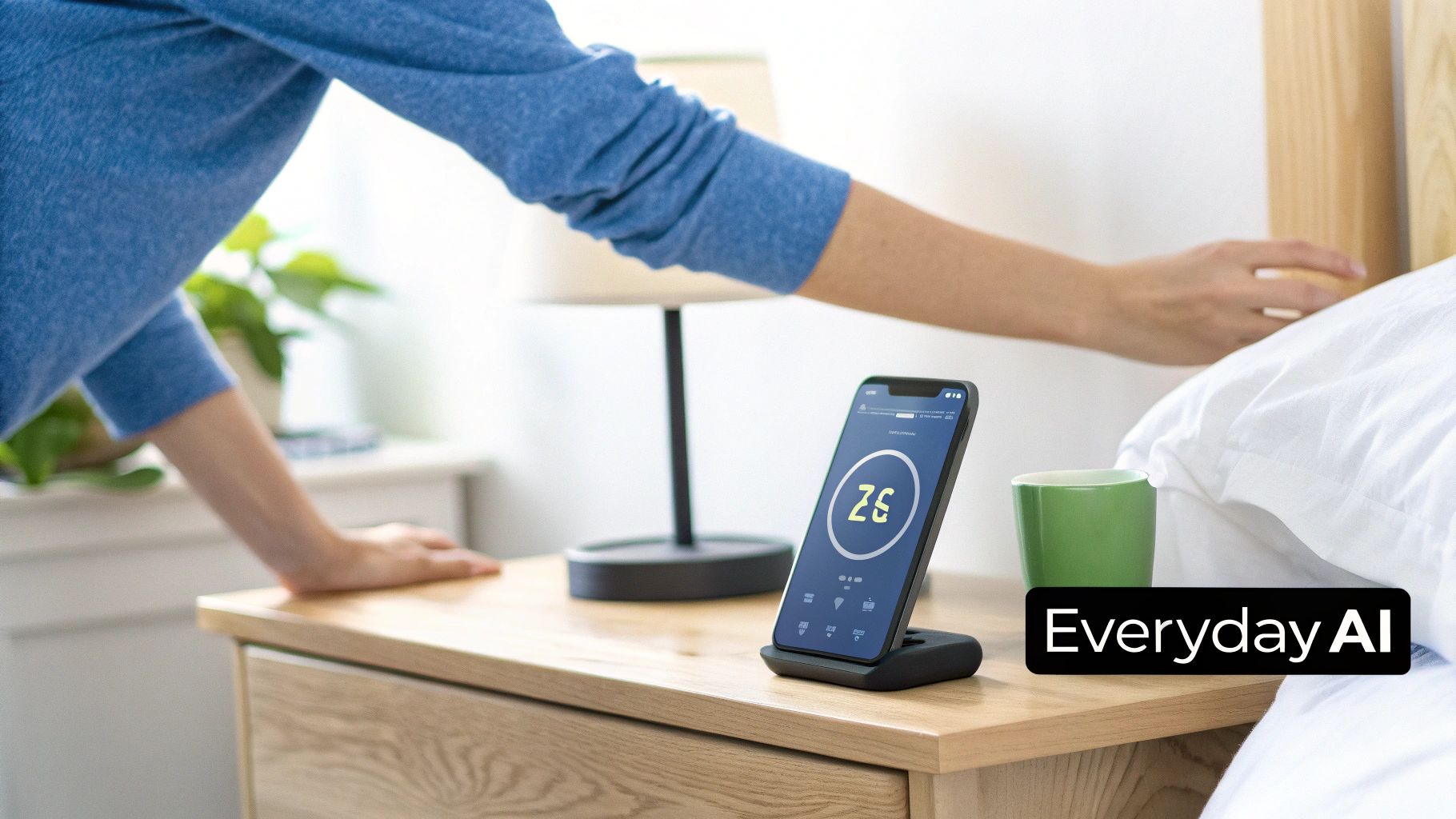
Take your morning commute, for example. It might start with a smart alarm on your phone that nudged you awake a few minutes early because it already checked the morning traffic. That’s AI in action.
Your Personalized Digital Assistant
While you’re getting ready, you might scroll through a news feed that seems to know exactly what you’re interested in or open a music app that has the perfect playlist for your mood. This isn't magic; it's clever algorithms learning from your habits. The engine driving this is a branch of AI called machine learning. To get a better handle on the mechanics, check out our guide on machine learning for beginners.
These systems crunch massive amounts of data to predict what you'll want to see, hear, or do next. And they're always learning, constantly fine-tuning the experience to feel like it was made just for you.
The best AI is the kind you don't even notice. It operates in the background, simplifying your choices and automating small frictions in your day, from suggesting the right word in an email to finding the fastest route home.
This "hidden" AI keeps working for you all day. When you pull up a navigation app like Google Maps or Waze, you're not just looking at a digital map. You’re using a powerful AI that is:
- Analyzing live traffic data from millions of other drivers.
- Predicting traffic jams based on historical patterns for that time of day.
- Instantly finding a new route if there's an accident or slowdown ahead.
Real-Life Example: Just last week, while driving to an appointment, my navigation app suddenly rerouted me through a side street. I was confused for a moment, but then I saw the traffic jam on the main road I had just avoided. The AI had analyzed real-time data from other drivers and saved me from being late.
The voice commands you use every day are another great example. Each time you ask for the weather or tell your phone to set a timer, you're tapping into a complex AI model. To see how different they are, it's interesting to compare the big players, like the popular AI assistants like Alexa, Siri, and Google Assistant.
The goal here is to pull back the curtain on these everyday tools. Once you start noticing the AI that's already around you, you can better understand what it does and learn how to make it work even better for you, both at home and on the job.
How AI Is Upgrading Your Home
You might think of AI in the home as just asking a smart speaker for the weather, but it’s already doing so much more. Quietly, in the background, AI is turning our houses into places that are more responsive, efficient, and secure. This isn't about some far-off futuristic dream; it’s about real, practical tools that save us time, cut down on energy bills, and just make managing a household a little bit easier.
The real magic is how these systems learn from our daily habits to figure out what we need before we even ask. It's like having an invisible helper that handles all the little things, making life feel a whole lot smoother.
Smarter Energy and Resource Management
One of the biggest wins for AI in everyday life at home is the impact on our energy bills. Take smart thermostats, for example. They've moved way past basic timers. These devices learn the rhythm of your household—when people come and go, how long it takes to warm up the living room, and even what the weather is doing outside.
Because they can predict your needs, your heating and air conditioning only run when they absolutely have to. This alone can slash heating and cooling costs by up to 15% a year. It's the same story in the kitchen, where smart fridges use cameras and AI to see what food you have.
These appliances can identify what's inside and suggest recipes for the ingredients you already own, helping you use up food before it spoils. It’s a small tweak that can seriously cut down on food waste, which is great for your budget and the planet.
These are perfect examples of AI being more than just a novelty. It's helping us build more sustainable homes. To see how else AI can simplify your tasks, check out our guide on AI tools for productivity.
Enhanced Security and Awareness
Home security is another area that’s gotten a major intelligence boost. Old-school systems were notorious for false alarms—a notification for every passing car or wandering cat. Today’s AI-powered cameras are much smarter. They can actually tell the difference between people, animals, packages, and vehicles.
Real-Life Example: A friend of mine lives near a busy street and her old security camera would send her dozens of alerts a day for passing cars. After upgrading to an AI-powered camera, she only gets notifications when a person or a package is detected in her designated zone, giving her peace of mind without the constant noise.
- Person Detection: It knows a person from a raccoon, so you don't get woken up at 3 AM for no reason.
- Package Recognition: Get a heads-up the moment a delivery is sitting on your porch.
- Familiar Face Alerts: You can set it up to recognize friends and family, giving you more specific and useful notifications.
This kind of detail changes home security from something that just reacts to problems to a system that helps you stay proactively aware of what’s happening around your home.
The Connected Home Ecosystem
Where AI really shines at home is when all these separate smart devices start working together as a team. A central AI assistant can link your thermostat, lights, security cameras, and even your coffee maker into one seamless system.
Think about it: when the last person heads out for the day, your home can automatically go into "away" mode. The doors lock, the thermostat dials back to save energy, and the cameras switch on. When you pull into the driveway later, it all reverses—lights on, temperature just right, and your favorite playlist starts. This isn't programmed manually; it's the AI learning your routines and making it happen automatically.
To give you a better idea of the main players in this space, here’s a quick look at the most popular smart home assistants that make these ecosystems possible.
Comparing Popular Smart Home AI Assistants
Choosing the right AI assistant is the first step toward building a truly connected home. This table breaks down the key features of the big three, helping you decide which ecosystem best fits your lifestyle and the devices you already own.
| Feature | Amazon Alexa | Google Assistant | Apple Siri |
|---|---|---|---|
| Device Compatibility | Widest range of third-party devices | Strong integration with Nest and Android | Best for Apple-centric homes (HomeKit) |
| Natural Language | Excellent at conversational commands | Best for complex queries and context | Simple and reliable for basic tasks |
| Smart Home Routines | Highly customizable with "Routines" | Good automation with "Routines" | Limited but effective with "Scenes" |
| Primary Ecosystem | Amazon Echo devices | Google Nest devices | Apple HomePod, TV, and iOS devices |
Ultimately, your choice will likely come down to which tech you're already comfortable with and how deep you want to go with automation. As AI technology keeps getting better, our homes are only going to become more intuitive and helpful partners in managing our busy lives.
The Global Impact of Everyday AI
It’s easy to think of AI in terms of our own homes and devices, but its influence is simultaneously reshaping entire societies on a global scale. The quiet creep of AI in everyday life isn’t just a local trend anymore—it’s a worldwide movement, with different countries finding unique ways to put it to work.
When you zoom out, you start to see how international AI developments directly affect the apps you download, the things you buy, and even the public services you rely on. The nations leading the charge are weaving AI into their core systems, giving all of us a sneak peek into what’s next.
How Different Nations Are Using AI
Not everyone is adopting AI the same way. Some countries are laser-focused on automating their industries, while others are pouring resources into public sector upgrades like smarter transit systems or more efficient healthcare. For example, AI-powered traffic management in major cities is already cutting down on congestion by predicting traffic flow and adjusting signals in real time.
This global progress has a ripple effect that reaches you directly. When a country pioneers a new AI diagnostic tool, that technology often finds its way into health apps and services across the world. We dive deeper into how healthcare AI is saving lives in our dedicated article on the topic. This mix of competition and collaboration between nations just makes these powerful tools available to everyone faster.
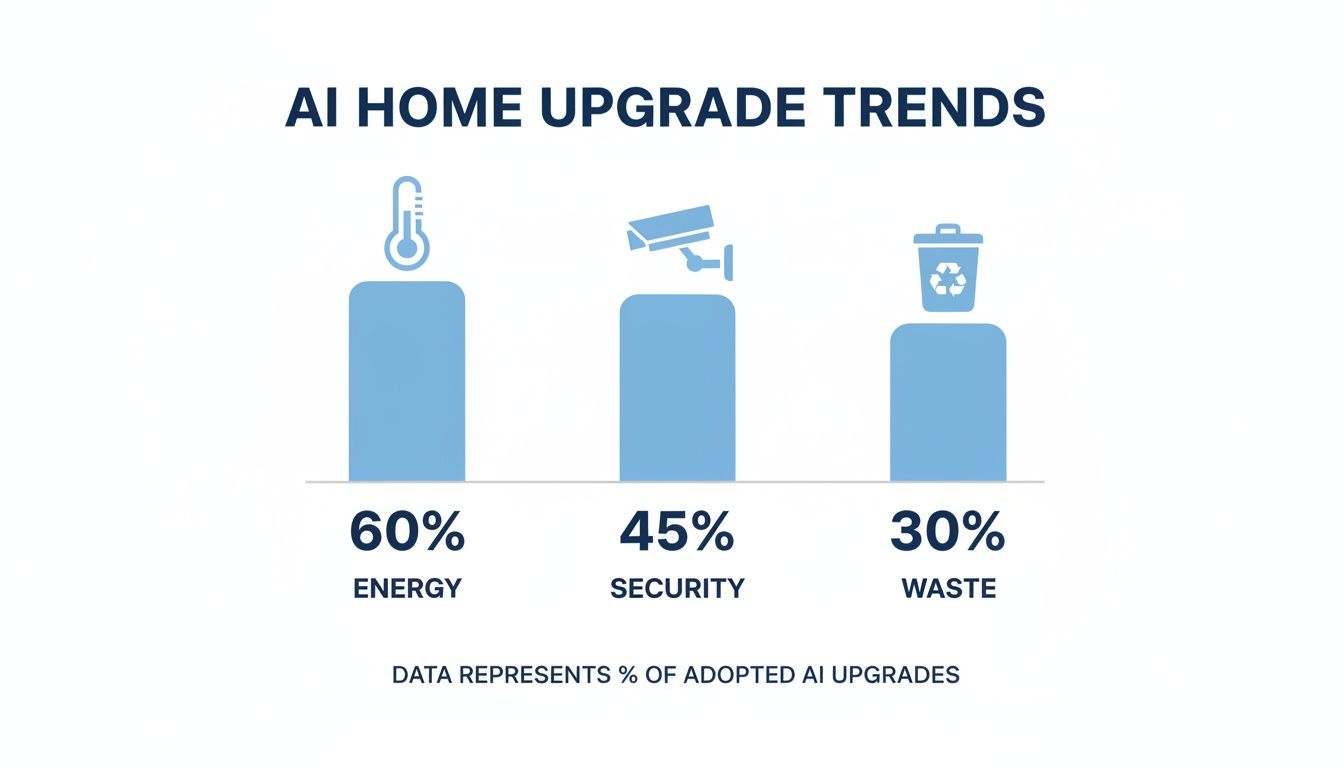
As this chart shows, homeowners are clearly prioritizing practical upgrades. Energy efficiency leads the pack, with security and waste reduction also being major areas where people are letting AI help out.
Global Usage Patterns and What They Mean
Looking at the map, you can see just how deeply AI is embedding itself into modern life. From Singapore’s high citizen engagement with AI to new apps making commutes easier, the data tells a pretty clear story.
A recent economic index revealed some surprising leaders in AI adoption. Israel is at the top in per-capita usage of one popular model, hitting 7x the expected level. Singapore follows at 4.57x, with Australia close behind at 4.10x.
The U.S. still holds the top spot for total usage at 21.6%, with a strong per-capita rate of 3.62x. While these numbers often track with national income, just like past tech waves, the sheer speed of AI adoption is something else entirely.
What’s fascinating is how these global trends are driven by billions of individual choices. Every time someone uses an AI-powered translation app or a smart navigation system, they contribute to a massive data set that makes these tools even better for everyone, everywhere.
Ultimately, understanding these larger economic and cultural forces gives us some much-needed context. The AI you use every day isn't just a gadget; it's the result of a global movement that is redefining how we live, work, and connect across borders.
How AI Is Becoming Your Professional Partner

The talk around AI at work has often felt like a doom-and-gloom story about job replacement. But what's actually happening is far more interesting—and collaborative. Instead of pushing you out, AI is stepping in as a surprisingly capable partner, designed to enhance your skills and take the tedious, repetitive work off your plate.
This partnership lets you zero in on what people do best: thinking strategically, solving complex problems, and connecting with others. AI can handle the grunt work, acting as your personal analyst, editor, and scheduler, all at the same time.
Augmenting Your Daily Workflow
One of the most immediate ways AI in everyday life is changing our careers is through the smart assistants quietly being built into the software we already use. These tools are automating tasks that used to eat up hours of our day. Think of the writing assistants that do more than just fix typos; they can help you adjust the tone of an email to make sure it lands just right.
Data analysis is another area where AI shines. It can tear through massive spreadsheets, spot important trends, and whip up clear, visual reports in seconds. Suddenly, you can make decisions backed by data without needing a PhD in statistics.
And for anyone who's ever had to capture meeting notes, modern AI-powered transcription software is a game-changer. These tools can turn an hour-long discussion into a searchable text document, complete with who said what and a list of action items.
Traditional vs AI-Powered Workflows
This shift is more than just a speed boost; it’s a fundamental change in how we get things done. The old ways of working are being completely reimagined.
Just look at the difference:
| Task | Traditional Method | AI-Powered Method |
|---|---|---|
| Meeting Summaries | Manually re-listening to recordings and typing up notes. | Automated transcription and summarization that pull out key decisions. |
| Data Analysis | Building complex formulas and pivot tables in spreadsheets. | AI tools generate instant insights and visuals from raw data. |
| Professional Writing | Multiple rounds of self-editing and asking colleagues for feedback. | Real-time suggestions for clarity, tone, and grammar as you type. |
| Scheduling | The endless email chain trying to find a time that works for everyone. | AI assistants scan calendars and instantly find the best slot for all. |
This frees you up to stop managing low-value tasks and start focusing your energy on the kind of high-impact work that actually moves the needle.
The Evolving Job Market and New Opportunities
AI is no longer just a concept discussed in boardrooms; it's actively reshaping jobs and daily routines. The World Economic Forum predicts that while 85 million jobs might be displaced by 2025, a net gain of 12 million new roles will pop up in their place. We're already seeing this happen. The number of daily AI users has exploded from 116 million in 2020 to 314 million in 2024—that's a nearly threefold increase in just a few years.
The most valuable professional skill in the coming decade won't be competing with AI, but learning how to collaborate with it effectively.
This shift means new kinds of jobs are emerging, centered around AI strategy, ethics, and implementation. Companies desperately need people who can connect what the technology can do with what the business needs to achieve. As you see how AI and automation are reshaping the future workforce, it becomes clear that learning new skills is non-negotiable. Knowing how to prompt an AI, make sense of its output, and weave it into your daily work are the new must-have skills for staying relevant.
Navigating Privacy in an AI-Powered World

As we weave more AI into our daily routines, we have to talk about the trade-off. Convenience on one side, privacy on the other. The very thing that makes AI in everyday life so powerful—its ability to learn from our data—is also what opens up serious questions about how our personal information is handled.
Think about it. Every time you ask a voice assistant for the weather, get a movie recommendation, or tag a friend in a photo, you're feeding data into the system. This information is the fuel that helps AI models get smarter. But it begs the question: how do we get the good stuff from AI without losing control over our digital lives?
Understanding the Data Exchange
At its heart, using most AI services is a simple exchange. You give it data—like your search history, where you are, or what you buy—and it gives you back a personalized, smoother experience. It's a powerful setup, but it’s not a spectator sport. You have to be an active participant to keep it secure and fair.
The goal isn’t to ditch AI altogether. It’s about engaging with it wisely. You can keep control by making conscious choices about what you share and which services you trust, all while still getting the benefits.
This really just means taking a proactive stance. Instead of clicking "accept" on every pop-up without a second thought, it’s about making small, deliberate tweaks to your settings and habits. These simple moves can make a huge difference in protecting your privacy.
Practical Steps to Protect Your Digital Privacy
You don't need to be a tech wizard to take charge of your data. It all starts with being aware and taking a few simple steps. Regularly checking your settings and making informed decisions is the foundation of a more secure digital life.
Here’s a quick look at some common privacy settings and how you can shift from a passive approach to a proactive one.
| Privacy Concern | Passive Approach (Default) | Proactive Approach (Recommended) |
|---|---|---|
| App Permissions | Accepting all permissions an app asks for when you install it. | Reviewing permissions and turning off camera, mic, or location access for apps that don't truly need them. |
| Data History | Letting companies keep your voice and activity logs forever. | Setting your data history to auto-delete after a set time, like 3 or 18 months. |
| Ad Personalization | Allowing ad networks to follow you around the web to show you targeted ads. | Opting out of ad personalization in your Google, Apple, and social media accounts. |
| Location Tracking | Leaving location services on for all your apps, all the time. | Limiting location access to "While Using the App" or "Ask Next Time" to stop constant tracking. |
Staying Alert to New Challenges
Managing your data is one thing, but new AI tools bring new problems. Take deepfakes, for example—those hyper-realistic but totally fake videos or audio clips that are popping up more often. The best way to spot them is to be skeptical, especially if something you see online seems designed to make you angry or scared.
By making these practices a habit, you can navigate our modern world with a lot more confidence. If you want to dive deeper, you can see what experts predict for online security in our article on cybersecurity in 2025. Staying informed is your best defense.
So, What's Next on Your AI Journey?
We've covered a lot of ground, and one thing is clear: AI isn't some far-off sci-fi concept anymore. It's already here, working quietly in the background to make our homes smarter, our jobs a bit easier, and our days run more smoothly.
But here’s the thing about powerful tools: their real impact comes down to how we decide to use them.
It's about being deliberate. This means choosing to protect your privacy, thinking critically about the information AI feeds you, and staying curious about how these systems actually work. When you do that, you stop being just a user and start becoming someone who actively shapes how technology fits into your life.
Keep Learning, Stay Curious
The best way to feel comfortable in a world with AI is to simply stay curious. As the tech grows and changes, keeping up with the basics will help you spot new ways it can help you reach your goals. You don't need to become a programmer, but a little knowledge goes a long way in using these tools safely and getting the most out of them.
And this isn't a niche trend. AI is going mainstream, fast. A recent Microsoft AI Diffusion Report found that AI use has climbed to 14.1% among working adults in the Global South and 24.7% in the Global North. That means roughly one in six people across the globe are already using AI for work and learning. The momentum is real. You can dive into the details by reading the full Microsoft research report.
Embracing AI isn't about letting technology take the wheel. It's about intentionally guiding it to enhance your life, support your growth, and free up your time for what truly matters.
Ultimately, this intentional mindset puts you in control. It allows you to weave AI into your life in a way that feels right for you and aligns with your values. The goal is a future where technology serves you—not the other way around. By staying curious and making smart choices, you can make sure the AI in your life is a positive force, helping you build a more balanced and successful future.
Frequently Asked Questions About AI in Everyday Life
1. What are the most common examples of AI I use daily?
You interact with AI constantly. Common examples include spam filters in your email, personalized recommendations on Netflix and Spotify, predictive text on your smartphone keyboard, navigation apps like Google Maps that adjust for traffic, and voice assistants like Siri and Alexa.
2. How can I start using AI to be more productive at work?
Start small. Identify a repetitive task and find an AI tool for it. For example, use an AI writing assistant to draft emails, an AI transcription service to summarize meetings, or a smart calendar assistant to schedule appointments automatically. These tools handle the busywork so you can focus on more strategic tasks.
3. Is my data safe with AI-powered devices like smart speakers?
Reputable companies use encryption to protect your data, but you must be proactive. Regularly review your privacy settings, use strong, unique passwords, and choose to auto-delete your voice command history. Avoid discussing highly sensitive information near an active smart device.
4. What is the difference between AI and machine learning?
Think of Artificial Intelligence (AI) as the broad goal of creating intelligent machines. Machine Learning (ML) is a specific, powerful method to achieve AI. Instead of being explicitly programmed, ML systems learn patterns from vast amounts of data to make predictions and decisions. Most AI you use today is powered by machine learning.
5. How does AI personalize my online shopping experience?
E-commerce sites use AI to analyze your browsing history, previous purchases, and even items you've clicked on. This data fuels personalized product recommendations ("You might also like…"), targeted ads, virtual try-on features for clothes, and customer service chatbots that can answer your questions instantly.
6. Can AI help me manage my personal finances?
Yes, many modern budgeting apps use AI to automatically categorize your spending, identify recurring subscriptions you might have forgotten, and analyze your financial habits to offer personalized savings tips. Some can even help you find ways to improve your credit score.
7. How will AI change healthcare in the near future?
AI is already making a significant impact. It's used to analyze medical scans like X-rays and MRIs with greater accuracy than the human eye, predict disease outbreaks, and help doctors create personalized treatment plans based on a patient's unique genetic makeup and lifestyle.
8. Is the AI in my car listening to my conversations?
In-car voice assistants are designed to listen for a specific "wake word" (e.g., "Hey, Mercedes") before they start processing commands. They do not continuously record and upload all your conversations. However, it's always wise to check the manufacturer's privacy policy to understand exactly how your data is used.
9. Can I trust news articles written by AI?
It depends entirely on the source. Established news organizations use AI for data-heavy tasks like reporting on financial earnings or sports scores, and their work is fact-checked. Be very cautious of AI-generated content from unknown or untrustworthy sources, as it can be used to create convincing but false information.
10. How do I turn off AI features if I don't like them?
While you can't "turn off AI" itself, you can control many of the features it powers. For example, you can go into your app settings to disable personalized ad recommendations, turn off predictive text on your keyboard, or limit location-based suggestions. You are in control of how these features interact with your life.
At Everyday Next, we believe that the more you understand technology, the better you can use it to your advantage. Explore our guides to stay up to speed on the innovations that are shaping our world. https://everydaynext.com
Related Posts

Previous Post
Next Post