
10 Beginner Investing Strategies To Build Wealth in 2026
Starting your investment journey can feel like navigating a complex maze. With countless terms, charts, and opinions swirling around, the biggest challenge is often just knowing where to begin. The good news is that you don't need a finance degree or a massive starting sum to build long-term wealth. The key is to find simple, sustainable, and proven beginner investing strategies that align with your personal goals, risk tolerance, and lifestyle. This isn't about chasing risky "get rich quick" schemes; it's about establishing consistent habits that allow your money to grow steadily over time.
This guide is designed to cut through the noise. We will break down ten distinct and actionable approaches to investing, moving beyond generic advice to give you a clear roadmap. For each strategy, you'll find a straightforward explanation of what it is, who it's best suited for, and its specific pros and cons. More importantly, we provide simple, step-by-step instructions to help you get started immediately.
Whether you have $50 to spare each month or a larger lump sum to invest, one of these methods can serve as the perfect foundation for your financial future. To dive deeper into various approaches, explore some of the best investment strategies for beginners. Our goal is to equip you with the practical knowledge and confidence needed to turn your savings into a powerful wealth-building engine. Let's explore which strategy is the right fit for you and start building your portfolio today.
1. Dollar-Cost Averaging (DCA)
Dollar-cost averaging is one of the most powerful and accessible beginner investing strategies available. The core concept is simple: you invest a fixed amount of money at regular, scheduled intervals, regardless of what the market is doing. This disciplined approach removes the emotional guesswork of trying to "time the market."

By investing consistently, you automatically buy more shares when prices are low and fewer shares when prices are high. Over time, this can lower your average cost per share, smoothing out the impact of market volatility and reducing risk. It's a strategy that turns market downturns into opportunities rather than sources of panic.
Real-Life Example: Imagine you commit to investing $100 every month into an S&P 500 ETF.
- Month 1 (Market is High): The ETF share price is $50. Your $100 buys you 2 shares.
- Month 2 (Market Dips): The ETF share price drops to $40. Your $100 now buys you 2.5 shares.
- Month 3 (Market Recovers): The ETF share price is back to $50. Your $100 buys 2 more shares.
After three months, you've invested $300 and own 6.5 shares. Your average cost per share is approximately $46.15 ($300 / 6.5 shares), which is lower than the average market price over that period.
Who It's Best For
DCA is ideal for new investors who want a hands-off, automated way to build wealth over the long term. It’s also perfect for anyone who gets paid on a regular schedule (like bi-weekly or monthly) and wants to invest a portion of each paycheck.
Getting Started with DCA: A Simple Plan
- Choose Your Investment: Low-cost index funds or Exchange-Traded Funds (ETFs) like the Vanguard S&P 500 ETF (VOO) are popular choices because they provide instant diversification.
- Pick Your Amount & Frequency: Decide how much you can comfortably invest and how often. Consistency is key, so even $50 a month is a great start.
- Automate Everything: Open an account with a brokerage like Vanguard, Fidelity, or a robo-advisor like M1 Finance. Set up an automatic transfer from your bank account to your investment account on a recurring schedule.
- Stay the Course: The most critical step is to resist the urge to stop your contributions when the market drops. Those are the times your fixed dollar amount buys the most shares, potentially accelerating your long-term growth.
Key Insight: The power of DCA isn't in finding the perfect investment; it's in the unwavering discipline of consistent investing over many years. Your workplace 401(k) is a perfect real-world example of DCA in action.
2. Index Fund Investing & The Lazy Portfolio Approach
Index fund investing is a cornerstone of smart, long-term wealth building, popularized by Vanguard founder Jack Bogle. Instead of picking individual stocks, you buy a single fund that holds hundreds or thousands of stocks, aiming to match the performance of a major market index like the S&P 500. This provides instant diversification at an incredibly low cost. The "lazy portfolio" is the practical application of this idea: using a small number of these index funds to build a simple, diversified, and hands-off investment plan.
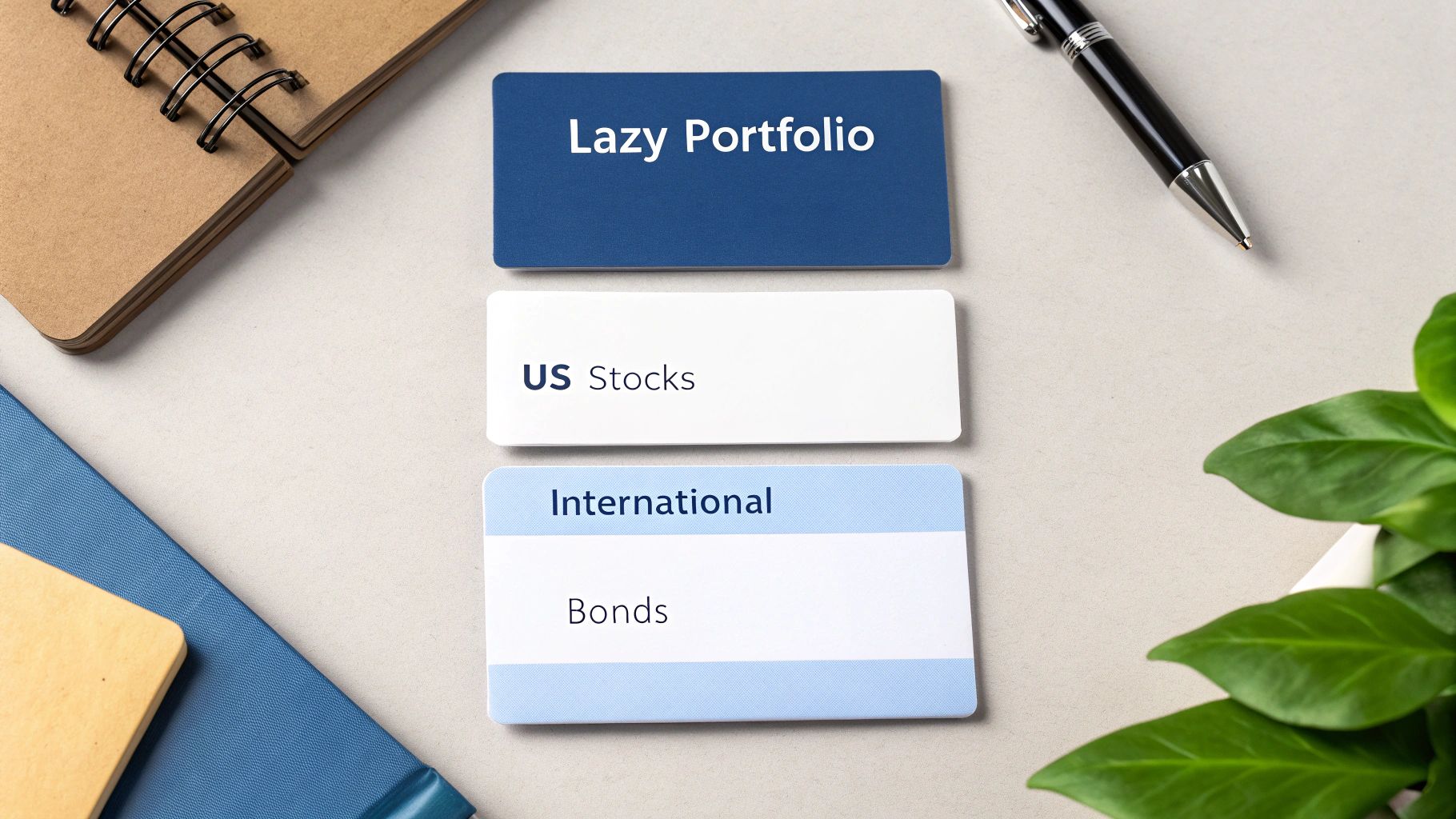
This strategy is one of the most effective beginner investing strategies because it eliminates the need for complex stock analysis and frequent trading. By owning a slice of the entire market, your success is tied to the long-term growth of the economy as a whole, rather than the fortunes of a few individual companies. It is a proven, 'set it and forget it' method for building wealth over time.
Who It's Best For
This approach is perfect for investors who want broad market exposure without the high fees or the stress of stock picking. It is ideal for anyone seeking a simple, low-maintenance, long-term strategy that has historically outperformed the majority of actively managed funds. If you value simplicity and evidence-based investing, this is for you.
Getting Started with a Lazy Portfolio: A Simple Plan
- Choose Your Allocation: A classic starting point is the "three-fund portfolio." A common allocation is 60% in a US Total Stock Market Index Fund, 30% in an International Stock Market Index Fund, and 10% in a Total Bond Market Index Fund.
- Select Your Funds: Open an account at a low-cost brokerage like Vanguard, Fidelity, or Schwab. Find their index funds or ETFs that track these broad markets. Look for funds with an expense ratio below 0.10%. Examples include VTSAX (Vanguard Total Stock Market Index Fund) or FZROX (Fidelity ZERO Total Market Index Fund).
- Invest and Automate: Make your initial investment according to your chosen percentages. Then, set up automatic contributions to continue investing regularly, similar to the dollar-cost averaging strategy.
- Rebalance Annually: Once a year, check if your portfolio's percentages have drifted away from your target. If so, sell some of the overperforming assets and buy more of the underperforming ones to get back to your original allocation. This enforces a "buy low, sell high" discipline.
Key Insight: The goal of index fund investing isn't to beat the market; it's to be the market. Over the long run, this simple ambition is a winning strategy that puts the power of compounding and broad economic growth to work for you.
3. The 50/30/20 Budget Rule Applied to Investing
While not strictly an investment strategy, the 50/30/20 budget rule is a powerful foundational framework that makes consistent investing possible. Popularized by Senator Elizabeth Warren, this simple rule allocates your after-tax income into three categories: 50% for needs, 30% for wants, and 20% for savings and investments. This structure creates a clear, automated path for your money.
The magic of this rule for beginner investing strategies is the dedicated 20% slice. By earmarking this portion of your income specifically for financial goals, you eliminate the guesswork and ensure you are always building your future. It turns investing from an afterthought into a non-negotiable part of your financial life, creating the discipline needed for long-term success.
Who It's Best For
This framework is perfect for beginners who struggle with knowing how much to invest or feel like they don't have enough money left over at the end of the month. It provides an immediate, actionable plan for anyone looking to create a structured and sustainable financial system.
Getting Started with the 50/30/20 Rule: A Simple Plan
- Calculate Your After-Tax Income: Look at your pay stub to find your net pay, which is your income after taxes and other deductions. For example, if your net pay is $4,000 per month, your targets are: $2,000 (Needs), $1,200 (Wants), and $800 (Savings/Investments).
- Track Your Spending: For one month, use a budgeting app like Mint or YNAB to track every expense. Categorize them into Needs (rent, groceries, utilities), Wants (dining out, subscriptions), and Savings (401k contributions, IRA funding).
- Automate Your 20%: This is the most crucial step. Set up an automatic transfer to move your 20% into a separate high-yield savings account or directly into your brokerage account on the day you get paid. This "pay yourself first" approach ensures the money is invested before you can spend it.
- Review and Adjust: Your initial spending might not align perfectly. Look for areas in the "Wants" category to trim back so you can hit your 20% savings goal. Revisit your budget quarterly or whenever your income changes.
Key Insight: The 50/30/20 rule isn't about restriction; it's about intention. By creating a deliberate plan for your money, you give every dollar a job and guarantee that your financial future is always a top priority.
4. Robo-Advisor Investing
Robo-advisor investing is a modern, automated approach to portfolio management that uses sophisticated algorithms instead of human financial advisors. These digital platforms build and manage a diversified investment portfolio for you based on your financial goals, timeline, and risk tolerance, making it one of the most hands-off beginner investing strategies available.
The process is remarkably simple. You answer a questionnaire about your financial situation and investment objectives, and the robo-advisor constructs a portfolio, typically using low-cost ETFs. It then automatically handles tasks like rebalancing your portfolio to maintain your target asset allocation and, in some cases, performs tax-loss harvesting to improve tax efficiency.
Who It's Best For
Robo-advisors are perfect for investors who want a professionally managed portfolio without the high fees of a traditional financial advisor. They are ideal for anyone who feels overwhelmed by choosing individual investments and prefers a "set-it-and-forget-it" method that is both accessible and based on proven investment theories.
Getting Started with a Robo-Advisor: A Simple Plan
- Choose Your Platform: Research top robo-advisors like Betterment, Wealthfront, or Schwab Intelligent Portfolios. Compare their fee structures, account minimums, and features like tax-loss harvesting.
- Complete the Questionnaire: Be honest about your risk tolerance, income, and long-term goals (e.g., retirement, buying a house). Your answers are crucial for building the right portfolio for you.
- Fund Your Account: Link your bank account and make your initial deposit. Many platforms have very low or no minimums, so you can start with a small amount.
- Set Up Automatic Deposits: Treat your robo-advisor account like your 401(k). Automate regular contributions to take advantage of dollar-cost averaging and build your wealth consistently without thinking about it.
Key Insight: Robo-advisors democratize professional investment management. They provide access to sophisticated strategies like automatic rebalancing and tax-loss harvesting that were once only available to wealthy investors.
5. High-Yield Savings and CD Ladder Strategy
While not a stock market strategy, combining high-yield savings accounts (HYSAs) and a Certificate of Deposit (CD) ladder is a foundational component of a sound financial plan. This conservative approach focuses on capital preservation and predictable returns, making it an excellent strategy for money you can't afford to lose, like your emergency fund or savings for a short-term goal.
The strategy involves two parts. First, you keep your most liquid cash (typically 3-6 months of living expenses) in an HYSA, which offers significantly higher interest rates than traditional savings accounts. Second, you build a "CD ladder" by dividing a lump sum of money across multiple CDs with staggered maturity dates, such as every three, six, or twelve months. As each CD matures, you can either use the cash or reinvest it into a new CD at the end of the ladder, maintaining the cycle.
This two-pronged approach ensures your emergency cash is accessible while allowing another portion of your savings to earn higher, fixed interest rates in a secure way. It provides a stable base from which you can confidently pursue other beginner investing strategies for long-term growth.
Who It's Best For
This strategy is perfect for risk-averse beginners, individuals building their emergency fund, or anyone saving for a specific short-term goal (like a down payment on a house) within the next one to five years. It provides stability and peace of mind.
Getting Started with HYSAs and CD Ladders: A Simple Plan
- Open a High-Yield Savings Account: Research online banks like Ally Bank, Marcus by Goldman Sachs, or Capital One. They consistently offer competitive rates. Start by funding it with at least 3-6 months' worth of essential living expenses.
- Plan Your CD Ladder: Decide on your ladder's length and "rungs." For a simple one-year ladder with quarterly access, you could divide $4,000 into four $1,000 CDs with 3-month, 6-month, 9-month, and 12-month terms.
- Shop for the Best CD Rates: Use rate-comparison websites to find the best CD rates, which are often at different banks than the best HYSA rates. Open the CDs according to your plan.
- Manage and Reinvest: As each CD matures, you can decide if you need the cash. If not, reinvest it into a new 12-month CD to keep your ladder going and continue capturing the best available long-term rates.
Key Insight: The goal here isn't to generate massive wealth, but to protect your financial foundation. Having a secure, high-interest home for your short-term savings gives you the confidence to take appropriate risks with your long-term investments in the stock market.
6. Target-Date Fund Investing
Target-date funds are a brilliant "set it and forget it" solution designed to simplify retirement investing. The core idea is that you pick a fund with a year in its name that roughly matches when you plan to retire. The fund then handles all the complex work of asset allocation and rebalancing for you.
Early in your career, the fund is aggressive, holding mostly stocks to maximize growth. As you get closer to your target retirement date, it automatically becomes more conservative, shifting its holdings from stocks to bonds. This "glide path" approach helps protect your savings from market volatility as you near the time you'll need the money. It's a fantastic, hands-off approach among beginner investing strategies.
Who It's Best For
This strategy is perfect for investors who want a completely hands-off way to save for retirement. It's especially well-suited for those who feel overwhelmed by choosing individual investments or don't have the time or desire to manage and rebalance their own portfolio. They are a common default option in workplace 401(k) plans for this reason.
Getting Started with Target-Date Funds: A Simple Plan
- Find Your Retirement Year: Estimate the year you plan to retire (e.g., if you plan to retire around 2055, you’d look for a 2055 fund).
- Choose Your Fund: Look for options in your 401(k) or IRA. Popular choices include the Vanguard Target Retirement series or Fidelity Freedom Index funds. Pay close attention to the expense ratio; lower is better.
- Invest Consistently: Set up automatic contributions from your paycheck or bank account. The power of these funds is magnified when combined with consistent investing over many years.
- Trust the Process: Let the fund do its job. Avoid the temptation to switch funds or sell based on short-term market news. The fund is designed to navigate market cycles for you.
Key Insight: Target-date funds solve one of the biggest challenges for new investors: asset allocation. They automatically manage your risk level, freeing you from the complex task of rebalancing a portfolio yourself.
7. Dividend Investing and Dividend Growth Strategy
Dividend investing is a strategy focused on building a portfolio of stocks or funds that pay out a portion of their earnings to shareholders as regular cash payments, known as dividends. This approach provides a steady stream of passive income, which can be spent or, more powerfully, reinvested to buy more shares and accelerate wealth through compounding.
A popular variation is dividend growth investing, which specifically targets companies that have a long history of not just paying dividends, but consistently increasing them year after year. These companies, often called "Dividend Aristocrats" or "Dividend Kings," tend to be stable, well-established businesses. This strategy provides a growing income stream that can help outpace inflation over time.
Who It's Best For
This strategy is excellent for investors seeking a reliable source of passive income, especially those nearing or in retirement. It's also suitable for long-term investors who appreciate the dual benefit of receiving regular cash flow while also having the potential for the underlying stock to appreciate in value.
Getting Started with Dividend Investing: A Simple Plan
- Choose Your Investment: For beginners, starting with a dividend-focused ETF is a safer approach than picking individual stocks. The Vanguard Dividend Appreciation ETF (VIG) is a popular choice that holds a diversified portfolio of companies with a history of increasing their dividends.
- Research Key Metrics: If you venture into individual stocks like Coca-Cola or Johnson & Johnson, look beyond just the dividend yield. Research the payout ratio (the percentage of earnings paid as dividends) to ensure it's sustainable, and check the company's history of dividend growth.
- Automate Reinvestment: Most brokerages offer a Dividend Reinvestment Plan (DRIP). Activating this automatically uses your dividend payments to purchase more shares of the same stock or fund, often without a commission. This is a powerful, hands-off way to compound your investment.
- Avoid Yield Traps: Be cautious of companies with an unusually high dividend yield. This can be a red flag that the company is in financial trouble and the dividend might be cut. Stability and a history of growth are more important than the highest possible yield.
Key Insight: The true magic of this beginner investing strategy isn't just the income you receive today; it's the growing income stream you can build for tomorrow by focusing on quality companies and reinvesting their payouts.
8. Micro-Investing and Fractional Share Investing
Micro-investing is a game-changing strategy that breaks down the barriers to entry for new investors. It allows you to invest very small amounts of money, often just a few dollars or even cents at a time, by purchasing fractional shares of stocks and ETFs. This means you can own a piece of a company like Amazon or Google without needing to buy a full, expensive share.

Popularized by apps like Acorns and M1 Finance, this approach often uses clever features like "round-ups," where your everyday purchases are rounded up to the nearest dollar, and the spare change is automatically invested. By turning small, almost unnoticeable amounts into investments, it helps build a powerful and consistent saving habit without impacting your budget.
Who It's Best For
Micro-investing is perfect for absolute beginners, students, or anyone with a limited budget who feels intimidated by traditional investment minimums. It's an excellent tool for those who want to learn the ropes of investing and build the habit of setting money aside regularly.
Getting Started with Micro-Investing: A Simple Plan
- Choose Your Platform: Select an app that fits your style. Acorns is great for automated round-up investing, while platforms like Robinhood or Public.com are ideal for buying fractional shares of specific companies with as little as $1.
- Link Your Accounts: Connect your primary checking account and debit/credit cards to the app. This enables features like automatic round-ups and recurring transfers.
- Start with Round-Ups: Activate the round-up feature to begin investing your spare change. This is the most painless way to start building your portfolio without feeling the financial pinch.
- Set a Small, Recurring Deposit: In addition to round-ups, set up a small weekly or monthly transfer, even just $5 or $10. This complements your micro-investments and accelerates your progress, establishing it as a core part of beginner investing strategies.
Key Insight: Micro-investing's true value isn't just about the money you accumulate; it's about the behavioral change it fosters. It transforms you from a spender into an investor, one penny at a time.
9. ESG (Environmental, Social, Governance) Investing
ESG investing is a strategy where you select investments based not only on their financial potential but also on the company's environmental, social, and governance practices. This approach allows you to align your portfolio with your personal values, supporting companies that demonstrate responsible and sustainable operations.
The idea is that companies with strong ESG credentials may be better managed, more resilient to future risks (like climate change regulations or consumer boycotts), and therefore positioned for long-term growth. It's a way to pursue financial returns while also contributing to positive change, moving beyond pure profit to consider a company's broader impact.
Who It's Best For
ESG investing is perfect for investors who want their money to reflect their ethical beliefs and make a positive impact on the world. It’s especially popular among younger generations, like Millennials and Gen-Z, who prioritize sustainability and corporate responsibility. It’s also great for anyone who believes that well-run, ethical companies are simply better long-term investments.
Getting Started with ESG Investing: A Simple Plan
- Define Your Values: What issues matter most to you? Is it renewable energy (Environmental), fair labor practices (Social), or transparent corporate leadership (Governance)? Knowing this helps you choose the right funds.
- Choose Your Investment: ESG-focused Exchange-Traded Funds (ETFs) are an easy entry point. Options like the Vanguard ESG U.S. Stock ETF (ESGV) or the iShares MSCI USA ESG Select ETF (SUSA) provide broad diversification while filtering for ESG criteria.
- Research the Fund's Criteria: Not all ESG funds are the same. Look at the fund's prospectus or website to understand exactly how it screens companies. Use third-party rating sites like Morningstar to see how your chosen fund stacks up.
- Invest and Monitor: Open an account with a major brokerage and purchase shares of your chosen ESG fund. Remember to review its performance and holdings periodically to ensure it still aligns with both your financial goals and your values.
Key Insight: ESG investing proves that you don't necessarily have to choose between your wallet and your values. The core idea is that sustainable and ethical practices are becoming crucial indicators of a company's long-term financial health and risk management.
10. Real Estate Investment Through REITs
Real Estate Investment Trusts (REITs) offer a powerful way to invest in income-producing properties without the hassle and expense of being a landlord. A REIT is a company that owns, operates, or finances real estate across various sectors, from apartment buildings and shopping malls to data centers and cell towers. By law, they must pay out at least 90% of their taxable income to shareholders as dividends, making them a popular choice for income-focused investors.
When you buy shares of a REIT, you are essentially buying a piece of a professionally managed portfolio of real estate assets. This strategy provides the benefits of real estate investing, like potential appreciation and rental income, with the liquidity and simplicity of trading a stock. It’s an accessible entry point into an asset class that was once reserved for the wealthy.
Who It's Best For
REITs are ideal for beginners who want to diversify their portfolios beyond traditional stocks and bonds. They are particularly attractive to investors seeking a regular income stream from dividends and those who want real estate exposure without the large capital outlay and management responsibilities of owning physical property.
Getting Started with REITs: A Simple Plan
- Choose Your Investment: For beginners, a diversified REIT ETF like the Vanguard Real Estate ETF (VNQ) is an excellent starting point. It provides instant exposure to hundreds of U.S. REITs. As you learn more, you might explore individual REITs like Realty Income (O), famous for its monthly dividends.
- Determine Your Allocation: Decide how much of your portfolio to allocate to real estate. A common guideline for this beginner investing strategy is between 5% and 15% to achieve diversification benefits without over-concentrating.
- Open and Fund an Account: Use a standard brokerage account from a provider like Fidelity, Schwab, or Vanguard. You can purchase REIT stocks and ETFs just like any other security. Consider holding REITs in a tax-advantaged account like a Roth IRA to maximize the benefits of their dividend distributions.
- Monitor and Rebalance: REITs can be sensitive to changes in interest rates. Keep an eye on economic trends and periodically rebalance your portfolio to ensure your real estate allocation stays aligned with your long-term goals.
Key Insight: The main advantage of REITs is providing liquidity and diversification to an otherwise illiquid asset class. You can gain exposure to massive commercial real estate projects with just a few clicks.
Beginner Investing Strategies — 10-Point Comparison
| Strategy | Implementation Complexity 🔄 | Resource Requirements ⚡ | Expected Outcomes ⭐📊 | Ideal Use Cases 📊 | Key Advantages 💡 |
|---|---|---|---|---|---|
| Dollar-Cost Averaging (DCA) | 🔄 Low — set recurring purchases, minimal oversight | ⚡ Low — regular small contributions; watch transaction fees | ⭐⭐⭐ — steady compounding, reduced timing risk | New investors, steady-income earners, automated plans | 💡 Discipline; volatility mitigation; easy automation |
| Index Fund Investing & Lazy Portfolio | 🔄 Very low — one-time allocation, occasional rebalance | ⚡ Low — low expense ratios; scalable with contributions | ⭐⭐⭐⭐ — market returns with low drag over time | Long-term retirement savers, hands-off investors | 💡 Broad diversification; very low fees; simple to scale |
| 50/30/20 Budget Rule (Investing) | 🔄 Low — budgeting framework, periodic review | ⚡ Variable — depends on income; recommends 20% to savings | ⭐⭐ — ensures contributions; outcomes depend on allocation | Beginners needing structure; household budgeting | 💡 Simplicity; habit formation; prevents overspending |
| Robo-Advisor Investing | 🔄 Low — automated setup, ongoing algorithmic management | ⚡ Low–moderate — small minimums; advisory fees (0.25–0.50%) | ⭐⭐⭐ — professional-style returns after fees; tax features | Busy professionals; those who want automation | 💡 Auto-rebalance; tax-loss harvesting; goal tools |
| High-Yield Savings & CD Ladder | 🔄 Low — simple ladder setup and renewals | ⚡ Low — cash reserves across banks for FDIC coverage | ⭐⭐ — predictable, guaranteed yields; low long-term growth | Emergency funds, short-term goals, risk-averse savers | 💡 Principal protection; regular liquidity; predictable income |
| Target-Date Funds | 🔄 Very low — choose date, fund adjusts automatically | ⚡ Low — single-fund solution in retirement accounts | ⭐⭐⭐ — age-adjusted allocations; retirement-focused outcomes | Retirement beginners, 401(k)/IRA default investors | 💡 One-fund diversification; automatic glide path |
| Dividend / Dividend Growth Investing | 🔄 Medium — requires screening and monitoring | ⚡ Moderate — meaningful income needs moderate capital | ⭐⭐⭐ — steady income plus potential long-term appreciation | Income seekers, retirees, cash-flow focused investors | 💡 Passive income; reinvestable dividends; lower volatility |
| Micro-Investing & Fractional Shares | 🔄 Very low — app-driven roundups and fractional buys | ⚡ Very low — invest from $1; platform availability varies | ⭐⭐ — builds habit; limited near-term wealth impact | Young investors, students, habit-building beginners | 💡 Low barrier to entry; fractional ownership; habit formation |
| ESG Investing | 🔄 Low–Medium — select funds with clear ESG criteria | ⚡ Low — ETFs available; may carry slightly higher fees | ⭐⭐ — values-aligned returns; performance varies by period | Values-driven investors, younger demographics | 💡 Aligns investments with values; potential risk mitigation |
| Real Estate via REITs | 🔄 Low–Medium — choose REITs/ETFs and monitor market cycles | ⚡ Moderate — capital for yield; tax treatment important | ⭐⭐⭐ — regular dividends and real-estate exposure; rate-sensitive | Investors seeking real estate income without property | 💡 Real estate diversification; liquidity; attractive yields |
Taking Your First Step: From Plan to Portfolio
You've just journeyed through ten distinct and powerful beginner investing strategies, each offering a unique pathway to building wealth. From the automated discipline of Dollar-Cost Averaging and Robo-Advisors to the set-and-forget simplicity of Target-Date Funds, the goal was to demystify the world of investing and present you with a full toolkit. We've explored how to align your portfolio with your values through ESG investing, generate passive income with REITs and dividend stocks, and even start with just a few dollars using micro-investing platforms.
The sheer volume of information can feel overwhelming, but the most crucial takeaway isn't to master every single strategy overnight. Instead, it's about empowerment and action. The real power lies in recognizing that you don't need to be a Wall Street expert to start growing your money. You simply need a plan that aligns with your financial situation, risk tolerance, and long-term goals.
Distilling the Core Principles
As you move from learning to doing, let’s boil everything down to three foundational principles that were woven through every strategy we discussed:
- Consistency is Your Superpower: Whether you choose to invest $50 a month with Dollar-Cost Averaging or allocate 20% of your income following the 50/30/20 rule, consistency is what transforms small contributions into significant wealth. The habit of investing regularly is far more impactful over the long term than trying to perfectly time the market.
- Time, Not Timing, Builds Wealth: Every strategy, from Index Fund Investing to Dividend Growth, relies on the magic of compound interest. The earlier you start, the more time your money has to work for you, with your earnings generating their own earnings. Resisting the urge to react to short-term market noise is a cornerstone of successful long-term investing.
- Alignment Drives Commitment: Your chances of sticking with a plan skyrocket when it feels right for you. Are you passionate about sustainability? ESG investing will keep you engaged. Do you prefer a completely hands-off approach? A Robo-Advisor or Target-Date Fund is your ideal match. Choosing a strategy that resonates with your personal values and lifestyle is the secret to staying the course.
Your Immediate Action Plan
Knowledge without action is just potential. The most important step you can take is the very next one. Don't let analysis paralysis stop you before you even begin. Here is a simple, three-step plan to transition from reader to investor, starting today:
- Choose Your "Starter" Strategy: Review the ten options. Which one felt the most intuitive and achievable for your current situation? Pick just one. You can always adapt and add more later. If you're still unsure, Robo-Advisor investing or a simple Index Fund strategy are excellent, well-rounded starting points.
- Open the Right Account: Based on your chosen strategy, open the necessary account. This could be a brokerage account (like Fidelity or Vanguard) for index funds, a specific Robo-Advisor platform (like Betterment or Wealthfront), or a high-yield savings account for a CD ladder. This process usually takes less than 15 minutes.
- Schedule Your First Transfer: This is the most critical step. Decide on a starting amount, no matter how small, and set up an automated, recurring transfer from your checking account. This single action puts the principle of consistency into practice and officially makes you an investor.
By taking these small, deliberate steps, you conquer the initial inertia and begin building a foundation for a more secure financial future. Remember, every expert investor was once a beginner. The journey you're starting today, built on the solid principles of these beginner investing strategies, is the most reliable path to achieving your long-term financial aspirations.
Frequently Asked Questions (FAQ)
1. What is the absolute best investing strategy for a complete beginner?
For most complete beginners, a combination of Dollar-Cost Averaging (DCA) into a low-cost Index Fund (like an S&P 500 ETF) or using a Robo-Advisor is ideal. These methods are simple, highly diversified, automated, and remove the stress of picking individual stocks or timing the market.
2. How much money do I need to start investing?
You can start with as little as $1. Modern strategies like Micro-Investing and Fractional Shares allow you to buy pieces of expensive stocks or ETFs for any dollar amount. The most important thing is not the amount you start with, but the habit of investing consistently.
3. Is it safe to invest in the stock market?
All investing involves risk, including the potential loss of principal. However, risk can be managed. Strategies like Index Fund Investing significantly reduce risk through diversification (owning hundreds of stocks at once). Historically, despite short-term downturns, the stock market has consistently trended upward over the long term.
4. What is the difference between an index fund and a target-date fund?
An index fund passively tracks a specific market index (e.g., the S&P 500) and maintains a consistent allocation. A target-date fund is a "fund of funds" that holds various index funds and automatically adjusts its asset allocation over time, becoming more conservative as you approach your target retirement date.
5. Can I lose all my money in a REIT?
While REITs are considered a relatively stable investment due to being backed by physical real estate, they are still traded on the stock market and their value can fall. It is highly unlikely for a diversified REIT ETF (like VNQ) to go to zero, but individual REITs can face financial hardship or bankruptcy, just like any other company.
6. Do I need a financial advisor to start investing?
No. For beginners with straightforward goals, Robo-Advisors provide many benefits of a financial advisor (like portfolio management and rebalancing) at a much lower cost. As your financial situation becomes more complex, consulting a human advisor might become more valuable.
7. What's more important: paying off debt or investing?
It depends on the interest rate of the debt. A common guideline is to prioritize paying off high-interest debt (typically anything over 7-8%, like credit card debt) before investing aggressively. For low-interest debt (like a mortgage or federal student loans), it often makes sense to make minimum payments while also investing, as historical market returns have been higher than the debt's interest rate.
8. How are dividends taxed?
Dividends are typically taxed in the year they are received. "Qualified" dividends (from stocks you've held for a certain period) are taxed at lower long-term capital gains rates. "Non-qualified" or "ordinary" dividends are taxed at your regular income tax rate. Holding dividend-paying investments in a tax-advantaged account like a Roth IRA can eliminate this tax burden.
9. What is an "expense ratio" and why does it matter?
An expense ratio is an annual fee charged by funds (like index funds, ETFs, and target-date funds) expressed as a percentage of your investment. It matters immensely because this fee directly reduces your returns. A low expense ratio (e.g., below 0.10%) is a hallmark of a good beginner-friendly fund, as it allows you to keep more of your money working for you.
10. How often should I check my investments?
For long-term beginner strategies, it's best to check your portfolio infrequently—perhaps once a quarter or even once a year. Checking daily or weekly can lead to emotional decision-making based on normal market volatility. The goal of these strategies is to "set it and forget it," letting time and compounding do the heavy lifting.
Ready to continue your financial education with clear, actionable insights? At Everyday Next, we specialize in breaking down complex topics into simple, manageable steps to help you build a better future. Explore our resources and join a community focused on smart, practical growth at Everyday Next.
Related Posts


Previous Post
Next Post