Mastering How to Negotiate a Salary Increase: A Practical Guide
Negotiating a raise is a completely normal part of doing business. It's all about building a solid case for your value, clearly communicating that to your manager, and handling the conversation like the professional you are. A single successful negotiation can seriously change your long-term earnings, thanks to the power of compounding.
Why You Must Negotiate Your Salary
Let’s face it, asking for more money can feel awkward. But skipping this conversation is one of the most costly mistakes you can make in your career. The trick is to reframe it. This isn't a confrontation; it's a standard business discussion that shows you're confident and understand what you bring to the table.
Honestly, most managers and company leaders expect their best people to negotiate. When you handle it the right way, it signals that you're invested in your career and aware of how your work helps the company win. This isn't just about a bigger paycheck next month; it sets a higher baseline for all your future raises and job offers.
The Compounding Power of a Single Raise
Think about the long-term impact for a second. That $5,000 raise you secure early on isn't just a one-time bump. It compounds. Year after year, future raises are calculated from that higher number. Assuming a typical 3% annual raise, that one conversation could easily net you over $150,000 in extra earnings across a 20-year career.
This financial ripple effect is why learning to negotiate is such a critical skill. It’s not just about today’s pay; it’s about shaping your financial future. It shows you understand that building wealth isn’t just about money—it's about seeing and seizing these key moments.
A Framework for Empowerment
To ditch the fear and step into the conversation with confidence, you need a solid plan. This guide gives you a clear, actionable framework built on three core ideas. We’ll walk through each one, giving you the tools and even the exact words to use when you advocate for yourself.
- Building an Undeniable Case: This is your homework phase. You'll gather the hard data—market research, your quantified wins, and the direct impact you've had on the business. This turns your "ask" from a personal request into a logical business proposal.
- Mastering the Conversation: Here's where prep meets performance. We'll cover the best language to use, how to handle the inevitable "no" or "not right now," and how to keep the tone collaborative and professional from start to finish.
- Navigating Any Outcome: Whether the answer is "yes," "no," or "maybe," you'll have a clear strategy. We’ll show you how to handle each scenario to protect your professional relationships and position yourself for success down the road.
Building an Airtight Case for a Raise
Let's be honest: a successful salary negotiation is won long before you ever walk into that meeting. This isn't about just asking for more money because you feel you deserve it. It's about building a data-backed business case that makes your value impossible to ignore.
The whole point of this prep work is to shift the conversation from "I work hard" to "Here's exactly how my work has moved the needle for this company." You're turning a hopeful request into a compelling, professional proposal.
Quantify Your Wins, Not Just Your Work
I see this all the time—people describe their job duties instead of their impact. Your manager already knows what's on your job description; what they need to see is the value you’ve created. This means you have to get good at translating your day-to-day accomplishments into tangible business results.
Start by creating a personal "brag sheet." Go back over the last 6-12 months and document every major project or initiative you were part of. For each one, nail down your specific role and, most importantly, the outcome.
Here’s what that looks like in practice:
-
Instead of saying: "I managed our social media accounts."
-
You should say: "I grew organic social media engagement by 35% over two quarters, which led directly to a 15% jump in website traffic from those channels."
-
Instead of: "I helped organize the annual conference."
-
Try this instead: "I co-led logistics for our annual conference and negotiated with vendors to slash event costs by 12%. On top of that, we improved attendee satisfaction scores by 10% year-over-year."
See the difference? These specific, quantified achievements are the foundation of your entire argument. They’re the hard evidence that proves your worth.
Know Your Market Value Cold
Once you've got a handle on your internal value, it's time to look outward. What are other companies paying someone with your exact skills, experience, and in your city? Pulling in objective data from trusted sources gives your request instant credibility.
Fire up sites like Glassdoor, Levels.fyi (especially for tech), and Payscale. Don't just glance at the national average. Dig deep and filter by your specific location, industry, and years on the job to get a salary band that’s actually relevant to you. This shows you’ve done your homework and that your request is grounded in market reality, not just a number you pulled out of thin air.
This data-first approach is catching on. A recent study found that a staggering 57% of American workers regret not negotiating their pay. The takeaway here is crucial: you have to speak up to avoid that nagging 'what if.' Younger workers are really driving this shift—55% of Gen Z negotiated their last offer, compared to just 48% of Millennials. It’s a trend worth learning from.
Your Personal Contribution Scorecard
To really bring all your research together, you need to organize it into a simple, powerful document. Use this scorecard to map your specific achievements to tangible business value, creating the data-backed foundation for your negotiation. It’ll serve as your cheat sheet during the actual conversation, ensuring you don't forget any of your key selling points.
| Achievement or Project | My Specific Role | Quantifiable Business Impact (%, $, Time) | Skills Demonstrated |
|---|---|---|---|
| Q3 Client Retention Initiative | I designed and implemented a new client feedback system. | Increased client retention by 8% in six months, protecting an estimated $250k in annual revenue. | Project Management, Data Analysis, Client Relations |
| Website Redesign Project | I managed the content migration and SEO optimization for the new site. | Improved organic search traffic by 22% and reduced bounce rate by 15% post-launch. | SEO, Content Strategy, Technical Proficiency |
| Internal Process Improvement | I automated the weekly reporting process using a new software tool. | Saved the team approximately 5 hours of manual work per week, freeing up resources for higher-value tasks. | Process Automation, Efficiency, Problem-Solving |
With this scorecard in hand, you're no longer just telling your manager you deserve a raise—you're showing them precisely why. The skills you highlight here are also what you should be focusing on for your long-term career growth. To learn more, check out our guide on the top skills that will make your resume stand out.
When you walk into that room this prepared, you're not just asking. You're presenting an undeniable case built on solid facts.
Time for the Talk: Navigating the Negotiation Conversation
You’ve done the hard work. You've researched the market, built a rock-solid business case, and now it's time for the actual conversation. This is where all that preparation pays off, turning what could be a nerve-wracking meeting into a confident, professional dialogue about your value.
The real key here is to frame the discussion as a partnership, not a battle. Your tone and your first few sentences will set the stage for everything else. This is where strong communication skills really shine, helping you project confidence without coming across as demanding.
Think of your preparation in three distinct phases: first you research, then you put hard numbers to your impact, and finally, you document everything.
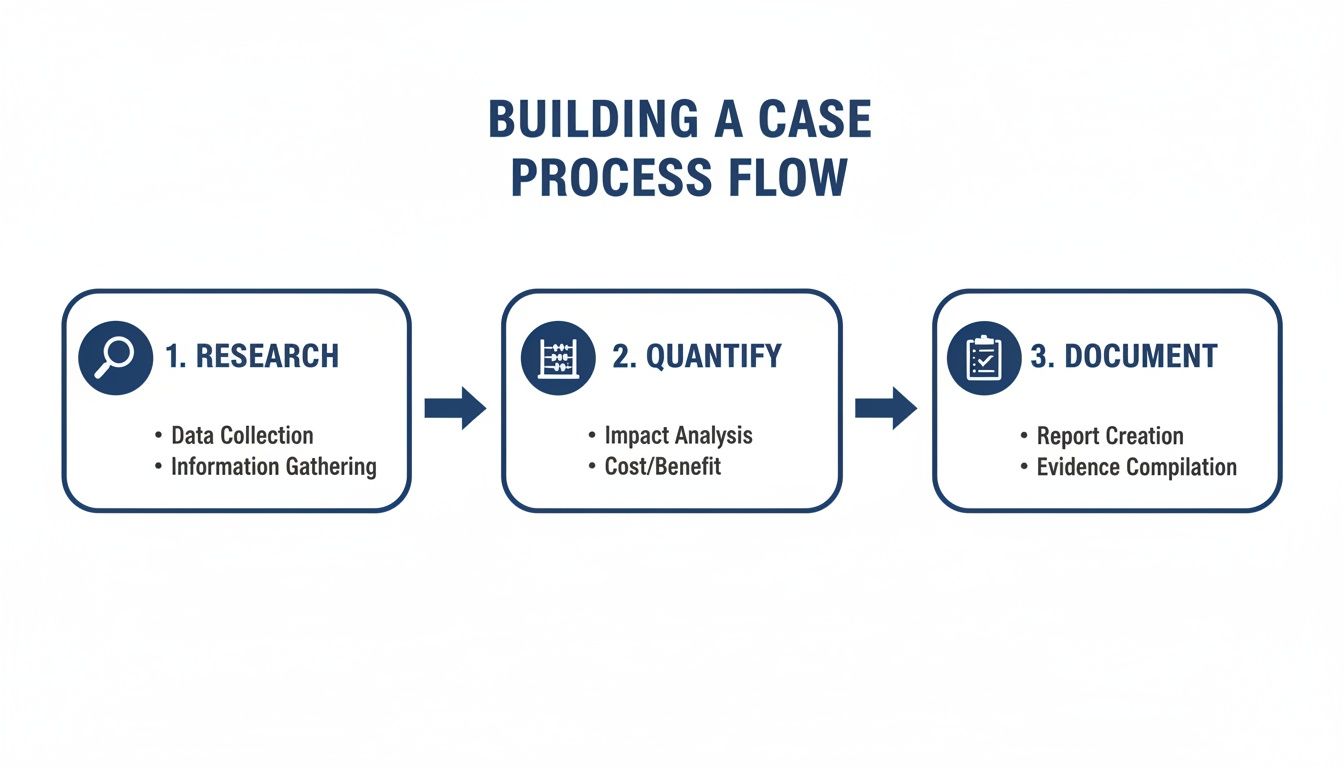
Each step logically flows into the next, building an argument for your raise that’s pretty tough to ignore.
Scripting Your Opener and Making the Ask
Walking into the room with a planned opening line can do wonders for your nerves and get the meeting started on the right foot. You want to sound genuinely enthusiastic about your job and your future at the company.
Give one of these collaborative openers a try:
- "Thanks for making the time. I'm really excited about where my role is headed, and I'd like to talk about my compensation to make sure it’s in line with my recent contributions."
- "Following the success of the [Project Name], I'm keen to discuss my career path here. Part of that for me is ensuring my salary reflects the level of responsibility I'm now handling."
Once you've set the stage, it's time to smoothly present your case. Pull out your notes—your "brag sheet"—and walk them through 2-3 of your most impressive achievements. Then, state your desired salary or range. Be direct and confident.
My Favorite Pro Tip: After you've stated your number, do the hardest thing possible: stop talking. Just be silent. It might feel awkward for a few seconds, but it gives your manager space to process. More importantly, it signals that you're confident in your request and you're waiting for a thoughtful response.
How to Handle Objections Like a Pro
Even with the most compelling case, you might hit a roadblock. Budgets are a real thing, and "no" is often the easiest first response for a manager. The way you handle this moment is everything.
Don't get defensive. Instead, treat an objection as an invitation to solve a problem together. This keeps the relationship positive and the negotiation alive. Honestly, many employers see the ability to negotiate well as a strength.
Consider this: research shows that 67% of procurement professionals successfully negotiated their salary. It's becoming the norm. And those who do negotiate see an average pay raise of 18.83%—a huge jump compared to the projected global average of just 4.5% for 2025. You can see more stats on negotiation success at Procurement Tactics. This isn't just you asking for more; it's a standard professional practice.
Let's game plan for the most common pushback you're likely to hear.
| Common Objection | What Not to Say (Reactive) | A Better Approach (Collaborative) |
|---|---|---|
| "The budget is really tight right now." | "But I've been working so hard." | "I understand there are constraints. Could we map out a timeline for when we could revisit my compensation, based on these contributions?" |
| "Your performance is good, but not quite there yet." | "What do you mean? I hit all my goals." | "Thanks for the feedback. Can you help me understand the specific metrics I need to focus on to reach that level in the next six months?" |
| "I need to talk to HR/my boss first." | "Okay, I'll just wait to hear back then." | "That makes sense. Should we schedule a quick follow-up for next week to touch base on their feedback?" |
| "We can only offer a 3% raise company-wide." | "That's not enough." | "I appreciate that there's a company-wide policy. Given my documented impact on [Project X], could we look at a one-time performance bonus or other compensation options?" |
By thinking through these scenarios ahead of time, you can stay cool and in control. Remember, the goal isn't just to get more money. It's to reinforce your image as a thoughtful, professional, and indispensable member of the team. This approach ensures that no matter the outcome, you handle the conversation with grace and actually strengthen your standing in the company.
What to Do When They Can’t Budge on Salary
You've done everything right. You built a rock-solid case, backed it with data, and timed your ask perfectly. But the answer on your base salary request is a firm "no."
Don't panic. This happens more often than you think, and it’s usually not personal. Often, a manager’s hands are tied by strict internal pay bands or a budget that’s already been locked in for the quarter. This isn't the end of the road; it's just a detour.

Experienced negotiators know that base salary is just one piece of the total compensation puzzle. When one door closes, you just have to know which other doors to try. This is your chance to get creative and negotiate for perks that can seriously improve your financial health and overall happiness at work.
How to Gracefully Pivot the Conversation
The trick is to accept their constraint without accepting defeat. You want to immediately shift the focus toward other solutions. This frames you as a collaborative partner who is invested in finding a win-win, not just an employee hung up on a single number.
Try saying something along these lines:
"I appreciate you being transparent about the budget constraints on base salary. I'm still really motivated to take on these new responsibilities and contribute at a higher level. Since a base increase isn't an option right now, could we talk about other ways to structure my compensation to reflect that added value?"
This simple pivot changes the entire dynamic. You’ve moved the conversation from a dead end into a creative brainstorming session, all while keeping things positive and forward-looking.
High-Value Alternatives to a Bigger Paycheck
Once you've opened the door to other options, be ready to suggest some. Managers often have more wiggle room with one-off expenses or non-cash benefits than they do with permanent salary bumps. Think about what matters most to you.
- Performance Bonuses: This is often the path of least resistance. Instead of a permanent raise, propose a one-time bonus tied to a clear, measurable achievement. For example, "What if we established a $5,000 bonus, payable upon the successful launch of the new platform by the end of Q4?"
- Extra Paid Time Off (PTO): Another week of vacation is gold. It can be worth thousands of dollars in real terms and is a powerful tool for preventing burnout. For the company, it’s often a low-cost concession.
- A Real Professional Development Budget: Don’t just ask for “training.” Ask for something specific. Propose that the company sponsor a key certification, cover the costs for an industry conference, or pay for an online course that will directly help you—and them. Frame it as an investment, not an expense.
- Stock Options or RSUs: If your company offers equity, this can be a huge opportunity. A larger grant of stock options or RSUs might have a far greater long-term payoff than the salary bump you were originally seeking. This is a bet on the company's future—and your role in it.
- Meaningful Work Flexibility: The ability to work from home, compress your week into four days, or simply have more control over your hours is a massive perk. As the hybrid work revolution shows, flexibility saves you real money on commuting and other daily costs, not to mention the value of a better work-life balance.
Comparing Salary vs. High-Value Perks
To figure out what to ask for, you need to weigh the short-term gains against the long-term impact. This table breaks down how different perks can serve your goals, giving you a wider range of options to bring to the table.
| Negotiation Point | Immediate Value | Long-Term Value / Impact | When This Is a Smart Ask |
|---|---|---|---|
| Performance Bonus | A lump-sum cash payment provides instant financial flexibility. | Does not compound like a salary increase but rewards high performance. | When the company has a "pay for performance" culture or you're leading a critical, time-bound project. |
| Extra PTO | More time for rest and travel improves immediate work-life balance. | Prevents burnout, boosts creativity, and keeps you engaged and productive. | When you feel overworked or know the company has flexible time-off policies. |
| Education Budget | Covers the cost of a course or certification you want now. | Builds valuable skills that increase your future marketability and earning potential. | When you've identified a specific skill gap that, once filled, will directly benefit the company. |
| Stock Options | Little immediate cash value. | Potential for significant financial gain if the company's stock price appreciates over time. | In a high-growth startup or a public company where you believe in the long-term vision. |
Ultimately, having a clear understanding of these alternatives makes you a much more effective negotiator. When you can’t get what you want in one area, you’ll have a ready-made list of other valuable options to secure.
What to Do After the Talk is Over
The conversation doesn't really end when you walk out of the room. What you do next—your follow-up—is just as important. It’s what locks in the result, keeps your professional relationship strong, and clears up any potential confusion down the line.
No matter the outcome—yes, no, or maybe—sending a quick, professional email is a must. It creates a written record of your discussion and shows you’re a pro, regardless of how things went.
When You Get a "Yes"
Fantastic news! But don't pop the champagne just yet. The final, crucial step is getting that "yes" down in writing to make it official.
Aim to send a thank-you email within 24 hours. Keep it brief and positive. The most important part is to gently re-state the specifics you agreed on. This simple action prevents any "misunderstandings" later.
Here’s a simple template for a "Yes":
Subject: Following Up on Our Conversation
Hi [Manager's Name],
Thanks again for your time today to discuss my compensation. I really appreciate you listening and supporting my growth here.
I'm thrilled to formally accept the new salary of [New Salary Amount], effective [Effective Date], as we discussed.
I’m genuinely excited for what's next and can't wait to keep contributing to the team's success.
Best,
[Your Name]
When the Answer is "No"
Hearing a flat-out "no" stings, there’s no doubt about it. But this isn't the end of the road. Think of it as a chance to pivot from rejection to a concrete plan for the future. Your follow-up needs to reflect that forward-looking attitude.
Start by thanking your manager for their time and honesty. Then, shift the focus to growth. Reiterate that you want to understand exactly what you need to do to get to a "yes" the next time you ask.
A "no" isn't a failure—it's an opportunity for clarity. When you ask for specific, measurable goals, you turn a disappointing moment into a clear career development plan.
When You're Left with a "Maybe"
Ah, the dreaded "maybe." This is often the trickiest response to handle because it leaves you in limbo. Your main goal here is simple: don't let the conversation just fade away.
Your follow-up needs to lock in a specific date and time to circle back. This shows you’re serious and organized, but it also respects that your manager might need to talk to HR or their own boss. A good follow-up keeps your request on their to-do list.
This kind of persistence is key in your career. It's the same principle you apply when you learn how to network like a pro in the digital age; consistent, professional follow-up is what gets results.
A Quick Guide to Your Follow-Up Strategy
Your tone and goal have to match the outcome. Sending the wrong kind of message can easily undo all the hard work you just put in.
| Outcome | Your #1 Goal | What to Do Next | Your Tone |
|---|---|---|---|
| Yes | Confirmation | Email a thank you and confirm the new salary and start date in writing. | Gracious & appreciative |
| No | Clarity | Ask for specific, measurable goals to achieve a raise in the next 6-12 months. | Professional & resilient |
| Maybe | Momentum | Get a firm date in the calendar for a follow-up meeting to get a final answer. | Patient but proactive |
Handling each of these situations with poise and a clear plan is the final piece of the puzzle. It ensures that no matter what happened in that room, you come out of the process in a stronger position than when you went in.
Frequently Asked Questions About Salary Negotiation
Here are answers to the 10 most common questions I hear from professionals getting ready to negotiate their salary. Having these scenarios thought through ahead of time will give you the confidence to handle whatever comes your way.
1. How much of a raise should I ask for?
A good starting point is 10-20% above your current salary, but your final number should be anchored in market research. Find the salary range for your role, location, and experience level using sites like Glassdoor and Levels.fyi. Always ask for a specific number at the top end of that range. This gives you room to negotiate down while still landing on a figure you're happy with. For example, if the market rate is $80k-$90k, ask for $90k.
2. When is the best time to ask for a raise?
Timing is crucial. The ideal time is 2-3 months before your company’s annual budget planning. Other strategic moments include:
- Immediately following a major professional win (e.g., closing a big deal, launching a successful project).
- During your annual performance review (give your manager a heads-up beforehand).
- When your responsibilities have significantly expanded beyond your original job description.
3. What if my boss says there's no budget?
This is the most common objection. Acknowledge the constraint ("I understand budget limitations") and then pivot the conversation to the future. Ask, "Could we set a timeline to revisit this in six months?" or "Are there other options, like a one-time performance bonus, that we could explore?" This keeps the dialogue open and positions you as a proactive problem-solver.
4. How do I handle negotiation if I find out a colleague makes more?
This is a delicate situation. Never mention your colleague by name. Use this information as motivation to do your own market research. Build your case based on your own quantifiable achievements and the external market data you’ve gathered. The conversation must remain focused on your value, not on office gossip.
5. Should I bring up a competing job offer?
This is a high-risk, high-reward tactic. Only mention another offer if you are 100% prepared to accept it if your current company says no. Using it as a bluff can destroy trust. If you are ready to leave, frame it professionally: "I've received another offer, but my preference is to stay here. I wanted to see if we could bridge the compensation gap."
6. Can I negotiate if I work remotely?
Absolutely. Your value is based on your results and skills, not your physical location. The negotiation principles are identical. However, be aware if your company uses a location-based pay scale and adjust your market research accordingly. Focus your case entirely on your impact and quantified achievements.
7. What's the biggest mistake people make during negotiations?
Getting emotional. The moment you let frustration or a sense of unfairness drive the conversation, you lose leverage. This is a business discussion about your value, not your personal worth. Stay calm, professional, and stick to the data you've prepared. Other common mistakes include not preparing data, talking too much after making your ask, and accepting the first offer.
8. How can I avoid sounding greedy?
Frame your request around mutual benefit and professional growth, not just personal gain. Use collaborative language like, "I'm excited about my future here and want to ensure my compensation aligns with my contributions," or "Based on the value I've delivered on Project X, I'd like to discuss my salary." This sounds confident and business-like, not demanding.
9. How soon can I ask for a raise after starting a new job?
The general rule is to wait at least six months, with one year being ideal. Your initial period should be focused on proving your worth and delivering exceptional results. The only major exception is if your role and responsibilities change dramatically soon after you're hired, making your original job description and salary obsolete.
10. What if the negotiation fails completely?
If you receive a firm "no" with no path forward, remain professional. Thank your manager for their time and consideration. Afterwards, reflect on the reason. Is it a temporary budget issue, or a sign that the company undervalues your contributions? If it's the latter, that "no" may be the signal you need to start exploring opportunities elsewhere.
At Everyday Next, we believe in empowering you with the knowledge to advance your career and build your wealth. For more insights on financial growth and personal development, visit us at https://everydaynext.com.
Previous Post
Next Post