Decoding Mark Carney’s Speech on a New World Order
When Mark Carney, the canadian politician and the former Governor of the Bank of England,economist spoke at Davos, he laid out a stark vision for the global economy. His speech, which many believe will be era-defining, argues that the comfortable, predictable period of a “rules-based international order” is gone for good. What’s replaced it, he said, is a “brutal reality” where powerful nations are now using economic ties as weapons. This guide breaks down the core concepts of the Mark Carney speech and what it means for middle powers, investors, and our collective future.
Breaking Down Mark Carney’s Davos Message
Carney’s speech was a no-nonsense take on where we stand today. His main point? We’re not just going through a “transition” but a fundamental “rupture” in how the world works. For years, he explained, the old system worked because it was a convenient story, propped up by American power, that kept things stable and predictable for middle powers like Canada and Australia.
But that deal is now off the table.
The Greengrocer Analogy: A Real-Life Example
To illustrate his point, Carney used a powerful analogy from Czech writer Václav Havel’s essay, The Power of the Powerless.
Imagine a greengrocer who puts a sign in his window every morning that says, “Workers of the world, unite!” He doesn’t believe it. His customers don’t believe it. He just does it to fly under the radar and signal he’s playing by the rules. Carney’s point is that for decades, “middle powers” have been doing the exact same thing—paying lip service to a rules-based order they knew was a fantasy.
Real-Life Example: Think of a country championing free trade principles at a global summit while simultaneously subsidizing its own domestic industries to give them an unfair advantage. This is a modern-day example of “living within a lie”—publicly supporting a system while privately undermining it for national gain.
“The system’s power comes not from its truth but from everyone’s willingness to perform as if it were true… It is time for companies and countries to take their signs down.”
This is Carney’s central challenge. He’s saying that pretending the old system still works is a dangerous game when economic dependency can be turned against you at any moment. For example, the largest exporters of 2023 now have to navigate a world where their trade routes and supply chains are seen as strategic weaknesses. We explored this very issue in our analysis of their impact on the global economy.
Why The Old Global Order Is Broken
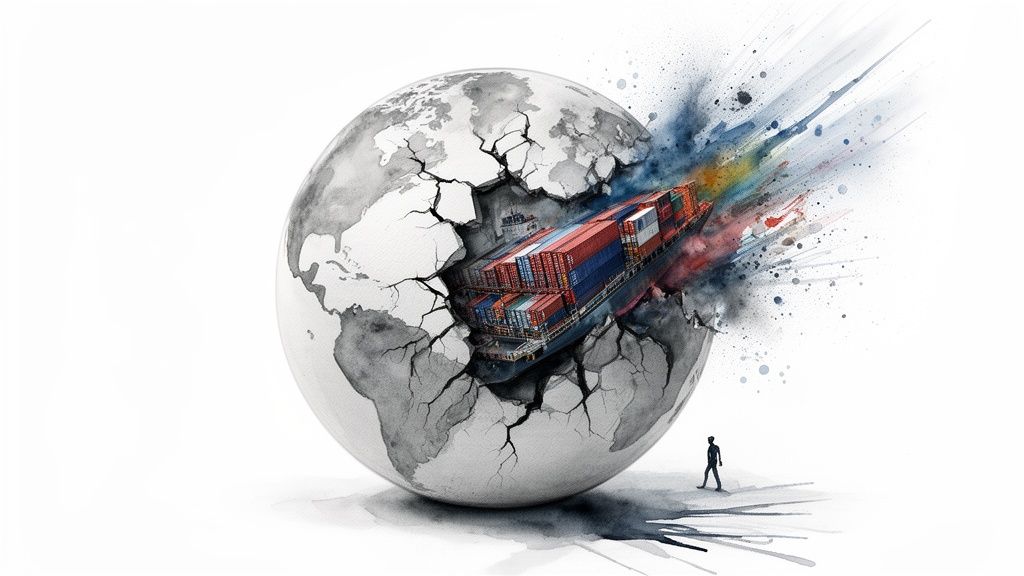
Mark Carney gets straight to the point in his speech: the world is seeing a fundamental break from the past. He calls it a “rupture, not a transition.” For decades, we all bought into the idea that global economic integration was a win-win for everyone. That era, he argues, is definitively over.
At the heart of this breakdown is how economic interdependence has been turned into a weapon. The very connections that were supposed to build cooperation are now being used as tools of coercion.
“You cannot ‘live within the lie’ of mutual benefit through integration when integration becomes the source of your subordination.”
This is a massive shift, and it means the old playbook is useless. The pillars that held up the global order are crumbling under the strain of this new, more confrontational reality.
The New Tools of Economic Warfare
In this new world, economic tools are being wielded for geopolitical ends. This isn’t just an abstract theory; you can see it playing out right now.
- Tariffs as Leverage: Tariffs are no longer just about protecting local industries. They’ve become a go-to weapon in geopolitical standoffs. To get a better sense of this, you can learn more about how new trade policies could look in 2025 and what that might mean for the global economy.
- Financial Infrastructure as Coercion: Cutting off a country’s access to global financial systems through sanctions is a powerful way to isolate it from the rest of the world.
- Supply Chains as Vulnerabilities: A nation’s dependence on another for essential goods—whether it’s microchips or medicine—is no longer just an economic reality. It’s a strategic weakness waiting to be exploited.
Real-Life Example: The recent “chip wars,” where the US restricted China’s access to advanced semiconductor technology, is a prime example of using supply chains as a weapon. This move was not just about economics; it was a strategic action to slow a rival’s technological and military advancement. This directly impacts global tech markets and forces other countries to choose sides. Carney’s speech points out how these shifts are changing the meaning of traditional economic signals. For a deeper dive into this, it’s worth understanding the weakening of currency and its effect on asset values.
Why Multilateral Institutions Are Fading
One of the biggest casualties of this rupture, as Carney lays out, is the decline of the very institutions built to manage the old system. The organizations that smaller countries once counted on for protection are finding it harder and harder to stay relevant.
| Institution | Old Role (The “Lie”) | New Reality (The “Rupture”) |
|---|---|---|
| World Trade Org (WTO) | Enforce fair and predictable global trade rules. | Routinely sidestepped or ignored in major trade fights. |
| United Nations (UN) | Provide collective security and resolve conflicts. | Often deadlocked by great power rivalries and vetoes. |
| Climate Pacts (COP) | Drive global cooperation on climate change. | Progress gets bogged down by national interests and competition. |
This institutional decay leaves middle-power and smaller countries in a tough spot. When the rules don’t protect you anymore, Carney warns, you have no choice but to protect yourself. The result is a world where every nation feels the need to build its own walls, which ultimately makes us all poorer, more vulnerable, and less secure.
A New Game Plan for Middle Powers
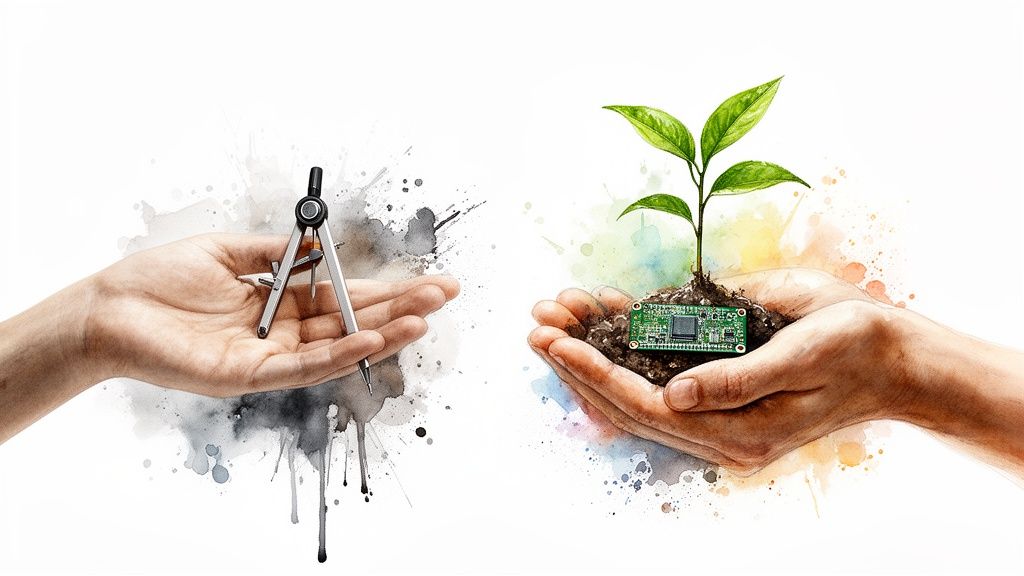
Mark Carney didn’t just spend his time at Davos pointing out the problems; he came with a game plan for countries stuck between the world’s giants. He borrows a phrase from Czech playwright and president Václav Havel, calling his strategy “living in truth.” It’s a powerful idea: stop pretending and start acting with a dose of hard-nosed realism.
The first step? Middle powers need to admit that the old “rules-based international order” isn’t what it used to be. They have to call the new reality what it is—a time of fierce competition where the biggest players are more than willing to use economic ties as a weapon.
“The powerful have their power. But we have something too – the capacity to stop pretending, to name reality, to build our strength at home, and to act together.”
This isn’t a call for countries to retreat into isolation. Far from it. Carney’s strategy is about building up real strength and independence so nations can deal with the world on their own terms, not as junior partners.
Getting Real with “Values-Based Realism”
At the heart of this new approach is a concept Carney calls “values-based realism.” Think of it as a practical philosophy that mixes firm principles with a clear understanding of how the world actually works.
| Concept | “Values-Based” Component | “Realism” Component |
|---|---|---|
| Definition | Upholding core principles like sovereignty, human rights, and territorial integrity. | Acknowledging that not all partners share these values and that progress is often incremental. |
| Action | Forming coalitions with like-minded democracies on critical issues (e.g., Ukraine). | Engaging strategically with a broader range of countries, even rivals, to manage global challenges. |
| Outcome | Building a foreign policy that is principled and predictable. | Avoiding idealism and focusing on tangible results in a world driven by competing interests. |
The Three Pillars of a Smarter Path
So, how do middle powers actually “live in truth” and avoid getting squeezed by the superpowers? Carney lays out a three-part plan that’s all about building strength from the inside out and forming new friendships abroad.
1. Build Up Strength at Home
A nation’s influence on the world stage is only as strong as its foundation at home. Carney is blunt about this: if a country can’t feed its people, power its economy, or defend its borders, it doesn’t have many choices. He highlights Canada’s push to speed up investment in critical areas like energy, AI, and key minerals as the right move. This focus on domestic capacity is happening everywhere; for instance, take a look at China’s surge in industrial robot production.
2. Branch Out and Forge New Alliances
Relying on old, creaky institutions won’t cut it anymore. Instead, middle powers need to be nimble, building new alliances for specific issues. Carney describes this as “variable geometry”—creating different groups for different problems, based on shared goals and values.
Real-Life Example: The AUKUS security pact between Australia, the UK, and the US is a perfect illustration of “variable geometry.” It’s a targeted alliance focused on a specific issue (Indo-Pacific security) and technology sharing (nuclear submarines), formed outside of traditional treaty organizations like NATO.
3. Be Consistent and Stick Together
“Living in truth” means you can’t have double standards. Middle powers have to apply the same rules to everyone, friends and foes alike. As Carney puts it, criticizing one country for economic bullying while staying quiet when an ally does it is just “keeping the old sign in the window.” By standing together, these nations gain the influence they lack on their own, making sure they have a seat at the table instead of being on the menu.
How This New Reality Impacts Your Investments
Mark Carney’s speech was a practical roadmap for anyone with money in the markets. The world he describes is shifting from a predictable, interconnected system to a fragmented one where nations are building up their own “fortresses.” This fundamentally changes the game for investors, creating brand new risks and surprising opportunities.
For decades, the winning strategy was to bet on companies with the most efficient global supply chains. That’s over. Now, the focus is on strategic autonomy, which is just a fancy way of saying countries want to control their own destiny. They’re scrambling to secure their own resources and build their own capabilities, which suddenly makes certain industries incredibly valuable.
Key Sectors In An Age Of Strategic Autonomy
In this new world, investments that are tied to a nation’s security and ability to stand on its own are going to attract a flood of capital. The game is no longer just about being the cheapest; it’s about being reliable.
- Energy Security: Nations need power they can count on. This is driving huge investments into everything from traditional oil and gas to renewables and next-gen nuclear power.
- Critical Minerals: There’s a global race to lock down the raw materials needed for modern tech, like the stuff in batteries and semiconductors. No one wants to be dependent on a single country for these anymore.
- AI and Technology: Building a country’s own AI capabilities is now seen as vital for national security. This means big money is flowing into domestic tech companies.
“A country that cannot feed itself, fuel itself, or defend itself has few options. When the rules no longer protect you, you must protect yourself.”
This line from Carney’s speech really hits home. It highlights the raw urgency behind this shift. Smart investing now means looking beyond a company’s balance sheet and asking a tough question: how resilient is it to geopolitical shocks? To get ahead of this, it’s a good time to revisit how to diversify your portfolio for this new era.
Investment Strategy Shifts: Old Order Vs. New Reality
| Investment Factor | Assumption In The Old Global Order | Reality In The New Geopolitical Era |
|---|---|---|
| Supply Chains | Valued for maximum efficiency and lowest cost, regardless of location. | Prioritized for resilience and security, often through onshoring or “friend-shoring.” |
| Geopolitical Risk | Often treated as a secondary or temporary factor for emerging markets. | A primary and persistent risk factor for all global investments. |
| Key Sectors | Consumer tech, global logistics, and multinational consumer brands. | Domestic energy, critical minerals, defense, and sovereign AI capabilities. |
| Globalization | Assumed to be a constant, ever-deepening trend. | Seen as fragmenting into regional blocs, creating new trade barriers. |
This isn’t about being pessimistic; it’s about being realistic. Understanding this new map is the first step to making smarter decisions and protecting your investments in the years to come. Interestingly, this aligns with other major shifts, like the rise of institutional crypto investment, showing how traditional finance is trying to adapt on multiple fronts.
Expert Analysis And Alternative Views
Mark Carney’s speech at Davos certainly made waves, and for good reason. It was refreshingly direct. Many experts nodded along with his main point: the old, predictable era of globalization is history.
His call for a new “values-based realism” isn’t seen as a step back, but rather as a smart adjustment to a world where major powers are increasingly clashing. Supporters believe his framework offers a pragmatic path for countries caught in the middle. The consensus among this group is that focusing on homegrown industries—like energy, AI, and critical minerals—and building new, flexible alliances is the only way for nations to stay in control of their own futures.
Critical Perspectives And Debates
Of course, not everyone is fully on board. Some critics feel the Mark Carney speech might be a bit too quick to declare the old system dead. They argue that while institutions like the WTO have taken a beating, they aren’t completely irrelevant. The fear is that if we give up on them too soon, we might just cause the very collapse Carney is warning us about.
Then there’s the matter of Carney’s own past. His move to openly discuss future interest rates while at the Bank of England was seen as a push for more transparency. However, his predictions didn’t always pan out, which led to him being dubbed the “unreliable boyfriend” in some financial circles. This history makes some analysts wonder if his big-picture vision, while impressive, might be missing some of the messy, real-world details of putting it into practice.
This chart really drives home the investment pivot Carney is talking about, showing the move away from the old global model and toward a new focus on strategic regional sectors.
You can see a clear shift in priorities, moving from a relentless search for global efficiency to a newfound emphasis on national resilience and self-sufficiency.
Ultimately, the whole debate comes down to one big question. Is Carney laying out a necessary survival guide for a new era, or is he writing an obituary for a global system that, despite its flaws, could still be fixed? Figuring out where you stand on that question is crucial for anyone trying to make sense of today’s tangled economy. For a deeper dive, take a look at our business insider’s guide to market trends.
What This Means For Our Future
If there’s one thing to take away from Mark Carney’s landmark speech, it’s this: nostalgia for the old world order is not a strategy. We can no longer pretend the “rules-based” system works the way it’s supposed to. Instead, we have to face the new reality of great power competition head-on.
This new geopolitical environment isn’t something we can just wait out. It demands that we—especially middle powers—get in the game and work together. As Carney so aptly put it, the future belongs to those who choose to “live in truth.” It’s about acting with clear-eyed realism to build something more resilient and cooperative out of the mess we’re in.
From Theory to Practice
This isn’t just high-minded talk; Carney is all about practical, measurable action. Just look at his track record. While at the Bank of England, he was instrumental in driving a 90% reduction in the “too-big-to-fail” public subsidy that propped up massive banks after the 2008 crisis.
That single move forced a return to real market discipline and proved that we can get a handle on systemic risks. It wasn’t just theory; it was a real-world shift that made the global financial system safer. You can actually dig into the details of how a decade of reform made the financial system safer on the Financial Stability Board’s website.
Ultimately, Carney is challenging us to think about how these huge global changes affect our own lives and decisions. Building resilience starts with seeing the world as it is, not as we wish it were.
Frequently Asked Questions (FAQ)
1. What was the main point of Mark Carney’s Davos speech?
The core message was that the era of a predictable, “rules-based international order” is over, replaced by a “brutal reality” of great power competition where economic interdependence is used as a weapon. He called this a “rupture, not a transition.”
2. What did Mark Carney mean by “living within a lie”?
He used this phrase, borrowed from Václav Havel, to describe how countries have been pretending the old global system still works, even though they know it’s broken. He urged nations to “take their signs down” and face the new reality honestly.
3. Who are the “middle powers” Carney’s speech focused on?
Middle powers are influential countries that are not superpowers, such as Canada, Australia, South Korea, and Germany. Carney argued they are most vulnerable in this new era and must work together to create a “third path” to avoid being dominated.
4. How does this new reality affect personal investments?
It means investors must prioritize resilience over pure efficiency. Companies with fragile global supply chains are at high risk. Sectors critical to national self-sufficiency—like domestic energy, critical minerals, and sovereign AI—are likely to see increased investment.
5. What is “values-based realism”?
It’s a pragmatic foreign policy strategy that combines a commitment to core values (like sovereignty and human rights) with a realistic understanding of global power dynamics. It involves building flexible coalitions to address specific issues, even with partners who don’t share all your values.
6. What is a real-world example of economic coercion mentioned in the speech?
The use of tariffs as leverage, sanctioning a country’s access to financial systems, and exploiting supply chain vulnerabilities (like for semiconductors or medical supplies) are all examples of economic integration being used as a weapon.
7. Why does Carney believe multilateral institutions like the WTO and UN are failing?
He argues they are “greatly diminished” because they are frequently sidestepped or deadlocked by great power rivalries. In the new reality, powerful nations often ignore the rules when it suits their interests, rendering these institutions less effective.
8. What is “variable geometry” in foreign policy?
“Variable geometry” refers to forming different coalitions for different issues, based on shared values and interests. Instead of relying on one large, slow-moving institution, countries can create nimble, issue-specific alliances to get things done.
9. How does Canada’s strategy reflect Carney’s advice?
Carney highlighted Canada’s shift towards building domestic strength (investing in energy, AI, critical minerals), diversifying trade away from single partners, and forming new strategic alliances with the EU and others as a real-life application of his proposed “values-based realism.”
10. Is Carney optimistic or pessimistic about the future?
While his diagnosis of the current situation is stark (“brutal reality”), his message is ultimately one of agency and cautious optimism. He believes that by facing reality honestly and acting together, middle powers can “build something better, stronger, and more just” from the fractures of the old order.
At Everyday Next, our goal is to provide clear insights to help you make sense of a complex world. For more deep dives into finance, technology, and personal growth, visit us at https://everydaynext.com.
Previous Post
Next Post