
Overcoming Imposter Syndrome at Work: A Practical Guide
Getting past imposter syndrome at work is all about learning to separate feelings from facts. It means actively reframing that negative inner voice and, just as importantly, keeping a record of your successes to build a case file of evidence-based confidence. This isn't an overnight fix; it's about shifting your mindset away from self-doubt and toward a genuine recognition of what you can actually do.
Let’s walk through some practical strategies to help you manage these feelings and start thriving in your career.
Understanding Imposter Syndrome in the Workplace
Ever landed a big promotion and had the immediate, sinking thought, "It's only a matter of time before they find out I have no idea what I'm doing"? Or maybe you brushed off a huge win as just "good timing" or "pure luck"? If that sounds painfully familiar, you've met imposter syndrome.
This isn't just a brief dip in confidence. Imposter syndrome is a persistent psychological pattern where you feel like a complete fraud, even when you have a mountain of evidence proving your skills and accomplishments. It’s all driven by a deep-seated fear of being "exposed" as incompetent.
The Breeding Ground for Self-Doubt
Modern, high-pressure workplaces can be a perfect incubator for these feelings, especially for high-achievers. The relentless demand for results, often mixed with a culture that glorifies perfection, can turn that quiet voice of inadequacy into a roar.
Here are a couple of real-life examples that illustrate how this plays out:
- The Developer's Dilemma: A software engineer, let's call her Maya, leads a team that launches a new app to rave reviews and high user adoption. When her director congratulates her, she immediately says, "We just got lucky with the market timing, and the junior devs did most of the heavy lifting." In her mind, her leadership and architectural decisions were minor factors, not the core reason for success.
- The New Leader's Fear: David gets promoted to his first management role. His team sees him as a confident, decisive leader. However, David spends every evening replaying his decisions, convinced he's failing his team. He avoids asking his own boss for guidance, fearing it will expose him as being out of his depth. He feels he has to project an aura of complete control, even when he's struggling internally.
These feelings are fueled by some powerful internal narratives. For a deeper look at navigating these complex emotions, a comprehensive guide on how to deal with imposter syndrome offers some fantastic additional perspectives.
The Psychology Behind the Feeling
So, what’s actually causing this gap between your reality and your perception? It usually comes down to a few core psychological drivers that really get amplified in a professional setting. Getting a handle on these is the first step to taking away their power. This is where a strong sense of self-awareness becomes your superpower, and why mastering emotional intelligence can build a powerful foundation for spotting and rewriting these internal scripts.
| Psychological Driver | How It Shows Up at Work |
|---|---|
| Perfectionism | You believe that anything short of flawless is an absolute failure. A 99% success is still a failure in your mind because you're fixated on that 1% flaw. |
| Fear of Failure | You actively dodge new challenges or avoid taking on more responsibility because the risk of making a mistake feels like a direct threat to your competence. |
| Discounting Praise | When someone gives you a compliment or positive feedback, your automatic response is to deflect. You chalk it up to luck, help from others, or anything but your own skill. |
Here’s the most important takeaway: You are not alone. Far from it. Study after study shows that a huge percentage of professionals—especially the highest performers—struggle with these exact feelings. Simply knowing how common this is can be the first real step toward moving past it.
Pinpointing Your Personal Imposter Syndrome Triggers
Before you can tackle imposter syndrome, you have to become a bit of a detective. It’s about figuring out precisely what situations, people, or even tasks make that nagging voice of self-doubt get louder. Without this awareness, you're just swinging in the dark. But once you can name your triggers, you can start building a real strategy to fight back.
Often, these triggers are just normal parts of the workday. Maybe it’s an upcoming performance review, the kickoff of a big project you’re suddenly in charge of, or even something as simple as a colleague giving you a compliment. The goal is to draw a clear line from the event to your internal reaction.
Unmasking the Five Imposter Types
Researchers have found that imposter syndrome isn't just one-size-fits-all. It often shows up in a few distinct patterns, or "types," each driven by a unique core belief. Pinpointing your dominant type is like getting a map that leads directly to the source of your anxiety. It explains why certain moments at work feel so much more threatening than others.
Identifying Your Imposter Syndrome Type
Use this table to recognize your dominant imposter pattern and the workplace scenarios that most often trigger it.
| Imposter Type | Core Belief | Common Workplace Trigger |
|---|---|---|
| The Perfectionist | "If it's not 100% flawless, it's a failure. I must get it perfect on the first try." | Delegating tasks to others, receiving constructive feedback, or submitting a project that feels anything less than perfect. |
| The Superhuman | "I must work harder than everyone else to prove I'm not a fraud. I feel lazy if I'm not constantly productive." | Taking vacation time, saying "no" to a new request, or having an unproductive day. |
| The Natural Genius | "If I don't master a skill quickly and with ease, it means I'm incompetent." | Starting a new role, struggling to learn a new software, or needing more time than a colleague to complete a task. |
| The Soloist | "I must accomplish everything on my own. Asking for help is a sign of weakness." | Working on a team project, needing guidance from a manager, or admitting you don't know the answer to a question. |
| The Expert | "I will never know enough. I'm afraid of being exposed as inexperienced or unknowledgeable." | Applying for a job where you don't meet every single qualification, or being asked for your opinion in a meeting on a topic you haven't fully mastered. |
See a pattern that feels a little too familiar? Recognizing yourself in one of these descriptions is a huge step forward. It gives you a language to describe what's happening internally.
Conducting a Self-Diagnosis
Okay, now let's put this into practice. The next time you feel that familiar wave of "I'm a fraud!" wash over you, just pause. Ask yourself a few simple questions. This isn't about judging yourself—it's about collecting data.
- What just happened? (e.g., "My manager just praised my report in a team meeting.")
- What was my immediate thought? (e.g., "She's just being nice. The report wasn't that good.")
- What emotion am I feeling? (e.g., "Anxiety, shame, fear of being found out.")
- Which imposter type does this sound like? (e.g., "The Perfectionist, because I'm focused on the one tiny mistake I know is in the report.")
Doing this consistently forges a powerful link between the trigger and your feeling. Before long, you'll start seeing patterns that show you exactly where to focus your efforts. Getting better at talking through these feelings is a skill in itself; our guide on how to improve your communication skills offers some great advice on this.
This simple flowchart really brings to life the mental gymnastics behind imposter syndrome.
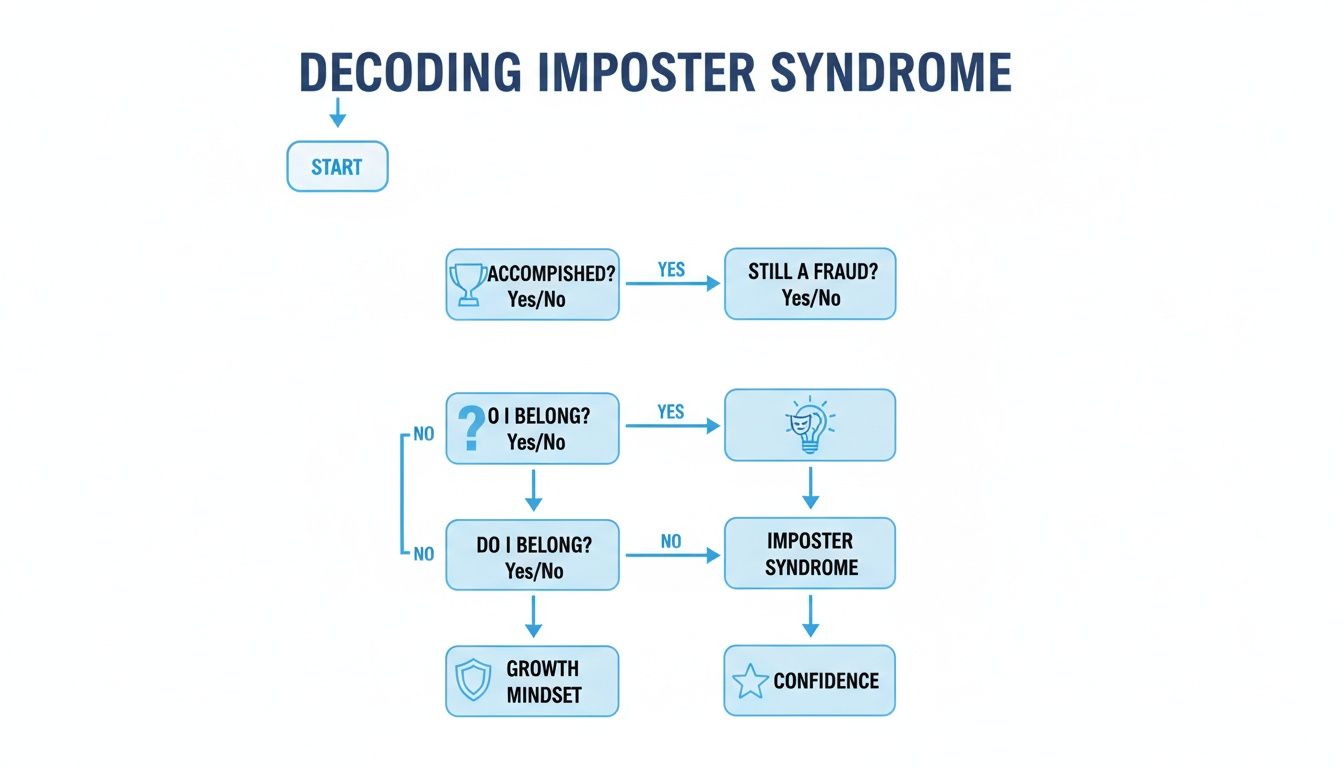
It’s a perfect illustration of how a genuine accomplishment can get twisted through a lens of self-doubt, leading straight to that fraudulent feeling.
Key Takeaway: Identifying your triggers isn't about blaming yourself. It’s about empowering yourself with the knowledge needed to dismantle the thought patterns that hold you back.
If you’re feeling this way, you're in good company—especially among high-achievers. Did you know a staggering 75% of female executives have reported experiencing imposter syndrome at some point? It’s not just seasoned leaders, either. A recent study found 32% of graduating seniors doubted their skills as they entered the workforce, a feeling directly linked to burnout and turnover. These statistics underscore a crucial point: this is a shared professional challenge, not a personal failing. You can read more about these workplace wellness insights from Wellics.com.
Proven Strategies to Reframe Your Mindset
Okay, so you've started to spot your imposter syndrome triggers. That's a huge step. But the real work begins when you move from just noticing those thoughts to actively challenging them.
This isn't about faking confidence or pretending you don't feel like a fraud. It's about building a solid, fact-based case against those feelings so they stop running the show. Instead of letting a thought like, "Wow, I just got lucky on that presentation," take root, you learn to consciously reframe it.
Think of it as a subtle but powerful shift from dismissing your success to owning it: "My prep work and analysis were on point, and that's why it went so well."

Create Your Evidence Log
One of the best ways to fight imposter syndrome is to arm yourself with cold, hard facts. Our brains are wired to fixate on missteps and gloss over wins, so you have to create a system that does the opposite. This is where an evidence log—what some people call a "kudos file" or a "brag book"—becomes your secret weapon.
It’s simply a dedicated place where you collect tangible proof of your skills and accomplishments. Think of it as your personal highlight reel you can turn to whenever that inner critic gets too loud.
So, what goes in this evidence log?
- Positive Feedback: Screenshot that great email from your boss or a happy client.
- Success Metrics: Did you help boost sales by 15%? Did you shave two weeks off a project timeline? Write it down.
- Skills You've Mastered: Jot down a note when you finally nail that new software or handle a tough conversation with grace.
- Problems You Solved: Detail a tricky situation you navigated, focusing on the specific steps you took to resolve it.
This isn't about building up your ego; it's about practicing objectivity. In fact, some studies show that high-achievers who log their wins weekly report 20-30% higher confidence. It works.
Actively Reframe Negative Self-Talk
That little voice in your head has a massive influence on your confidence. The goal here is to catch those distorted, negative thoughts in the act and consciously swap them for something more realistic.
A powerful tool for this is a cognitive therapy technique, often managed with a thought record. If you want to get structured about it, a resource like Master Your Mind with a Cognitive Therapy Thought Record can walk you through the process of identifying, challenging, and changing the thoughts that hold you back.
Here’s a quick look at what this reframing looks like in practice.
| Imposter Thought (The Feeling) | Reframed Thought (The Fact) |
|---|---|
| "I have no idea what I'm doing in this meeting." | "I might not know everything, but they invited me for my specific expertise in marketing analytics." |
| "Any minute now, they're going to find out I'm a fraud." | "My track record of delivering quality work proves I'm capable of handling this role." |
| "I only got this project because no one else wanted it." | "My manager gave me this project because she trusts my skills in project management and client relations." |
Actionable Tip: The next time an imposter thought pops into your head, physically write it down. In a column right next to it, write a more objective, evidence-based alternative. The simple act of writing it out makes the process more concrete and much more effective.
Embrace a Growth Mindset
Imposter syndrome really thrives in a fixed mindset—the belief that our intelligence and talents are set in stone. When you believe you're either "good" at something or "bad" at it, every single challenge feels like a pass/fail test of your fundamental worth. A mistake isn't just a learning opportunity; it's proof that you're an imposter.
The alternative is a growth mindset, which is the understanding that your abilities can be developed through hard work and dedication. This perspective changes everything.
| Mindset Trait | Fixed Mindset (Fuels Imposter Syndrome) | Growth Mindset (Builds Confidence) |
|---|---|---|
| Challenges | Avoids challenges to avoid potential failure. | Embraces challenges as opportunities to learn and improve. |
| Effort | Sees effort as a sign of weakness or lack of natural talent. | Views effort as the essential path to mastery. |
| Feedback | Takes criticism personally; feels like an attack on their ability. | Welcomes constructive feedback as valuable data for growth. |
| Setbacks | Gets discouraged by setbacks; sees them as proof of inadequacy. | Views setbacks as learning experiences and chances to pivot. |
Adopting this view helps you stop seeing your job as a performance where you might get "found out." It becomes a journey of learning and improvement instead. This shift is crucial because it decouples your self-worth from your day-to-day performance.
Building Your Professional Support System
Trying to tackle imposter syndrome by yourself is like trying to see the back of your own head. You just can't get the right perspective. While so much of this work is internal, the truth is, you can't do it alone.
A strong support system at work acts as a powerful antidote. It creates a space where you can be vulnerable without feeling like you're going to be "found out."
Isolation is the fuel that keeps imposter feelings burning. When you keep those nagging "I'm not good enough" thoughts to yourself, they feel monumental, like you're the only one in the world who feels this way. But the minute you share them with a trusted colleague or mentor, you'll likely find they shrink right down to a manageable size. You'll realize just how common this experience really is.
Finding Your People: Mentors and Peers
Your network is your best defense against that relentless inner critic. The right people can offer a reality check, validate your skills, and remind you of your wins when you’re struggling to see them. This isn’t just about finding cheerleaders; it’s about connecting with people who can offer honest, constructive, and truly empowering feedback.
Two of the most powerful allies you can have are mentors and peers.
-
Finding the Right Mentor: A great mentor is more than just someone with an impressive career path. Look for a person who gets the emotional side of professional growth. The best mentors don't just give advice; they share their own stories of fumbling, uncertainty, and eventual success, which makes your own journey feel completely normal.
-
Building a Peer Support Crew: Get together with a few trusted colleagues at a similar stage in their careers. The idea is to create a safe space to share wins without feeling like you're bragging, talk through challenges without judgment, and hold each other accountable for actually celebrating successes instead of immediately dismissing them. You can also learn how to network like a pro in the digital age to build this circle beyond your immediate team.
This sense of connection isn't just a nice-to-have; it has a real, measurable impact. A study of 4,000 adults by Women in CX found that a staggering 72% of women and 63% of men have felt imposter syndrome at work. But here's the good news: friendship is a powerful buffer. Data from the American Survey Center shows that weekly self-doubt drops by a full 16 percentage points for people who have friends at work. You can discover more insights about these findings from Women in CX.
Scripts for Asking for What You Need
It can feel incredibly awkward to talk about your struggles, but having a few simple scripts in your back pocket makes it so much easier. Think of these as conversation starters designed to help you ask for support in a clear, professional way.
Workplace dynamics can often pour gasoline on the imposter syndrome fire, especially when feedback is vague or your workload is out of control. Advocating for yourself is one of the most practical skills you can build to fight back.
Use these scripts as a starting point for conversations with your manager or a mentor.
| Conversation Goal | What to Say (The Script) |
|---|---|
| Discussing Workload | "I'm fully committed to this project's success. To make sure I deliver the best quality, could we walk through the priorities? I want to ensure my focus is aligned with our top goals." |
| Asking for Feedback | "I'm working on my professional development and would value your perspective. Could you share one thing you think I did well on the recent proposal and one area where I have an opportunity to grow?" |
| Sharing a Feeling of Doubt | "I sometimes struggle with feeling like I'm not doing enough, despite the positive outcomes. Have you ever felt that way? I'd appreciate hearing how you've navigated that." |
Real-World Example: Sarah, a project manager, constantly felt her ideas were dismissed in meetings. She formed a small support pact with two female colleagues. Before big meetings, they would review each other's key points. During the meeting, if one of them was interrupted or their idea was ignored, another would jump in with, "I'd like to circle back to Sarah's point, I think it's worth exploring further." This simple peer support system not only amplified her voice but also built her confidence to speak up on her own.
Cultivating Long-Term Confidence Habits
Let’s be real: overcoming imposter syndrome isn't a one-and-done deal. It’s about building the right habits that stick with you for your entire career. Think of it less like a quick fix and more like building muscle—true confidence comes from consistent, intentional practices that slowly but surely rewire how you see yourself and your value.
The whole process is about shifting your mindset from a constant need for perfection to a focus on progress. It's about learning to see a setback as just another piece of data, not a disaster that defines your worth. To make these strategies a real part of your professional life, you need a game plan. By weaving small but powerful habits into your weekly routine, you’ll build a solid internal foundation that won't crumble when self-doubt inevitably shows up.

Start a Weekly Self-Reflection Practice
This might sound simple, but a quick weekly check-in can make a massive difference. All you need is 15 minutes. Every Friday afternoon, before you shut down for the weekend, take a moment to look back on your week—not with a critical eye, but with genuine curiosity. The goal here is to actively gather evidence that proves your inner critic wrong.
During this quick reflection, just ask yourself these three things:
- What was one small win this week? Seriously, anything counts. Maybe you finally nailed that presentation, or maybe you just got your inbox to zero. It all matters.
- What was a challenge I faced, and how did I handle it? Focus on what you did—your effort, your problem-solving skills—not just whether the outcome was perfect.
- What did I learn? This question helps you frame every single experience, good or bad, as an opportunity to grow.
Doing this regularly helps you see your progress in real-time. It short-circuits that "imposter amnesia" that conveniently makes you forget all your accomplishments the second something goes wrong. If you want more ideas on building these kinds of powerful routines, check out our guide on micro-habits that transform your life.
Reframe Setbacks and Actually Celebrate Progress
At its core, imposter syndrome is driven by a deep-seated fear of failure. To fight back, you have to get comfortable with making mistakes. Instead of seeing a setback as definitive proof that you’re incompetent, you need to reframe it as a valuable data point. It’s just information telling you what didn't work, which is a critical part of figuring out what will work next time.
Here’s how you can start shifting your perspective from that fixed, self-critical view to one that’s all about growth.
| Setback Scenario | Imposter-Driven Reaction | Confidence-Building Reframe |
|---|---|---|
| A project deadline is missed. | "I failed. I can't handle this level of responsibility and everyone knows it." | "We misjudged the timeline. What can we learn about our process to be more accurate next time?" |
| You receive critical feedback. | "I'm not good enough for this role. I knew I couldn't do it." | "This feedback is a gift. It shows me a blind spot and gives me a clear path for improvement." |
Just as important is learning to celebrate the small wins. When you finish a tough task or someone gives you a compliment, don't just brush it off. Pause for a second and let it sink in. Acknowledge the effort and skill it took. This is how you build positive momentum and teach your brain that your successes are earned, not just happy accidents.
The goal is progress, not perfection. An obsession with flawless execution is a breeding ground for imposter syndrome. By focusing on learning and incremental improvement, you take away its power.
Build Your Go-To Confidence Toolkit
When those imposter feelings flare up—and they will—it helps to have a pre-planned toolkit of actions you can take right away. This isn't about trying to shove the feeling down; it’s about responding to it constructively before it spirals.
Your personal toolkit could include things like:
- Review Your Evidence Log: Spend five minutes reading through your "kudos file" or accomplishment list. Reconnecting with past successes gives you an instant reality check based on cold, hard facts, not fleeting feelings.
- Connect with an Ally: You don't need to pour your heart out. Just send a quick message to a trusted mentor or a work friend. Simply connecting with someone in your corner can be enough to disrupt the cycle of negative self-talk.
- Take a Five-Minute Reset: Get up and step away from your desk. Do a simple breathing exercise or just walk around the block. This simple physical act creates the mental space you need to separate yourself from that overwhelming feeling.
By cultivating these long-term habits, you're not just "managing" imposter syndrome. You're actively building a career defined by resilience, self-awareness, and a much more authentic kind of confidence.
Frequently Asked Questions (FAQ)
Here are answers to some of the most common questions about navigating imposter syndrome in a professional setting.
1. What is the difference between imposter syndrome and humility?
Humility is rooted in accurate self-assessment and security; you know your strengths but also recognize you have more to learn. Imposter syndrome stems from insecurity and a distorted self-perception, where you genuinely believe you're a fraud despite your accomplishments. A humble person can accept praise, while someone with imposter syndrome deflects it, attributing success to external factors like luck.
2. Can imposter syndrome affect men, or is it mainly a female issue?
Absolutely, it affects men too. While early research focused on high-achieving women, we now know it is a widespread experience across all genders. Societal pressures on men to always appear confident can make it even harder for them to admit these feelings, which can lead to greater isolation.
3. Will changing jobs get rid of my imposter syndrome?
Unlikely. While a toxic work environment can certainly worsen these feelings, imposter syndrome is primarily an internal pattern of thought. A new job might provide temporary relief, but the feelings will likely resurface once you face new challenges unless you work on reframing your internal mindset.
4. How can I support a colleague who seems to be struggling with imposter syndrome?
Be specific with your praise. Instead of "good job," say, "The way you handled that client's difficult questions was impressive; your research really paid off." Gently counter their self-deprecating comments with evidence. Sharing your own past struggles can also help normalize the experience and make them feel less alone.
5. Is imposter syndrome a recognized mental health disorder?
No, it is not listed in the DSM-5 as a clinical diagnosis. It's considered a psychological pattern or phenomenon. However, the chronic stress, anxiety, and self-doubt it causes can contribute to or coexist with diagnosed conditions like anxiety and depression. If the feelings are overwhelming, seeking professional help is recommended.
6. Why do so many successful people experience imposter syndrome?
It's a paradox, but high-achievers often have it the worst. They set extremely high standards for themselves, so they are more aware of what they don't know. Each new accomplishment can feel like it raises the stakes, increasing the fear of being "exposed" as not being as brilliant as everyone thinks they are.
7. What's the best first step to take if I think I have imposter syndrome?
Start by acknowledging the feeling without judgment. Then, begin creating an "evidence log" or "kudos file." This is a simple document or folder where you save positive feedback, list your achievements, and note problems you've solved. This creates a factual record to consult when feelings of doubt arise.
8. Can a manager's behavior make imposter syndrome worse?
Yes, significantly. Managers who provide vague feedback, micromanage, or foster a culture of unhealthy competition can amplify feelings of inadequacy. Conversely, a supportive manager who gives clear, constructive feedback and creates psychological safety can be one of the most powerful buffers against it.
9. Are there any physical symptoms associated with imposter syndrome?
Yes. The persistent stress and anxiety can manifest physically. Common symptoms include tension headaches, fatigue, difficulty sleeping, and digestive issues. It's a mental pattern with real-world physical consequences.
10. Can you ever fully "cure" imposter syndrome?
For most people, it's more about management than a complete cure. The goal is to develop the tools to recognize the thoughts when they appear, challenge them with evidence, and prevent them from dictating your actions and career choices. Over time, its voice becomes quieter and its power diminishes significantly.
At Everyday Next, we believe that personal and professional growth go hand-in-hand. We are committed to providing practical guides and insights to help you navigate your career with confidence. Explore more resources to support your journey at https://everydaynext.com.
Previous Post
Next Post