
Quantum Computing Explained Simply
Picture a computer that doesn't work through problems one step at a time, but instead looks at millions of possible solutions all at once. That's the core idea behind quantum computing. This isn't just about making our current computers faster; it's a completely different approach to computation, built on the strange and powerful principles of quantum mechanics.
What Is Quantum Computing in Simple Terms?
To really get a handle on quantum computing, let's first think about the device you're reading this on. Your computer or phone runs on what we call classical bits. A bit is like a simple light switch—it can be on (which we call a 1) or it can be off (a 0). That's it. Every amazing thing your device does, from streaming movies to crunching numbers in a spreadsheet, is just the result of billions of these simple on/off switches working together in a long sequence.
Quantum computing breaks out of that binary box. It uses qubits, or quantum bits, which are a whole lot more flexible.

Beyond the Binary Limit
Instead of a simple on/off switch, think of a qubit as a dimmer. A dimmer switch isn't just on or off; it can be set to any brightness level in between. A qubit works in a similar way: it can be a 1, a 0, or a blend of both at the same time.
This strange ability to exist in many states at once is a fundamental concept in quantum physics called superposition. It’s the secret sauce that lets a quantum computer explore a vast number of possibilities simultaneously, rather than having to check each one sequentially.
This massive parallel processing capability is what makes quantum machines so different. They aren't just a small step up; they're a new kind of tool built to crack problems that are far too complex for even the most powerful supercomputers we have today.
A New Frontier of Problem-Solving
By tapping into properties like superposition, quantum computers promise to solve problems that would take a classical computer billions of years to figure out. This unlocks the potential for incredible breakthroughs in all sorts of fields:
- Medicine: Designing new life-saving drugs by accurately simulating how molecules behave. A real-world example is the work being done to model the protein spikes of viruses like COVID-19 to find new inhibitors more quickly.
- Finance: Building incredibly complex financial models to better predict market trends and manage risk. For example, a bank could optimize a retirement portfolio of thousands of assets in seconds, a task that currently takes hours or days.
- Material Science: Discovering novel materials with revolutionary properties for things like hyper-efficient batteries or next-generation solar cells. This could lead to batteries that charge in minutes or solar panels that work even on cloudy days.
Ultimately, quantum computing is a specialized tool for these kinds of monumental challenges. You can see how these developments fit into the bigger picture of tech innovation and what it all means for the future. It’s a field poised to completely redraw the map of what we consider possible.
Getting to the Heart of Quantum Power
So, what makes a quantum computer so different from the one on your desk? It all comes down to a few core ideas that, while a bit strange, are the secret sauce behind its power. Instead of the simple on/off switches (bits) in classical computers, quantum machines use principles that are fundamentally different.
Let's break down the three pillars that give quantum computers their incredible potential. It all starts with the qubit, the quantum version of a classical bit.
Pillar 1: Superposition
Imagine you flip a coin. While it’s spinning in the air, what is it? Heads or tails? You could say it’s in a state of both until it lands. Only when you stop it and look—when you "measure" it—does it commit to one definite answer.
A qubit works in a similar way, thanks to a principle called superposition. It can be a 0, a 1, or a mix of both at the same time. This ability to hold multiple values at once is a game-changer. It allows a quantum computer to explore a vast number of potential solutions simultaneously.
A classical computer, on the other hand, has to plod through each possibility one by one. This is where the exponential power comes from; adding just one more qubit to a quantum system doubles its computational space.
Pillar 2: Entanglement
The next pillar is even more mind-bending. It’s a phenomenon Albert Einstein famously described as "spooky action at a distance." He was talking about entanglement, a deep connection that can link two or more qubits together. Once linked, their fates are intertwined, no matter how far apart they are.
Think of it like having two of those magic spinning coins, but this time they are entangled. If you stop one and find it landed on heads, you instantly know the other one landed on tails, even if it's on the other side of the galaxy.
This instant link creates a powerful synergy. In a quantum computer, entangled qubits don't act as individual units but as a single, coordinated system. This allows for incredibly complex calculations where changing one part of the system immediately influences another.
This bizarre property enables information processing in ways that simply have no classical parallel, creating computational shortcuts for solving certain types of monstrously difficult problems.
Pillar 3: Interference
The final pillar, quantum interference, is how a quantum computer sifts through all the potential solutions to find the correct one. It's a lot like how waves in a pond can either build each other up (constructive interference) or cancel each other out (destructive interference).
Quantum algorithms skillfully manipulate the probabilities of the qubits. They amplify the "probability waves" that lead to the right answer while canceling out the ones that lead to the wrong ones. This process essentially steers the calculation toward the desired solution, making it pop out when the final measurement is taken.
So, to recap how it all fits together:
- Superposition lets qubits explore countless possibilities at once.
- Entanglement links those qubits into a powerful, cohesive system.
- Interference zeroes in on the correct answer from all those possibilities.
These three pillars work in concert to create the engine of a quantum computer. Their combined effect is what gives it such a massive computational edge. To put it in perspective, a single 300-qubit machine could potentially outperform all classical supercomputers combined, tackling optimization puzzles like airline scheduling that could save billions each year. You can explore the projected growth of this technology and discover more insights about the global quantum market on bccresearch.com.
Grasping these principles makes it clear why this isn't just a faster computer—it's a completely new way of computing. To see how these ideas are already making an impact, it’s worth checking out the latest quantum computing breakthroughs happening in labs around the world.
Comparing Classical and Quantum Computers
To really get a feel for what makes quantum computing so different, it helps to put it right next to the classical computers we use every day. Think of them less as a faster version of your laptop and more as a completely different kind of machine, built on entirely different rules to solve entirely different problems.
Let's use an analogy. Imagine you're standing at the entrance of a massive, impossibly complex maze.
A classical computer is like a very, very fast runner. It will sprint down one path, hit a dead end, backtrack, and try the next one. It does this meticulously, checking every single route one by one until it finds the exit. For most mazes, this works great. But for a maze with billions of paths, it would take longer than the age of the universe.
A quantum computer, on the other hand, gets to cheat. Thanks to superposition, it's like it can explore every single path in the maze at the exact same time. By checking all possibilities simultaneously, it can find the exit in a tiny fraction of the time. This isn't just about speed; it's a fundamental shift in how you solve the problem.
Key Operational Differences
The real difference comes down to how each machine handles information. Classical computers are built on a bedrock of certainty. Their language is binary, using bits that are always either a 0 or a 1. There's no in-between. This simple, predictable system is perfect for the logical, step-by-step tasks we ask of them, from sending an email to running a video game.
Quantum computers, however, embrace the weirdness of quantum mechanics. They run on probability. Their basic units, qubits, can exist in a state of potential—a mix of 0 and 1 at the same time—right up until the moment you measure them. This unique ability lets them tackle uncertainty and complexity in a way classical machines just can't fathom.
The infographic below really helps visualize how these quantum principles build on each other to create such a powerful system, starting with the qubit itself.
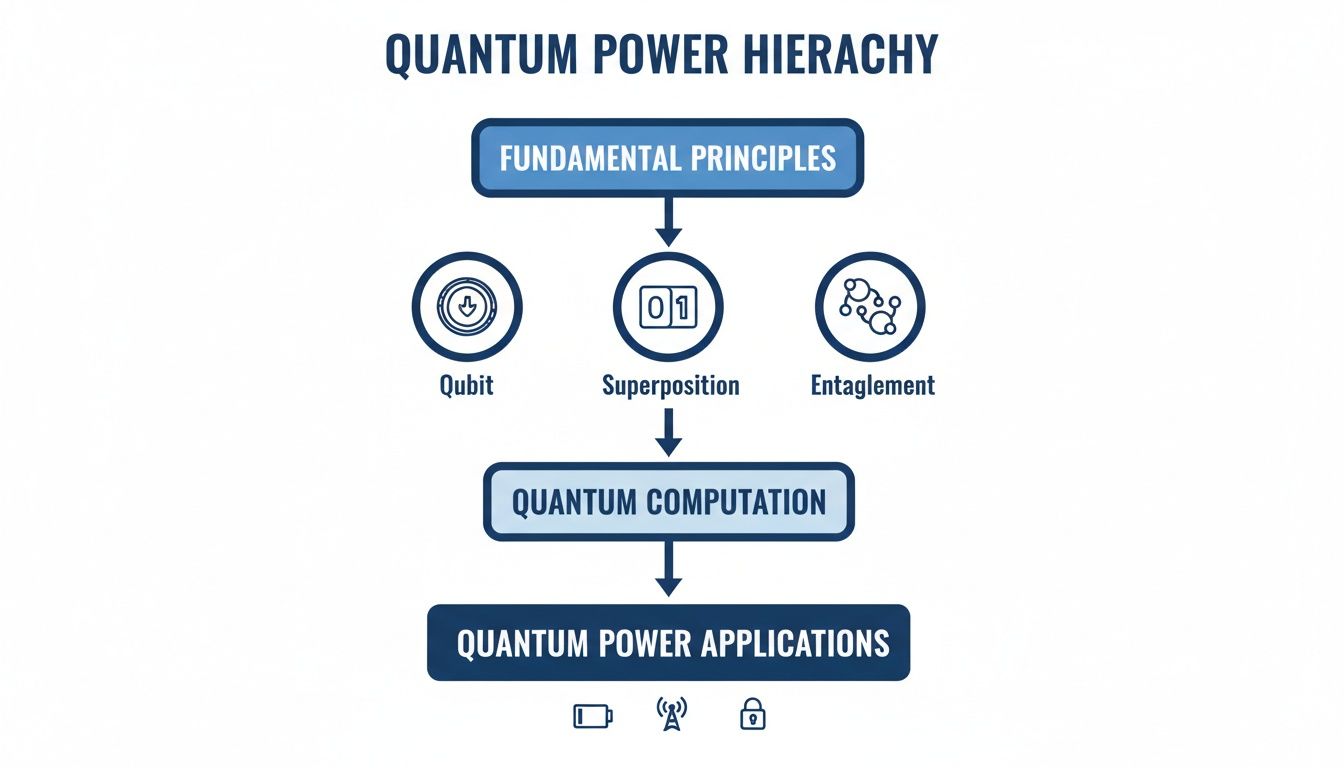
As you can see, the qubit is the foundation that makes superposition and entanglement possible. These aren't just cool sci-fi concepts; they are the literal engines of a new form of computation.
Classical vs. Quantum Computing: At a Glance
Sometimes a side-by-side comparison is the best way to see the contrast. This table breaks down the core differences in how classical and quantum computers work, what they're made of, and what they're good at.
| Feature | Classical Computing | Quantum Computing |
|---|---|---|
| Basic Unit | Bit: A switch that is either 0 (off) or 1 (on). Simple, stable, and predictable. | Qubit: Can be a 0, a 1, or both at the same time through superposition. This allows for massive parallel processing. |
| Problem-Solving | Sequential: Works through problems one step at a time, following a linear path to the answer. | Probabilistic & Parallel: Explores countless possibilities at once, finding the best solution among them. |
| Error Handling | Reliable: Bits are sturdy and not easily disturbed, which means very low error rates. | Fragile: Qubits are incredibly sensitive to "noise" like heat and vibrations, requiring extreme cold and heavy error correction. |
| Ideal Use Cases | Everyday Tasks: Perfect for web browsing, spreadsheets, gaming, and nearly all current digital activities. | Complex Problems: Tackling huge challenges in drug discovery, materials science, financial modeling, and breaking encryption. |
| Real-Life Analogy | A Light Switch: It can only be on or off. | A Dimmer Switch: It can be on, off, or any brightness level in between, representing many states at once. |
The key thing to remember is that quantum computers aren't here to replace your phone or laptop. They are highly specialized tools, purpose-built to take on a certain class of problems—those with a mind-boggling number of variables that are simply unsolvable for even the most powerful supercomputers today.
As the technology develops, we'll see it working alongside classical computers, with each machine playing to its strengths. This kind of hybrid computing is shaping up to be one of the top tech trends of 2025, combining the reliability of classical with the raw power of quantum. Understanding this distinction is the first step to seeing where this incredible technology is heading.
How Quantum Computing Will Change Our World
So, we've talked about the mind-bending concepts of qubits and entanglement. Now, let's bring it back to earth and look at how this technology is actually poised to reshape our world. This isn't just a cool science experiment; it's a completely new way of computing that could help us crack some of humanity's toughest problems.
The real magic of a quantum computer is its ability to simulate and understand immense complexity—the kind of complexity that makes even our biggest supercomputers grind to a halt. This unique skill is set to make waves in just about every industry, but a few areas are especially ripe for a quantum leap forward.

Revolutionizing Medicine and Materials Science
Drug discovery is one of the most promising frontiers. Right now, creating a new medicine is a marathon, often taking more than a decade and costing billions. A huge chunk of that time and money is spent on trial-and-error, trying to figure out how different molecules will behave inside the human body.
Classical computers just can't keep up. They struggle to accurately model even medium-sized molecules because the quantum dance between atoms is just too complicated for them.
A quantum computer, on the other hand, speaks the same language as those atoms. It operates on the very same quantum principles, making it the perfect tool to simulate molecular behavior with pinpoint accuracy.
Instead of just guessing, scientists could design drugs from the ground up, building them molecule by molecule to attack specific diseases with fewer side effects. This could shrink development timelines from years down to months.
The same idea applies to creating new materials. Imagine designing a catalyst that efficiently sucks carbon dioxide right out of the air. Or what about a room-temperature superconductor that could create a zero-loss energy grid? These are the kinds of game-changing innovations that quantum simulation could finally put within our reach.
Of course, the hardware itself is a massive engineering challenge. Qubits are incredibly fragile; they lose their quantum state (a process called decoherence) in microseconds and have to be kept in extreme cryogenic coolers at nearly -460°F. But progress is being made. Startups like Alice & Bob are already developing error-corrected logical qubits, which is a major step toward building a truly useful machine.
Transforming Finance and Logistics
The global economy is another area where quantum computers could have an outsized impact. Financial markets are chaotic, with millions of variables all interacting at once. Quantum machines could build far more sophisticated financial models to better forecast market behavior, price complex assets, and optimize global investment strategies.
- Risk Analysis: A real-world application involves Monte Carlo simulations. Banks use these to model risk, but they are computationally expensive. A quantum computer could run far more complex simulations to better predict market crashes, leading to a more stable financial system.
- Portfolio Optimization: Investors could find the absolute best mix of assets to maximize returns while keeping risk in check, fine-tuned to incredibly specific goals.
Then there's logistics. Companies are constantly wrestling with the "traveling salesman problem"—figuring out the most efficient route between thousands of destinations. It sounds simple, but the problem gets exponentially harder with every new stop you add.
A quantum computer could solve these kinds of optimization puzzles in a flash. For a logistics giant like FedEx or Amazon, this would mean:
- Massive reductions in fuel costs and carbon emissions.
- Faster delivery times for customers.
- A leaner, more efficient operation.
A New Era for Artificial Intelligence
Quantum computing is also set to team up with artificial intelligence in some powerful ways. Quantum machine learning algorithms could process information in entirely new ways, spotting patterns in data that are completely invisible to today's AI. This could drastically speed up how we train complex AI models and make them more accurate.
This connection is especially interesting when you think about how AI and automation are reshaping the future workforce. By taking on the heaviest computational tasks, quantum computers could free up AI to tackle even bigger challenges, from driving scientific discovery to helping with creative problem-solving.
Real-World Problems: Classical vs. Quantum Approach
This table offers a clear look at how each type of computer tackles specific, challenging problems.
| Problem Type | Classical Computer's Approach | Quantum Computer's Advantage | Real-World Example |
|---|---|---|---|
| Molecular Simulation | Relies on approximations and struggles with accuracy for complex molecules. | Simulates molecules perfectly as it operates on the same quantum rules. | Designing a new drug for Alzheimer's by accurately modeling protein folding. |
| Large-Scale Optimization | Tries every possibility one-by-one, which is too slow for very large problems. | Explores all possibilities at once to quickly find the optimal solution. | Optimizing the flight paths for an entire airline to save millions in fuel. |
| Database Searching | Searches one item at a time (linearly). Requires a sorted database for efficiency. | Can search an entire unsorted database much faster using Grover's algorithm. | Finding a specific gene sequence in a massive genomic database. |
| Cryptography | Modern encryption is based on problems that are too hard for classical computers to solve. | Can break many current encryption methods by efficiently factoring large numbers. | A future quantum computer could potentially crack the encryption protecting online banking. |
The Major Hurdles on the Road to a Quantum Future
While the promise of quantum computing is immense, building a powerful, reliable machine is one of the toughest scientific and engineering challenges we've ever faced. This isn't just a matter of shrinking transistors like we do with classical computers. We're trying to control the very fabric of reality at the subatomic level, and that comes with some serious obstacles. These hurdles are the reason you don't have a quantum laptop on your desk right now.
The biggest enemy, by far, is something called quantum decoherence. Qubits are the soul of a quantum computer, but they are also incredibly fragile. Those special quantum states we talked about—superposition and entanglement—can be destroyed by the slightest nudge from the outside world.
Imagine a soap bubble floating perfectly still in a clean room. It holds its beautiful, shimmering shape. But the moment a tiny gust of wind or a single speck of dust touches it, it pops. A qubit is a lot like that bubble. The "wind and dust" can be anything: a tiny change in temperature, a stray magnetic field, or even a subtle vibration. This environmental "noise" makes the qubit lose its quantum magic and collapse into a plain old classical bit, introducing errors into the calculation.
The Challenge of Extreme Engineering
To keep these delicate qubits stable, scientists have to go to incredible lengths to create a perfectly isolated environment. This is why most quantum computers look less like computers and more like giant, elaborate chandeliers tucked inside massive refrigerators.
-
Extreme Cold: Many of these systems have to be cooled to temperatures colder than deep space—often just a tiny fraction of a degree above absolute zero (-459.67°F or -273.15°C). This intense cold slows down atomic vibrations, essentially freezing everything around the qubits to stop them from getting bumped.
-
Total Isolation: The machines are also heavily shielded from electromagnetic radiation and physical vibrations. They're often built in specialized labs, sometimes deep underground, to protect them from everything from a passing truck to a cosmic ray from space.
This level of engineering is a clear sign of just how difficult the problem is. We are literally building the quietest, coldest, and most stable places in the universe just to give these qubits a chance to work before decoherence kicks in.
The Race for Error Correction
Since decoherence is always a threat, engineers know that errors are simply a fact of life. The next great frontier in the field is developing solid quantum error correction methods. This is a whole different ballgame compared to error correction in your laptop. You can't just "read" a qubit to see if it has an error, because the very act of looking at it destroys its quantum state.
Instead, scientists are working on clever schemes that use many physical qubits to create a single, much more stable "logical qubit." This group of qubits can be monitored for errors indirectly, without disturbing the core information, allowing the system to find and fix mistakes as they happen.
Despite these challenges, the field is moving forward at an astonishing pace, attracting massive investment. The global quantum computing market is already valued at around $1.44 billion and is expected to grow at 30.88% annually through 2034. By then, the market could be worth over $16 billion. You can read the full market research on Precedence Research to get a sense of the scale here.
Of course, this progress also creates new problems, especially for cybersecurity. To get a better handle on how quantum breakthroughs will affect digital security, check out our guide on cybersecurity in 2025 and beyond.
Frequently Asked Questions About Quantum Computing
1. Will a quantum computer replace my laptop?
No. Classical computers like your laptop are excellent for everyday tasks (email, browsing, gaming). Quantum computers are specialized tools designed for specific, highly complex problems that are impossible for classical computers. They will work alongside, not replace, them.
2. When will quantum computers become widely available?
While early-stage quantum computers are accessible via the cloud today, a powerful, fault-tolerant machine capable of solving major real-world problems is likely still 5 to 10 years away. The field is advancing quickly, but significant engineering hurdles remain.
3. Should I be worried about quantum computing and cybersecurity?
Yes, this is a serious long-term concern. A powerful quantum computer could break much of the encryption that protects our data today. Because of this threat, governments and researchers are actively developing "quantum-resistant" encryption standards to secure our digital infrastructure for the future.
4. What is a qubit?
A qubit, or quantum bit, is the basic unit of information in a quantum computer. Unlike a classical bit that must be either a 0 or a 1, a qubit can exist in a combination of both states at the same time, thanks to a principle called superposition.
5. What is superposition?
Superposition is a core quantum principle where a qubit can be a 0, a 1, or both simultaneously. Think of a spinning coin: while it's in the air, it's a mix of heads and tails until it lands. This allows quantum computers to explore many possibilities at once.
6. What is quantum entanglement?
Entanglement is a "spooky" connection between two or more qubits. When entangled, the state of one qubit is instantly linked to the state of the other, no matter how far apart they are. Measuring one immediately tells you the state of its partner.
7. Why do quantum computers need to be so cold?
Qubits are extremely fragile. Any "noise" from the environment, like heat (which is just atomic vibration), can disrupt their quantum state and cause errors (a process called decoherence). Extreme cold helps create a stable, quiet environment for the qubits to operate.
8. What kinds of problems are quantum computers good for?
They excel at three main types of problems: simulation (e.g., designing new drugs and materials), optimization (e.g., finding the most efficient shipping routes), and factoring large numbers (which has major implications for cryptography).
9. Can I invest in quantum computing?
Yes. You can invest in large tech companies with quantum divisions like [IBM], Google, and Microsoft, or in pure-play public companies like [IonQ]. There are also ETFs focused on emerging technologies that include quantum computing. As with any new technology, this carries both high potential and high risk.
10. Where can I learn more about quantum computing?
To dive deeper, you can explore online courses on platforms like Coursera and edX, read books and articles from trusted science publications, or even try running your own simple experiments on a real quantum computer through cloud platforms offered by companies like IBM.
At Everyday Next, we're committed to breaking down complex topics to help you stay ahead. From tech breakthroughs to financial insights, we deliver the knowledge you need to navigate an ever-changing world. Explore more at https://everydaynext.com.

Previous Post
Next Post