Personal Development Plan Template: Fillable Planner
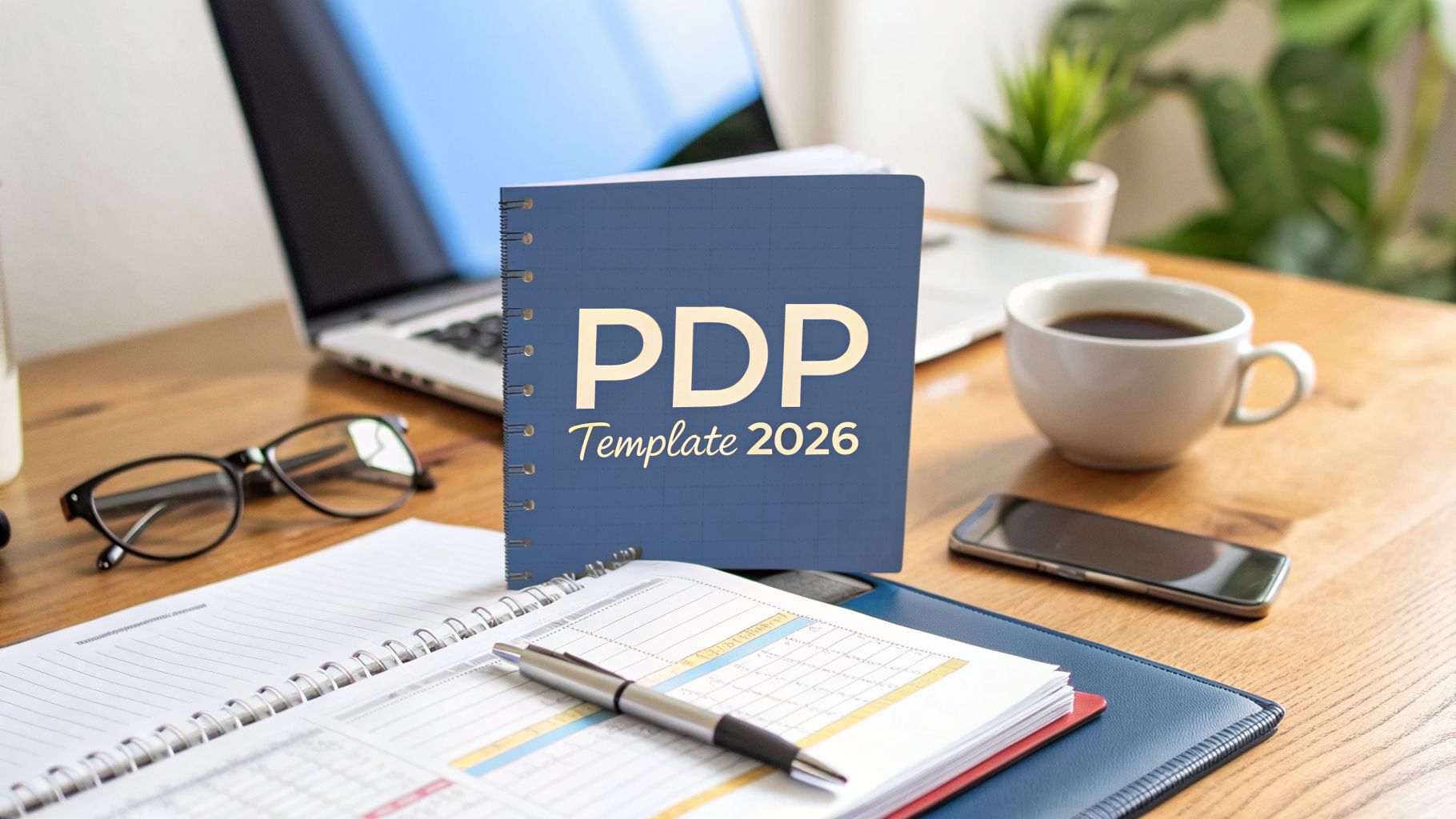
A personal development plan template should connect a specific capability gap to a practice activity, a realistic schedule, evidence of progress, and a review decision. Start with one priority, describe your current baseline, and choose an action you can repeat and evaluate. A completed form organizes learning; it does not guarantee an outcome.
This page is the practical worksheet: complete the fields, build a summary, and download a plain-text copy. For a broader explanation of choosing priorities and preparing a plan, see how to create a personal development plan. For goal wording and obstacle planning, use our SMART goals guide.
Updated October 14, 2026. The planner and examples are Everyday Next adaptations, not a validated assessment. No coaching experience, promised improvement rate, or guaranteed career outcome is claimed.
What belongs in a personal development plan template?
A useful plan records what you want to become more capable of doing, why it matters, where you are starting, and how you will know whether practice helped. It connects learning with application rather than treating course completion as the final result.
CIPD’s continuing professional development cycle connects identifying and planning learning with learning, reflection and recording, and application and sharing. Its professional context informs this worksheet; completing it does not satisfy a professional body’s requirements automatically.
The template below focuses on eight decisions: the gap, baseline, intended result, practice, time and resources, likely obstacle, evidence, and review. You can add organizational requirements separately. Keep one plan for one priority so that different goals do not compete invisibly for the same time.
Fillable evidence-to-action planner
Complete the form, build the summary, then download it as a .txt file. This tool runs in your browser. It does not submit answers to Everyday Next, save them between visits, or sync them to another device. Reloading clears your entries; download a copy before leaving. Normal site privacy policies still apply.
JavaScript is off. Copy the field labels into a document and complete the plan there. The summary and download buttons require JavaScript.
Complete the template in a useful order
1. Describe a capability gap, not a personal label
“I am bad with numbers” is difficult to act on. “I cannot reliably reconcile a small table of expenses” describes a task you can practise. Avoid turning an isolated mistake into a permanent judgment about yourself.
Record a recent example: what you attempted, which part worked, and where you needed help. Mark assumptions separately. Our claim-check worksheet can help distinguish evidence from an interpretation of your performance.
2. Define an observable result
Choose a demonstration, such as preparing an accurate example worksheet or explaining a concept without notes. A result does not always need to be a single number. A clear description and a consistent review method can be useful for communication or creative skills.
Separate the outcome from the action. Producing a clear explanation is an outcome; rehearsing it and requesting specific feedback are actions. You control the practice more directly than another person’s reaction or an external opportunity.
3. Choose practice that resembles the task
If you want to improve a spreadsheet task, work on a representative dataset instead of only watching tutorials. If you want clearer conversations, rehearse a short explanation and check what a listener understood. Reading can support practice, but hours consumed do not establish skill by themselves.
Use materials you have permission to share. Remove private customer, workplace, medical, or family information from examples. You can often practise with fictional data and still test the relevant steps.
4. Budget time and resources
Identify a realistic slot and the materials or support needed. Include setup time and the effort required to obtain feedback. Check any course cost, prerequisites, cancellation terms, and accessibility arrangements before paying; this page does not recommend a particular provider.
Our personal-growth resources guide helps compare learning formats. Start with the smallest resource that addresses your gap and produces something you can inspect.
5. Prepare one if–then response
Write a likely obstacle and an achievable response: “If the planned evening session is interrupted, then I will use Saturday’s reserved slot for the same exercise.” Specify the situation and action, rather than “If life is busy, try harder.”
Gollwitzer and Sheeran’s 2006 meta-analysis examines implementation intentions. It supports considering concrete if–then planning, not a promise that one response will overcome every obstacle or produce a fixed success rate.
6. Decide what evidence you will review
Save the first attempt and a later comparable attempt. Use the same task constraints where feasible. Record errors, necessary help, feedback, or completed steps. A course certificate can document completion, but it may not show whether you can apply the learning independently.
Harkin and colleagues’ 2016 meta-analysis found that progress-monitoring interventions improved goal attainment on average across the studies reviewed. That does not validate this particular planner or establish one ideal review schedule for everyone.
Three illustrative completed plans
Example: learn a spreadsheet check
Gap: reconcile categories without losing transactions. Baseline: a fictional 20-row table contains two uncategorized entries. Practice: build a category summary and compare its total with the original list during two planned sessions.
Evidence: the summary matches the source total, exceptions are identified, and you can repeat the steps on a fresh table. Review: after the second session, decide whether you need a formula lesson, a simpler method, or another independent practice attempt. The row count and schedule are examples, not required targets.
Example: explain an unfamiliar idea
Gap: explain a concept without relying on jargon. Baseline: a listener can recall the terminology but not the main point. Practice: write a short explanation, deliver it, and ask the listener to summarize what they understood.
Evidence: compare the intended message with the listener’s account. Obstacle: if nobody is available, record a rehearsal and check it against your written purpose. Do not claim that recording provides the same feedback as another person. Use our communication guide for related practice ideas.
Example: develop a family listening routine
Gap: move too quickly into advice. Practice: during a suitable ordinary conversation, summarize what was said and ask whether advice is wanted. Evidence: note whether you paused and checked understanding, without recording a child’s sensitive disclosures.
Review: assess your own actions, not whether the child behaved as you hoped. Our parenting-talks guide explains age-sensitive communication and situations that require professional support.
Review, change, or stop the plan
Choose a review date that follows enough practice to provide useful evidence. For a small task, that might follow a few sessions; a complex capability may need a longer cycle. These are planning choices, not scientifically established universal intervals.
Ask what improved, what remains difficult, and whether the practice addressed the actual gap. If progress stalled, inspect time, resources, task difficulty, and feedback before blaming motivation. Record the reason for a change so the next review can evaluate it.
You can continue, change the activity, reduce the scope, pause, or finish. Use the decision toolkit if several feasible next steps compete. Do not keep adding goals without deciding what receives less time.
Frequently asked questions
Is this a downloadable PDF or Notion template?
The working asset here is a browser form with a real plain-text export. You can copy that file into your preferred document tool. A separate PDF, Google Docs, or Notion download is not claimed.
Does the planner save automatically?
No. Inputs stay in the current page session and are cleared by reloading. Build and download the current plan before leaving. Keep the downloaded file somewhere appropriate for its contents.
How is this different from a to-do list?
A development plan connects activities to a capability and evidence of learning. A to-do list can schedule those activities but does not necessarily explain why they matter or how progress will be assessed.
How many goals should I include?
Start with one priority in this worksheet. Add another only when you can identify the time and resources for it. There is no universal ideal number for every person’s circumstances.
What if I miss the review date?
Set a new date and record why it moved. Check whether the scope or schedule needs revision. A missed date does not prove that the underlying goal is unsuitable.
Should I share the plan?
Share selected parts when useful for feedback or agreed support. Keep sensitive reflections private. If the plan is part of an employer or professional-body process, check its specific requirements and permissions.
Sources and next step
- CIPD: Getting started with your CPD.
- Gollwitzer and Sheeran, 2006: Implementation intentions and goal achievement.
- Harkin et al., 2016: Monitoring goal progress.
The evidence-to-action planner is an original practical adaptation. Complete one gap, one goal, and one practice action, then download your current plan. Use the review to decide what the evidence justifies next.
Related Posts


Previous Post
Next Post