
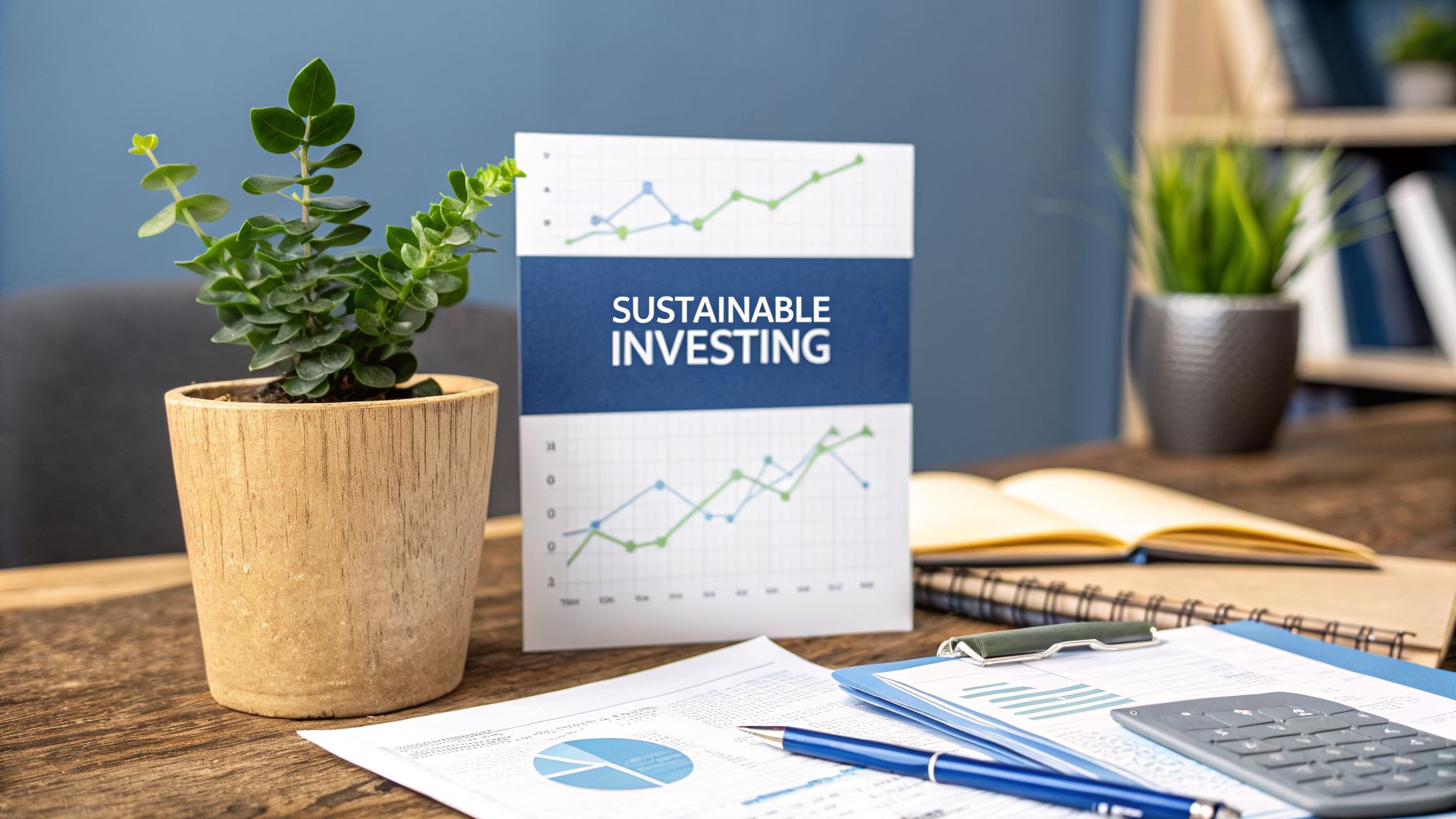
What Is Sustainable Investing? A Guide to Aligning Your Portfolio with Your Principles
Sustainable investing is more than just a financial strategy; it's a powerful way to align your money with your values. It’s an approach that seeks solid financial returns while simultaneously driving positive change in the world. This means looking beyond the balance sheets and quarterly reports to understand a company's true impact on the planet, its people, and its own governance.
Beyond Profits: A New Definition of Wealth
What if your investments could do more than just grow your bank account? What if they could also help build a better, more sustainable future? That’s the simple yet profound idea at the heart of sustainable investing.
This approach enhances traditional financial analysis by integrating Environmental, Social, and Governance (ESG) factors into the investment decision-making process.
But let's be clear: this isn't charity. It's smart, long-term thinking. The core thesis is that companies demonstrating strong performance in environmental stewardship, social responsibility, and ethical governance are often better managed, more resilient, and better positioned for long-term success.
Think of it this way: when choosing your morning coffee, you might opt for a local café that uses fair-trade beans and compostable cups over a large chain with a questionable environmental record. You still get a great cup of coffee (your "financial return"), but your purchase also supports a business that aligns with your values. Sustainable investing applies this same logic to your entire investment portfolio.
The Three Pillars of Sustainable Investing
So, what are investors actually looking at? It all comes down to those three core pillars: Environmental, Social, and Governance. These ESG criteria provide a richer, more holistic view of a company's health, revealing risks and opportunities that traditional financial analysis alone might miss.
Here’s a breakdown of what each pillar covers.
| Pillar | Focus Area | Example Investment Considerations |
|---|---|---|
| Environmental | A company’s impact on the planet. | Does the company have a credible strategy to reduce its carbon footprint? How does it manage waste, pollution, and water usage? Is it investing in renewable energy and circular economy principles? |
| Social | How a company treats people—its employees, customers, and communities. | Does it ensure fair labor practices, a safe workplace, and a living wage? How does it protect customer data privacy? Does it foster diversity and inclusion? |
| Governance | How a company is managed, led, and held accountable. | Is the board of directors diverse and independent? Is executive compensation tied to performance and reasonable? Does the company operate with transparency and protect shareholder rights? |
By viewing a company through this ESG lens, you gain a clearer picture of its long-term viability and resilience. This mindset is a natural extension of making conscious choices in our daily lives, like those discussed in our guide on how to make sustainable living easy.
Sustainable investing is ultimately about recognizing that the health of our planet, society, and corporate structures is directly linked to the health of our economy and our investments. It redefines "good performance" to include both profit and purpose.
What was once a niche strategy has exploded into the mainstream. Sustainable investing has grown into a market valued at an incredible USD 35.48 trillion in 2025. Projections show it's not slowing down, with forecasts suggesting it could reach USD 191.22 trillion by 2035. For a deeper dive into these figures, consult Precedence Research's detailed market analysis.
Decoding The Language Of Ethical Investing
Diving into sustainable investing can feel like learning a new language. You’re suddenly surrounded by acronyms and terms that all sound vaguely similar but have important differences. The best way to get your bearings is to understand the three main strategies people use to align their money with their values: ESG Integration, Socially Responsible Investing (SRI), and Impact Investing.
Let's use an analogy. Imagine you're picking a place for dinner.
- ESG is like checking the restaurant's details: What’s its health inspection score (Governance)? How does it treat its staff (Social)? Does it compost its food waste (Environmental)? You're using extra data to pick a well-run establishment.
- SRI is like having a hard-and-fast rule: "I refuse to eat at any fast-food chains, period." You're simply avoiding places that violate your principles.
- Impact Investing is like deciding to eat at a new farm-to-table restaurant specifically because you want to support local growers and boost the community's economy. You're choosing it to make a positive change.
Let’s break down what each of these looks like in the real world of investing.
ESG Integration: The Pragmatic Approach
ESG Integration is the most widespread strategy in use today. It’s less about blacklisting entire industries and more about using Environmental, Social, and Governance information to make smarter financial decisions.
Think of it this way: an ESG-focused fund manager might still invest in an oil company. But they’ll choose the one with a serious plan for transitioning to clean energy and a stellar worker safety record over a competitor that’s ignoring those issues. The guiding principle is that companies that manage these ESG factors well are generally better-run, more resilient, and ultimately, better long-term investments.
An ESG investor operates on the belief that sustainability factors are financially material. A company with terrible labor practices could face costly strikes, while a heavy polluter might get hit with massive fines. These aren't just ethical concerns; they are real financial risks.
SRI: The Values-Based Filter
Socially Responsible Investing (SRI) is what most people think of as the original "ethical" investing. Its main tool is negative screening, which means it actively excludes companies or whole sectors that clash with an investor's moral or ethical code.
Common SRI exclusions include:
- Tobacco
- Firearms
- Gambling
- Fossil Fuels
- Adult Entertainment
This approach creates a straightforward filter, ensuring your portfolio doesn't contain companies involved in activities you find objectionable. While it starts with what to avoid, many modern SRI strategies also use positive screens to actively seek out companies that are leaders on issues like clean tech or diversity.
This framework of looking at a company's environmental, social, and governance practices is central to most sustainable strategies.

As you can see, it's about evaluating a company's total footprint, not just its balance sheet.
Impact Investing: The Proactive Driver Of Change
Impact Investing takes things a step further. Instead of just avoiding bad actors or rewarding good ones, the goal here is to intentionally fund projects that create a specific, positive, and measurable outcome for the world—all while aiming for a financial return.
An impact investor isn't just buying stock in a public company. They might provide direct funding to a startup like d.light, which designs and distributes affordable solar-powered products to off-grid communities. The expectation is twofold: to get their capital back with a profit, and to see clear data on how many people gained access to clean energy because of their investment. This mindset is very similar to the goals of mission-driven businesses, which you can learn about by exploring the essence of social entrepreneurship.
Sustainable Investing Strategies Compared
| Strategy | Primary Goal | Method | Real-World Example |
|---|---|---|---|
| ESG Integration | Enhance long-term financial returns by analyzing ESG risks and opportunities. | Integrating ESG data into traditional investment analysis. | A fund manager chooses Microsoft for its strong data privacy policies (Governance) and carbon-neutral goals (Environmental) over a peer with weaker metrics. |
| SRI | Align investments with personal values by avoiding harmful industries. | Negative screening (excluding specific sectors like tobacco or weapons). | The Parnassus Core Equity Fund (PRBLX) avoids investing in companies that derive significant revenue from fossil fuels, tobacco, or gambling. |
| Impact Investing | Generate measurable positive social or environmental impact alongside a financial return. | Direct investments into projects or companies with a clear, positive mission. | An investor provides capital to Lend-A-Hand India, an organization that offers vocational training to young people to improve their employment prospects. |
While they all fall under the "sustainable" umbrella, each strategy offers a different way to put your money to work. Understanding these distinctions is the key to finding the approach that feels right for you.
Does Investing With Your Conscience Hurt Your Wallet?
Let's get right to the million-dollar question: do you have to choose between your portfolio and your principles? For a long time, the prevailing wisdom was that ethical investing meant sacrificing returns. But that’s a myth that’s quickly falling apart under the weight of real-world evidence.
The thinking has shifted. It turns out that companies that genuinely care about their Environmental, Social, and Governance (ESG) impact are often the ones that are better run. They’re more innovative, smarter about managing long-term risks, and more resilient when the market gets rocky. This isn’t just feel-good talk; it’s a business quality that smart money is starting to notice and reward.
The Proof Is in the Performance
We’re no longer debating this in theory. We now have years of hard data, and the results are compelling. While performance will always shift with the market, sustainable funds have shown they can absolutely keep pace with traditional ones—and in many cases, pull ahead.
Take the first half of 2025, for example. It was a fantastic period for sustainable funds, which delivered median returns of 12.5%. That significantly outpaced the 9.2% return from their conventional peers. This surge was fueled by smart investments in a rebounding global market, and as a result, total assets in sustainable funds climbed to a new record of USD 3.92 trillion. Morgan Stanley's in-depth market analysis has the full story on these impressive numbers.
The takeaway is clear: sustainable investing has moved beyond a simple values-based screen. It has become a sophisticated strategy for identifying well-managed, forward-thinking companies that are built for long-term success.
Why Strong ESG Can Lead to Stronger Returns
So, what’s happening behind the scenes? Why do companies with high ESG ratings often deliver such solid financial results? It really boils down to a few key business advantages that are directly tied to how they operate.
- Better Risk Management: When a company is proactive about things like climate risk, employee safety, or supply chain ethics, it’s less likely to get hit with surprise fines, brand-damaging lawsuits, or operational shutdowns. That foresight adds a layer of financial stability.
- Increased Innovation: The challenge of becoming more sustainable often sparks incredible creativity. It can lead to more efficient new products, entirely new revenue streams (think clean energy tech), and a real competitive advantage.
- Enhanced Brand Reputation: We live in an age of conscious consumerism. A strong reputation for sustainability builds deep trust and loyalty with both customers and employees, which is an invaluable (if intangible) asset.
- Attracting Top Talent: The best and brightest people increasingly want to work for companies that align with their personal values. A firm known for its positive social and environmental impact has a huge leg up in attracting and keeping great employees.
Ultimately, these factors all contribute to a more robust and resilient business. Just as building a solid foundation is one of the essential investing strategies for beginners, focusing on companies with strong ESG fundamentals helps build a more durable portfolio. The evidence suggests that investing with your conscience isn't a handicap; it might just be one of the smartest financial moves you can make for the long haul.
How To Start Your Sustainable Investing Journey

Alright, so you get the concepts behind sustainable investing. Now for the important part: putting your money where your values are. The best news is that you don't need a finance degree or a huge bank account to get started. Investing with your conscience is more accessible today than ever before.
Whether you're looking for a simple, hands-off strategy or want to be more directly involved, there’s a path that will work for you. Let's look at the three most common ways people begin, along with the real-world pros and cons of each.
Start With Sustainable Funds And ETFs
For most people, the simplest on-ramp is through Exchange-Traded Funds (ETFs) and mutual funds. Just think of them as ready-made baskets of investments. Each basket holds stocks or bonds from dozens, sometimes hundreds, of companies that have already been screened for specific ESG standards.
This approach gives you instant diversification without the headache of researching every single company. You’re essentially buying a slice of the sustainable market in one go.
- How it Works: You purchase shares of these funds through a regular brokerage account, the same way you’d buy stock in a company like Apple or Amazon. They are built for easy access and are a fantastic foundation for any sustainable portfolio.
- Real-World Example: The iShares ESG Aware MSCI USA ETF (ESGU) is one of the biggest players in this space. It provides broad exposure to large and mid-sized U.S. companies that demonstrate positive environmental, social, and governance characteristics.
- Who It's For: Perfect for beginners and any investor who values a low-cost, diversified, and no-fuss approach.
The real advantage here is simplicity. You aren't expected to become an expert ESG analyst overnight. Instead, you're letting a fund manager do the heavy lifting of vetting companies that fit the fund's mission.
Of course, knowing the basics of how these funds work is always a good idea. If you're new to this style of investing, you can learn the ropes in our detailed guide.
Use A Robo-Advisor With An ESG Focus
What if you want an even more hands-off experience? That’s where robo-advisors come in. These are automated platforms that build and manage a portfolio for you, based entirely on your financial goals and comfort with risk. Most leading platforms now offer ESG or SRI portfolios as a standard option.
It's as simple as it sounds. You answer some questions about your goals, flag your interest in sustainable investing, and the platform does the rest. It automatically picks the right mix of sustainable funds, keeps your portfolio balanced, and reinvests your dividends for you.
- How it Works: Sign up, fill out a quick questionnaire, and deposit your funds. The robo-advisor then builds you a personalized portfolio using low-cost, sustainable ETFs.
- Real-World Example: Platforms like Betterment and Wealthfront offer socially responsible portfolio options. Betterment, for instance, allows you to choose from three SRI portfolios: Broad Impact, Climate Impact, and Social Impact, each emphasizing different ESG criteria.
- Who It's For: Ideal for investors who want a completely managed, "set it and forget it" solution and would rather not pick their own funds.
Invest Directly In Projects You Believe In
For those who want to feel a much closer connection to their impact, a new wave of platforms enables direct impact investing. This route lets you put your money into specific, tangible projects or private companies that are actively solving social and environmental problems.
Instead of a broad fund, you might invest in a local community solar farm, help fund a woman-owned small business in a developing country, or back a startup building affordable housing.
This method often gives you the most direct sense of making a difference, as you can see exactly where your money is going. Be aware, however, that these investments are usually less liquid (harder to sell quickly) and can carry more risk than a publicly traded fund.
Comparing Your Options
| Approach | Best For | Pros | Cons |
|---|---|---|---|
| Sustainable Funds/ETFs | Beginners & DIY Investors | Low-cost, highly diversified, easy to buy and sell. | Less control over individual holdings; relies on fund's screening methodology. |
| Robo-Advisors | Hands-Off Investors | Fully automated management, personalized to risk tolerance, simple setup. | Management fees can be higher than DIY; less customization in fund selection. |
| Direct Impact Investing | Hands-On Impact Seekers | Tangible connection to impact, potential for high returns, clear outcome. | Higher risk, less liquidity, requires significant due diligence from the investor. |
No matter which path you feel is right for you, the most important thing you can do is simply get started. When you align your money with your values, you're doing more than just building wealth—you're actively shaping the kind of world you want to live in.
How To Spot Fake Eco-Friendly Claims

With the explosion of interest in sustainable investing, an unfortunate shadow has grown alongside it: greenwashing. Think of it as a marketing trick where a company or fund puts on a green-tinted costume to look more sustainable than it really is, all to attract well-intentioned investors like you.
Falling for it means your money might not be making the impact you believe it is. Worse, it can prop up the very companies you're trying to avoid. The good news is that with a bit of a critical eye, you can learn to spot the fakes and find the truly committed players.
Look Beyond The Label
The single most important thing you can do is look under the hood. A fund's name can be incredibly misleading. A fund with a name like the "Future Planet ETF" sounds perfect, right? But what does it actually own?
You have to check a fund's holdings. This isn't secret information; it’s available right on the fund provider’s website or on most financial data platforms. If that "clean energy" fund is packed with utility companies that still get most of their power from fossil fuels, you've just spotted a big red flag.
Investor Tip: Always check the top 10 holdings of any fund you're considering. These few positions often make up a huge chunk of the portfolio and give you the clearest, quickest snapshot of its real strategy.
This kind of deep dive is becoming standard practice for the big players. Institutional investors are the ones really moving the needle, controlling a staggering 79% of the USD 5.87 trillion sustainable finance market in 2024. And on a global scale, 69% of assets now operate under active stewardship policies that demand ESG accountability. This powerful trend is detailed further in the sustainable finance market analysis from Global Market Insights.
Common Greenwashing Tactics to Watch For
Greenwashing isn't always a blatant lie. More often, it's a subtle art of distraction that hides in vague claims, glossy images, and clever omissions. Once you know the common plays, they become much easier to spot.
Keep an eye out for these classic moves:
- Fluffy Language: Watch out for feel-good words like "eco-friendly," "green," or "conscious" that aren't backed by hard numbers. A genuinely sustainable company will give you specifics, like "we cut our carbon emissions by 15% last year."
- Misleading Imagery: A company's marketing materials might be filled with lush forests, solar panels, and happy people in nature. If that imagery has nothing to do with what the company actually does, be skeptical. It's often just a visual distraction.
- The Hidden Trade-off: This is a big one. A company will shout about one great thing it's doing while conveniently staying silent on a much bigger negative. Think of a clothing brand that boasts about its organic cotton T-shirts but never mentions the poor labor conditions in its factories.
- Irrelevant Claims: Sometimes a company will brag about a "green" practice that is either required by law or totally unrelated to its core business. It’s a classic misdirection designed to make you look away from the issues that really count.
Learning to be a good greenwashing detector is a crucial part of figuring out what is sustainable investing. It’s how you ensure your money isn't just chasing financial returns, but is actually helping build the better world you want to see.
The Future Of Doing Good With Your Money
Sustainable investing isn't a fixed target; it's a movement that's constantly growing up. As we investors get smarter about this stuff, the tools we use to match our money with our morals are getting sharper, too. Keeping an eye on what’s coming next is the only way to make good, forward-thinking decisions.
A few key trends are really starting to shape the future here. These aren't just small adjustments—they're big shifts that will change what it means to invest for both profit and purpose. The whole idea is moving beyond simply avoiding "bad" companies to actively finding opportunities that create positive, real-world change.
Tech Meets Transparency
One of the most exciting developments is how technology is giving us a much clearer picture of a company's real impact. We're now seeing artificial intelligence and big data sift through massive, messy datasets—everything from satellite images tracking deforestation to what employees are saying on job review sites. This gives us a much more honest look at a company's ESG performance, well beyond what they put in their own glossy reports.
This tech-driven clarity is happening right as investors are demanding more transparency. We're not happy with vague promises anymore; we want cold, hard data, especially on the social side of things.
- Employee Well-being: There's a huge new focus on "human capital." This means rewarding companies that actually invest in their people with fair wages, safe workplaces, and real career growth.
- Diversity and Inclusion: We're now looking at data-driven metrics. Things like board diversity, gender pay gaps, and inclusive hiring aren't just buzzwords; they're becoming critical factors for evaluation.
From Carbon to Capital Nature
For a long time, climate change was the star of the "E" in ESG. Now, that focus is widening to include biodiversity and what's called natural capital. We're finally starting to recognize that healthy ecosystems—clean water, good soil, thriving forests—are incredibly valuable economic assets.
It's no longer just about asking, "What are a company's carbon emissions?" The new question is, "How does this business rely on and affect nature?" This means digging into issues like water usage, deforestation in their supply chains, and pollution.
Looking ahead, we'll see more innovative solutions become part of the sustainable investing landscape. Think of things like Virtual Power Plants (VPPs), which bundle together renewable energy sources to build a cleaner, more stable power grid. To see how this might play out in a portfolio, check out our analysis on ESG investing in 2025 and balancing profit.
Finally, the rulebooks are catching up. Governments around the world are putting new regulations in place that demand more standardized and honest reporting on sustainability. This push for consistency helps create a level playing field, making it easier for us to compare companies and much harder for greenwashers to get away with it. This whole journey of aligning our wealth with our values is clearly here to stay.
Your Sustainable Investing Questions Answered
1. What's the main difference between ESG and SRI?
The easiest way to think about it is "what gets left out" versus "what gets included." Socially Responsible Investing (SRI) traditionally starts by excluding entire industries that don't align with specific values (like tobacco or weapons). ESG (Environmental, Social, and Governance) investing takes a broader approach, focusing on including companies that are leaders in their ESG practices, regardless of their industry. An ESG strategy might even invest in an oil company if it's the "best-in-class" at managing its carbon footprint and transitioning to renewables.
2. Can I really make a difference with a small investment?
Absolutely. While your individual investment might seem small, it joins a collective force. When thousands of investors choose sustainable funds, it sends a powerful signal to the market, pressuring companies to improve their practices. Your capital also fuels innovative companies and projects that might otherwise lack funding. Think of it as a vote for the kind of economy you want to support.
3. Do I have to sacrifice returns to invest sustainably?
This is a persistent myth. Extensive research and real-world performance show that sustainable investing does not necessarily mean lower returns. In fact, many studies indicate that companies with strong ESG profiles are often better managed and more resilient, potentially leading to superior long-term performance.
4. How do I know if a fund is truly sustainable and not just "greenwashing"?
You need to be a skeptical consumer. First, look beyond the fund's name and examine its top 10 holdings—are they what you'd expect? Second, use third-party rating services like MSCI and Sustainalytics which provide in-depth ESG analysis. Finally, look for genuine transparency reports from the company or fund that use specific data, not just vague "eco-friendly" language.
5. What are some real-world examples of impact investments?
Impact investments directly fund projects with measurable social or environmental outcomes. Examples include:
- Investing in a microfinance fund that provides loans to female entrepreneurs in developing nations.
- Providing capital to a startup developing affordable water purification systems for rural communities.
- Buying green bonds that finance the construction of renewable energy projects like wind or solar farms.
6. Are sustainable investments more expensive?
Not necessarily. While some actively managed niche funds may have higher fees, the rise of sustainable ETFs and index funds has made it possible to build a sustainable portfolio with expense ratios comparable to traditional funds. Always compare the fees (expense ratio) before investing.
7. Do I need to be an expert to start?
Not at all. The easiest ways for beginners are through:
- Sustainable ETFs: Buy a diversified basket of pre-screened companies in a single transaction.
- Robo-Advisors: Many platforms now offer dedicated ESG or SRI portfolios, automating the process for you.
8. What is the "Social" part of ESG?
The 'S' in ESG refers to how a company manages relationships with its employees, suppliers, customers, and the communities where it operates. Key issues include labor practices, employee health and safety, diversity and inclusion policies, data privacy and security, and community engagement.
9. What is a "B Corp" and is it related to sustainable investing?
A Certified B Corporation (or B Corp) is a company that has met a high standard of verified social and environmental performance, public transparency, and legal accountability to balance profit and purpose. While not an investment product itself, a company's B Corp status is a strong, credible signal for sustainable investors that it is committed to its stated values.
10. Where can I find information on a company's ESG performance?
Many companies now publish annual sustainability or corporate responsibility reports on their websites. For more objective views, you can consult independent ESG rating agencies like MSCI, Sustainalytics, and CDP (formerly the Carbon Disclosure Project). Many brokerage platforms are also beginning to integrate these ESG ratings directly into their stock information pages.
At Everyday Next, we believe that making informed decisions is the first step toward a better future—both for your finances and the world. For more insights on building wealth and living well, explore our guides and analyses at https://everydaynext.com.
Previous Post
Next Post









Pingback: Sustainable Living Made Easy: 5 Practical Habits