

Are Airline Credit Cards Worth It for You in 2026?
If you fly with the same airline even just a couple of times a year, the short answer is almost always yes. But the real reason might surprise you.
The magic of a good airline credit card isn't really about racking up a mountain of miles for "free" flights. It's about something much more immediate: fighting back against the endless nickel-and-diming of airline fees.
Table of Contents
- The Real Value of an Airline Credit Card
- How You Turn Everyday Spending Into Free Flights
- The Perks That Outweigh Annual Fees
- Figuring Out Your Personal Break-Even Point
- When an Airline Credit Card Is a Bad Idea
- Your Final Verdict for 2026
- Frequently Asked Questions
- 1. Will an airline credit card hurt my credit score?
- 2. Is an airline card better than a general travel rewards card?
- 3. What credit score do I need for an airline card?
- 4. Do I have to pay for my flight with the airline card to get the perks like a free bag?
- 5. How many miles do I need for a free flight?
- 6. Will my miles expire?
- 7. What happens to my miles if I cancel my card?
- 8. Is there a difference between miles earned from flying and miles from a credit card?
- 9. How does a companion certificate work?
- 10. Are airline cards worth it if I only fly domestically?
The Real Value of an Airline Credit Card
So, are airline credit cards actually worth it? The answer has less to do with earning miles and everything to do with how much cash you can keep in your pocket on travel days.
Think of these cards as a toolkit for dodging those frustrating add-on charges. Perks like free checked bags, priority boarding, and companion passes can easily save you more than the card’s annual fee on a single trip.
This guide will give you a no-nonsense way to run the numbers for your travel style. We’ll show you exactly how to figure out if an airline card is a clear financial win for you.
Perks That Beat Airline Fees
The clearest way to see the value is to stack a card's benefits right up against the fees they erase.
For instance, a single checked bag usually costs around $35 each way. A card that gives you and a travel partner a free checked bag on just one round-trip flight instantly saves you $140.
Just like that, you've likely paid for the card's annual fee before you've even earned a single mile. These aren't just little conveniences; they are direct, measurable savings that shield you from the extra fees that have become a standard part of flying.
To get a better handle on how airline cards fit into the bigger picture, it helps to understand the entire rewards universe. For a solid overview, check out this ultimate guide to travel rewards programs.
Quick Value Check: How Card Perks Beat Airline Fees
Let's do some quick math. This table shows how a few common card perks directly cancel out annoying airline fees, giving you a snapshot of what you could save.
| Card Perk | Typical Airline Fee It Replaces | Potential Savings (Per Person Per Round Trip) |
|---|---|---|
| First Checked Bag Free | Checked baggage fee | $70 |
| Priority Boarding | Early boarding fee | $25 – $50 |
| In-Flight Purchase Discount | Full price for food & drinks | 25% off each purchase |
The value here is concrete and easy to see.
If you and a partner take just two trips this year, that free checked bag perk alone could put $280 back in your wallet. That’s more than enough to cover the annual fee on most mid-tier airline cards, making everything else—from the miles to the other perks—pure profit.
How You Turn Everyday Spending Into Free Flights
What if your weekly grocery run or filling up the car actually got you closer to that beach vacation you’ve been dreaming of? That’s the whole idea behind an airline credit card—it turns your everyday, run-of-the-mill spending into a travel fund.
The concept is refreshingly simple. You use the card for your regular purchases, and for every dollar you spend, you earn miles with a specific airline. Flying still gets you miles, of course, but credit cards have completely changed the game, becoming the primary way most people rack up rewards.
It’s a surprising fact, but most frequent flyer miles are no longer earned at 30,000 feet. A 2022 study found that a staggering 63% of all consumer miles and points came straight from airline credit cards. You can see the breakdown of these trends yourself, but the takeaway is clear: card spending funded an estimated 15 million domestic trips that year.
Earning Miles on Your Monthly Budget
So, how does this actually work in a real-world budget? Let's follow a hypothetical family. By putting their normal expenses on an airline card, they can collect a serious stash of miles without spending an extra dime.
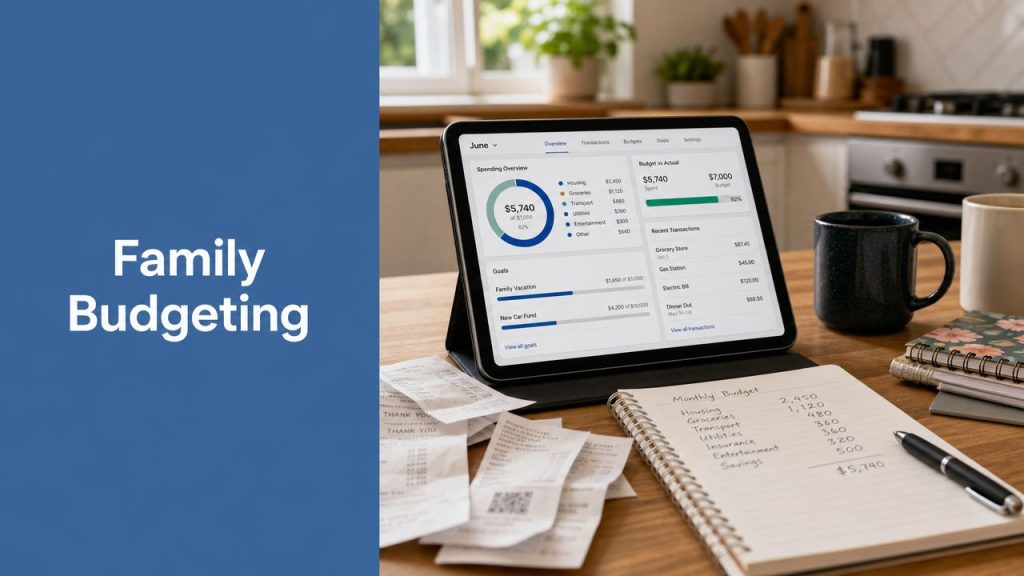
The first step is simply knowing where your money goes. If you aren’t already tracking your spending, grabbing one of the best free budgeting apps can give you a clear picture and help you find opportunities to earn more rewards.
Let's see how quickly the miles can add up with a typical budget.
Real-Life Example: A Family's Monthly Spending
This table shows how a family spending $2,500 a month can build their mileage balance. Some cards offer bonus miles on things like dining or groceries, but for this example, we’ll stick to a straightforward baseline of one mile per dollar.
| Monthly Expense Category | Monthly Spend | Miles Earned (at 1x per dollar) |
|---|---|---|
| Groceries | $800 | 800 Miles |
| Gas & Commuting | $300 | 300 Miles |
| Utilities & Bills | $400 | 400 Miles |
| Dining & Entertainment | $500 | 500 Miles |
| Shopping & Other | $500 | 500 Miles |
| Total | $2,500 | 2,500 Miles |
Just by paying for their normal expenses, this family would pocket 30,000 miles in a year. For many airlines, that’s already enough for a free domestic round-trip flight.
The Power of the Sign-Up Bonus
Earning miles month by month is great, but the real shortcut to a free flight is the sign-up bonus. This is a huge, one-time drop of miles you get after being approved for a card and hitting a certain spending target (like spending $3,000 in the first 3 months).
A good sign-up bonus can be anywhere from 40,000 to 75,000 miles. That initial windfall is often enough to book one or even two domestic round-trip tickets right out of the gate, providing a ton of value upfront.
This bonus is the single biggest reward most people will ever get from a card. For many, it’s the one thing that makes the annual fee immediately worth it, since the value of the miles can easily be worth hundreds of dollars.

This "earn while you spend" model truly makes travel more accessible. When you combine the steady trickle of miles from daily life with a big sign-up bonus, your next trip suddenly feels a lot closer.
The Perks That Outweigh Annual Fees
Sure, racking up miles for a "free" flight down the road is nice, but the real magic of airline credit cards often happens on day one. These aren’t some fuzzy, long-term benefits; they're immediate, hard-cash savings that can make the annual fee feel like a bargain after just one trip.
Let's do the math on the perks that really matter.
The Free Checked Bag Advantage
The easiest win, by far, is the free first checked bag. With most airlines charging $35 or more each way for a suitcase, those fees can gut your vacation budget, especially if you're traveling with family.
Real-Life Example: Family Vacation Savings
Imagine a family of four heading out on a single round-trip vacation.
- Without a card: 4 people x 1 bag each way x $35/bag x 2 flights = a painful $280 in baggage fees.
- With the right airline card: $0.
Just like that, a card with a standard $95 annual fee has already saved you $185 on a single trip. For a lot of people, that calculation alone is all the proof they need.
Priority Boarding Is More Than a Convenience
Next up is priority boarding. This might sound like a simple ego boost, but its true value is all about securing that precious overhead bin space. As planes fill up, being in the last boarding group often means getting your carry-on forcibly gate-checked. It’s a frustrating and time-consuming start to any trip.
Having an airline card gets you on the plane earlier, pretty much guaranteeing you and your carry-on will stick together. Think of it as carry-on insurance. If you want to dig deeper, this guide to understanding priority boarding benefits is a great resource. It's not about skipping the line—it's about starting your vacation with less stress.
These perks have become even more crucial now that airlines are pushing restrictive 'basic economy' fares. For instance, just by holding the right AAdvantage® credit card, you can still get your free checked bag and preferred boarding even on those bare-bones tickets. Some United cards even offer a 10% discount on award flights, dropping a 100,000-mile redemption down to 90,000—a straight-up savings.
The Power of the Companion Certificate
This one can be a game-changer. The companion certificate, offered on cards like the Alaska Airlines Visa Signature® card and some of the higher-end Delta Amex cards, is easily one of the most valuable perks in the entire travel world. It lets you book a flight for a friend or family member for just the taxes and fees (usually from $99).
Real-Life Example: The Companion Certificate in Action
Let's say you and your partner have your eyes on a trip from Seattle to Hawaii.
- A standard round-trip ticket costs $600.
- With a companion certificate, you buy your ticket at that price.
- Your partner's ticket? It costs you just $99 + taxes.
You just saved over $500 on a single booking. That one perk can pay for the annual fee many times over. For more ways to squeeze every drop of value from your travels, check out our full guide to travel hacks for 2026.
When you start to quantify these benefits, you quickly realize an airline card's annual fee isn't just another bill. It's an investment in cheaper, better travel.
Figuring Out Your Personal Break-Even Point
So, is an airline credit card actually worth the annual fee? It’s not a mystery—it’s just simple math. To see if a card is a smart move for your wallet, you need to calculate your personal break-even point. Forget generic advice; this is about putting the numbers to work for you.
The formula is surprisingly simple but incredibly powerful:
(Value of Perks You Use + Value of Miles You Earn) – Annual Fee = Net Value
If the final number is positive, the card is paying for itself and then some. If it’s negative, you’re probably better off with a different card, maybe even a no-fee cashback option.
Let's run the numbers for two very different travelers.
Scenario 1: The Solo Business Traveler
First up is Alex, a consultant who flies four times a year on the same airline for work. Alex uses a mid-tier card with a $250 annual fee. Here’s the breakdown:
| Perk/Benefit Used | Calculation | Value |
|---|---|---|
| Lounge Access | 4 visits x $50 per visit | $200 |
| Priority Boarding | 4 round trips x $25 value per trip | $100 |
| Free Checked Bag | 2 round trips x $70 per trip | $140 |
| Miles Earned | 15,000 miles earned x 1.3 cents/mile | $195 |
| Total Value | $635 | |
| Less Annual Fee | -$250 | |
| Net Value | $385 |
For Alex, this card is a no-brainer. The perks alone more than wipe out the annual fee, making the miles pure profit. This doesn't even factor in the sign-up bonus, which would easily add hundreds more in value that first year.
Running these numbers is much easier when you know where your money is going. Our guide on how to create a monthly budget is a great place to start.
Scenario 2: The Vacationing Family
Now, let’s look at the Miller family—two adults and two kids. They take one big vacation a year and are always looking for ways to cut travel costs. They’re loyal to the main airline that flies out of their home airport.
For a family, the math can be even more compelling, as perks often scale.

Let's say the Millers get a higher-tier card with a $650 annual fee. It sounds steep, but watch what happens when they use the perks.
The Millers' Calculation:
| Feature Used | Calculation | Dollar Value |
|---|---|---|
| Free Checked Bags | 4 people x $70 per round trip | $280 |
| Companion Certificate | Value of 1 adult ticket | $450 |
| Total Value of Perks | $730 | |
| Less Annual Fee | -$650 | |
| Net Value | $80 |
Even before earning a single mile on their spending, the card is already putting $80 back in their pocket. Every dollar they spend and every mile they earn from here on out just adds to their total return.
By taking a few minutes to run these numbers for your own travel habits, you can stop guessing and know for sure if an airline card is right for you.
When an Airline Credit Card Is a Bad Idea
While these cards look great on paper, they aren’t for everyone. In fact, for some people, signing up for an airline card is more than just a missed opportunity—it can be a genuine financial mistake.
Knowing when to walk away is just as important as knowing when to apply. Let's talk about a few situations where you're better off skipping the airline card.
You Don't Fly Very Often
If you’re only in the air once or twice a year, it’s going to be tough to get your money's worth. The real value in these cards comes from using perks like free checked bags and priority boarding over and over. When you don't travel much, you just don't have enough chances to use them.
Think about it: a card with a $95 annual fee means you need to save at least $95 in perks to break even. If you’re flying solo and checking one bag, you’d need to take at least two round-trip flights just to cover the fee with baggage savings. If that doesn't sound like you, you’re essentially paying for benefits you'll never use.
You Aren't Loyal to One Airline
Do you hop on Google Flights and book the absolute cheapest ticket, no matter who’s flying the plane? If your loyalty is to your wallet and not a specific airline, a co-branded card will feel more like a trap than a tool.
These cards are designed to lock you into a single airline’s ecosystem.
- Your miles are stuck: The points you earn are only good for that airline or its partners. You lose the freedom to book a great deal on a rival carrier.
- Your perks don't travel: That free checked bag on Delta is worthless when you find a flight on Spirit that’s $100 cheaper.
If you’re a deal-hunter, you’re almost always better off with a flexible cash-back card or a general travel card. You’ll earn rewards you can use anywhere, without being tied down.
You Carry a Credit Card Balance
This is the big one. If you even think you might carry a balance from month to month, please steer clear. Airline cards, like most rewards cards, have notoriously high interest rates (APRs)—often well over 20%.
Let me be crystal clear: carrying a balance on one of these cards makes any rewards you earn completely worthless. The interest you'll pay will cost you far more than a free flight or a checked bag ever could.
Imagine you charge a $1,500 vacation to a card with a 25% APR. If you only chip away at it with minimum payments, you could easily pay over $500 in interest before it's paid off. That $70 you saved on baggage fees? It’s gone, and then some. You've just turned your "free" reward into a massive expense. Before diving into rewards cards, your financial foundation needs to be solid; learning how to build an emergency fund is the best place to start.
Your Final Verdict for 2026
So, after all the number-crunching and benefit breakdowns, what’s the final call on airline credit cards in 2026? The honest answer isn’t one-size-fits-all. It really just boils down to your personal travel style.
For the right kind of traveler, these cards deliver real, tangible value that you can feel in your wallet. The decision hinges on a simple question: will you consistently use the perks enough to make the annual fee a non-issue?
The Real Value Proposition
At its core, an airline card's main job is to act as a shield against the endless wave of airline fees. It’s less about earning aspirational flights and more about practical, immediate savings.
The quickest way to see a return is by using just one or two key benefits. A single round-trip with a free checked bag for you and a travel buddy can easily save you $140, often paying for the card's annual fee in one shot.
Of course, the trade-off is being locked into one airline and paying that yearly fee. If you're someone who prizes flexibility above all, an airline-specific card is going to feel more like a chain than a key.
So, Who Is an Airline Card Actually For?
Let's break it down into two simple paths.
An airline card is a great fit if: You’re loyal to one airline, fly at least a couple of times a year, and almost always check a bag. If that sounds like you, the card will likely pay for itself with just the perks alone.
A general travel or cashback card is a better bet if: You're a deal-hunter who simply books the cheapest flight available, regardless of the airline. The same goes if you only travel once in a while and won't get to use the airline-specific benefits.
Ultimately, the right card is the one that fits how you already spend and travel. And while you’re optimizing your travel rewards, don’t forget about the rest of your financial picture. Exploring smart options like high-yield savings accounts to maximize your cash can be a powerful partner to your rewards strategy.
Take a minute to do your personal break-even math. It’s the only way to move forward with confidence, knowing you’ve made the best choice for your wallet.
Frequently Asked Questions
1. Will an airline credit card hurt my credit score?
Applying for any new credit card results in a "hard inquiry," which can cause a small, temporary dip in your credit score (usually just a few points). However, using the card responsibly by paying your bill on time and in full each month will likely improve your credit score over the long term by building a positive payment history and increasing your available credit.
2. Is an airline card better than a general travel rewards card?
It depends entirely on your travel habits.
- Airline Card: Best if you are loyal to a single airline. The specific perks (free checked bags, priority boarding, lounge access on that airline) provide direct value that a general card can't match.
- General Travel Card: Better if you are a "free agent" who books the cheapest flight available, regardless of the carrier. Cards like the Chase Sapphire Preferred offer flexible points you can transfer to multiple airlines or use to book travel directly, giving you more freedom.
3. What credit score do I need for an airline card?
Most co-branded airline cards with valuable perks require a "good" to "excellent" credit score, which is typically 670 or higher. If your score is below this range, you may have difficulty getting approved and should focus on building your credit first.
4. Do I have to pay for my flight with the airline card to get the perks like a free bag?
In most cases, no. The free checked bag benefit is usually linked to your frequent flyer account, not the specific transaction. As long as your airline card is open and your frequent flyer number is on your reservation, you should receive the perk. However, always double-check the card's specific terms and conditions.
5. How many miles do I need for a free flight?
There's no single answer, as airlines use dynamic pricing. A short domestic flight during an off-peak season might cost as little as 7,500 miles, while a long-haul international flight in business class could cost 150,000 miles or more. The "price" in miles constantly changes based on demand, route, and time of booking.
6. Will my miles expire?
It depends on the airline's policy, but it's usually easy to prevent. For most programs, any account activity—like earning miles from a flight, a credit card purchase, or an online shopping portal—resets the expiration clock on your entire mileage balance. With many airline credit cards, your miles won't expire as long as your card account remains open.
7. What happens to my miles if I cancel my card?
Your miles are safe. The miles you earn are deposited directly into your frequent flyer account with the airline, not the credit card company. They belong to you even if you close the card. What you will lose are all the card-specific benefits like free checked bags, priority boarding, and the ability to earn more miles on your spending.
8. Is there a difference between miles earned from flying and miles from a credit card?
No, a mile is a mile. Whether you earn it by flying or by swiping your card for groceries, it goes into the same frequent flyer account and has the same value when you redeem it for a flight.
9. How does a companion certificate work?
A companion certificate is like a buy-one-get-one-for-a-discount coupon. You buy a regular cash ticket for yourself, and you can then book a ticket for a companion on the same flight for just the cost of taxes and fees (often starting from $99). These are extremely valuable but come with rules and restrictions (like blackout dates and eligible fare classes), so reading the fine print is crucial.
10. Are airline cards worth it if I only fly domestically?
Absolutely. For many people, this is where the card provides the most value. You don't need to fly internationally to benefit. Saving $70 per round trip on a checked bag for yourself, or $280 for a family of four, can easily offset a card's annual fee on just one or two domestic trips a year.
Related Posts

Previous Post
Next Post
Previous Post

Next Post