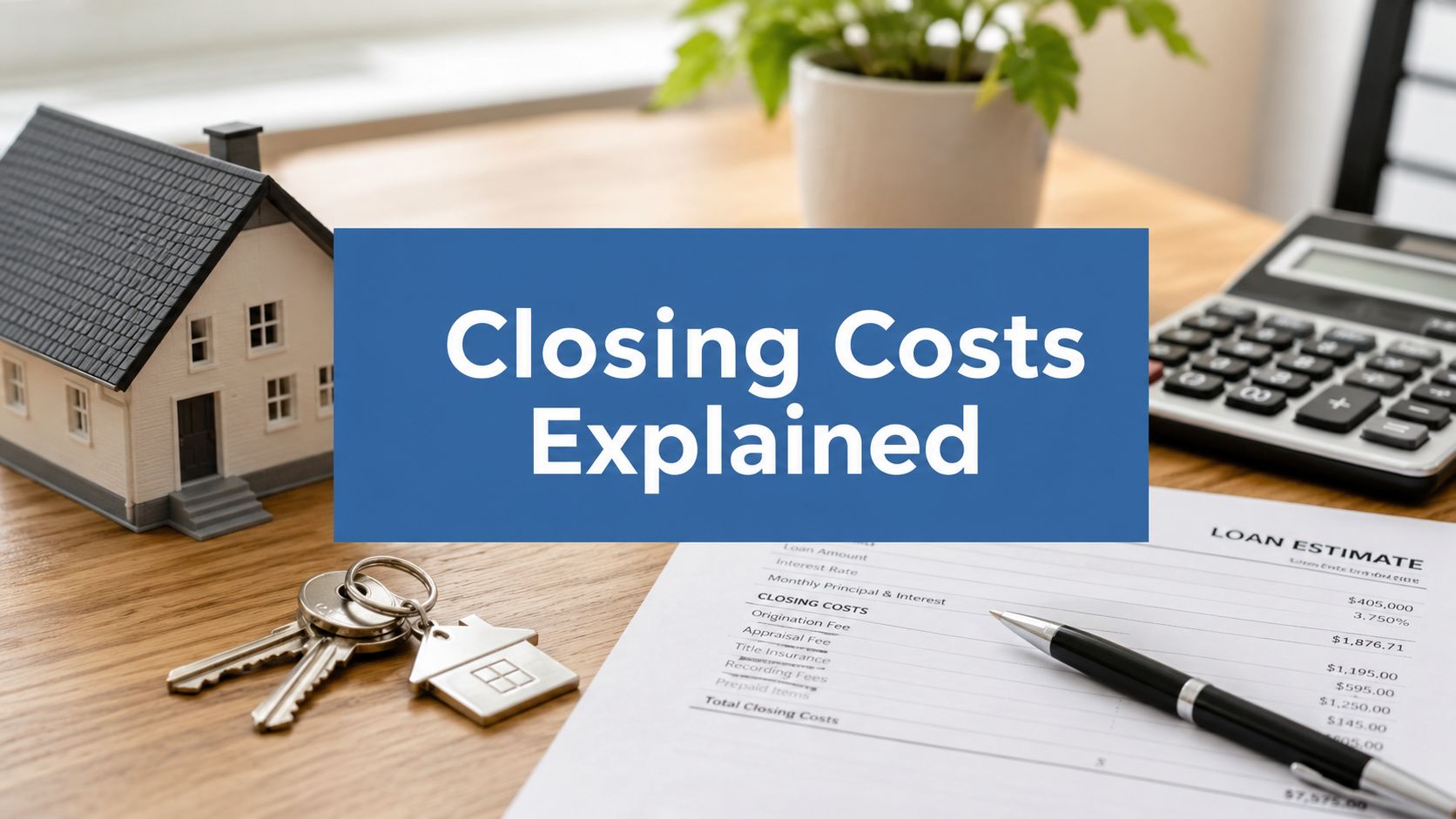
Closing Costs Explained: A Complete Guide for Buyers in 2026
When you’re buying a home, the down payment gets all the attention. But it's only one piece of the puzzle. There's another major expense you must prepare for: closing costs.
Think of them as the final round of fees you pay to make the home officially yours. They cover all the services and administrative work required to finalize the home purchase, transfer ownership, and hand you the keys. This guide, updated for 2026, will walk you through everything you need to know.
By Mark Thompson, Certified Mortgage Advisor (CMA) with 15+ years of experience helping first-time homebuyers navigate the closing process. My goal is to demystify these costs and empower you to save money.
Table of Contents
- What Are Closing Costs and How Much Should You Budget?
- Breaking Down Your Closing Costs, Line by Line
- A Real-World Closing Disclosure Walkthrough
- Actionable Strategies to Lower Your Closing Costs
- Closing Costs for Sellers Compared to Buyers
- Your Closing Day Checklist and Final Steps
- 10 Frequently Asked Questions About Closing Costs
- 1. Can I roll closing costs into my mortgage?
- 2. What’s the catch with a "no-closing-cost" mortgage?
- 3. Are closing costs tax-deductible?
- 4. Can I use a cash gift for my closing costs?
- 5. Why do closing costs vary so much between states?
- 6. Who actually pays for the title insurance?
- 7. What’s the difference between a down payment and closing costs?
- 8. How accurate is my initial Loan Estimate?
- 9. What happens if I'm short on cash at closing?
- 10. Can I negotiate every single closing fee?
What Are Closing Costs and How Much Should You Budget?
So, you’ve saved diligently for a down payment and found your dream home. The last thing you want is a surprise bill for thousands of dollars right at the finish line. Unfortunately, that's a reality for many unprepared homebuyers.
Closing costs are completely separate from your down payment. They are a collection of fees paid to all the different people and companies who helped make your home purchase happen, from your lender to the title company and local government.
These costs generally fall into three buckets:
- Lender Fees: Charges from your mortgage provider for creating, underwriting, and processing your loan.
- Third-Party Fees: Payments for essential services from independent companies, such as the home appraisal, title search, and credit report.
- Prepaid Items & Escrow: Your first payments for ongoing expenses like property taxes and homeowners insurance, which are collected upfront to establish your escrow account.
Setting Your Budgetary Target
A good rule of thumb is to budget between 2% to 6% of your total loan amount for closing costs. It's crucial to note this is based on the loan amount, not the home's purchase price. The exact percentage depends heavily on your state's tax laws and the specific services required.
So, if you’re taking out a mortgage of $400,000, you could expect to pay anywhere from $8,000 to $24,000 in closing costs.
To help you visualize this, here’s a quick breakdown of potential costs at different loan amounts.
Quick Look at Estimated Closing Costs by Loan Amount
| Mortgage Amount | Estimated Closing Costs (2%) | Estimated Closing Costs (6%) |
|---|---|---|
| $250,000 | $5,000 | $15,000 |
| $400,000 | $8,000 | $24,000 |
| $550,000 | $11,000 | $33,000 |
| $700,000 | $14,000 | $42,000 |
As you can see, the range can be quite wide, which is why getting a specific estimate from your lender is so important once you start the process.
Expert Insight: Planning for this expense is just as important as saving for the down payment. In my experience, I've seen deals fall through at the last minute because a buyer came up short on closing costs, even after being approved for the loan. Don't let this happen to you.
Mastering your finances is key to any major purchase. For more great financial planning advice, check out these UAE financial strategy insights.

Because these costs are significant, you need to build them into your savings plan from day one. A solid budget will help you see where your money is going and how you can start setting aside funds for both the down payment and your closing costs.
To get started on the right foot, take a look at our guide on how to create a monthly budget.
Breaking Down Your Closing Costs, Line by Line
Getting your Loan Estimate can feel like you're trying to read a secret code. It's just a long list of unfamiliar terms and numbers. But once you understand how it's organized, it all starts to make sense.
The best way to think about it is like an itemized receipt for the biggest purchase you'll ever make. Every single charge has a role to play in making that home officially yours. Let's break it down into the three main groups of fees you’ll find on almost every statement.
1. Lender Fees
First up are the fees your mortgage lender charges directly. These cover the cost of their work in putting your loan together, from the initial application to the final approval. You have the power to reduce these fees by shopping around and comparing offers from multiple lenders.
- Loan Origination Fee: This covers the lender's administrative work to process your application. It’s typically a percentage of your total loan, usually around 0.5% to 1%.
- Underwriting and Processing Fees: This is the charge for the behind-the-scenes work of verifying all your financial documents and giving your mortgage the official green light.
- Credit Report Fee: A small but necessary fee the lender pays to pull your credit scores and history from the major credit bureaus.
2. Third-Party Fees
This next batch of costs goes to all the other independent professionals involved in your home purchase—not your lender. These services are essential to make sure the transaction is secure and that the property is a sound investment. For many of these, you have the right to shop around for your own provider to find a better price.
- Appraisal Fee: An independent appraiser will assess the home's fair market value. This reassures the lender (and you) that the property is worth the price you've agreed to pay.
- Title Search & Insurance: A title company does the critical work of researching the property's history to confirm there are no hidden ownership claims or liens. This fee pays for both the lender's required policy and your own owner's policy.
- Home Inspection: You'll hire a professional to give the property a thorough physical check-up, looking for any potential defects or repairs you should know about.
- Survey Fee: This pays for a surveyor to officially map and confirm the property's legal boundaries.
- Attorney Fees: Depending on your state, you may be required to have a real estate attorney review documents and oversee the closing.
While scanning your documents, you might also see charges for special assessment real estate. It's important to know what these are, and this helpful guide explaining MUDs and HOAs breaks it down clearly.
3. Prepaid Items and Escrow
The final category isn't really a "fee" at all. It's your own money that you’re paying upfront. These funds are collected at closing to pre-fill an escrow account that your lender will manage for you.
Expert Insight: Think of your escrow account as a dedicated savings account for your home's major bills. You make a small deposit every month as part of your mortgage payment, and the lender pays the bills (like property taxes and insurance) when they come due. This prevents you from facing a huge, unexpected bill once a year.
Here are the most common prepaid items:
- Property Taxes: You'll likely need to pay for several months of property taxes upfront to give your escrow account a healthy starting balance.
- Homeowners Insurance: Your first full year's insurance premium is almost always paid in full at closing.
- Prepaid Interest: This covers the interest on your loan for the period between your closing date and the end of the month.
Understanding how all these pieces fit together is the key to reviewing your loan documents with confidence. If you're looking to learn more about the bigger picture, our real estate investment guide is a great place to start.
A Real-World Closing Disclosure Walkthrough
Theory is great, but nothing prepares you like seeing the actual numbers on paper. Let's step away from the definitions and walk through a real-life scenario to see how all those costs we've talked about come together.
Real-Life Example: The Chen Family's First Home
The Chens are buying a $400,000 home in Texas with a 20% down payment, so their loan amount is $320,000. At least three business days before closing day, a critical, five-page document lands in their inbox: the Closing Disclosure (CD). This is where it all gets real. Their main job is to put this document side-by-side with their initial Loan Estimate and play detective.
From Estimate to Final Numbers
Think of your Loan Estimate as your lender's best guess and the Closing Disclosure as the final, locked-in bill. While some numbers, like the loan origination fee, must match perfectly by law, others have a little wiggle room. For example, your prepaid interest might shift slightly if your closing date gets pushed back a day or two.
The most important number on your Closing Disclosure is the "Cash to Close." For the Chens, this number is $89,750. This is the final, bottom-line amount they need to bring to closing. It’s their $80,000 down payment plus $10,500 in closing costs, minus a $750 credit they received from the seller for a minor repair.
To see how that "Cash to Close" number is built, this infographic breaks down the three main buckets your costs will fall into.

As you can see, the final total is a mix of lender fees for creating the loan, third-party fees for services like the appraisal and title search, and the initial funds you'll put into escrow for taxes and insurance.
Understanding Cost Proportions
It’s important to know that many closing costs are fixed fees. An appraisal or a title search costs about the same whether the house is big or small. This means closing costs can feel disproportionately high on lower-priced homes.
Research from the Urban Institute shows this clearly: a buyer with a $97,000 mortgage might pay $4,500 in closing costs—that's 4.6% of the loan! The flat fees for services simply make up a larger percentage of a smaller loan.
Red Flag Warning: The biggest thing to watch out for is a major, unexplained jump in the "Loan Costs" section between your Loan Estimate and the final Closing Disclosure. If a number looks way off, stop and ask your loan officer for a line-by-line explanation immediately. Don't sign anything until you understand every charge.
Getting comfortable with this final document will give you the confidence you need to cross the finish line. For a bigger-picture look at the entire home-buying process, check out our crash course in real estate to master the basics.
Actionable Strategies to Lower Your Closing Costs
While some closing costs are set in stone, you absolutely have more control than you might think. A few smart moves can save you thousands, turning you from a passive participant into an empowered buyer. Think of it as a game plan for keeping more of your hard-earned cash.
Your biggest lever for savings starts before you even find a house: shop for your lender. Don't just go with the first pre-approval you get. Collect official Loan Estimates from at least three different lenders and compare them line by line. Look past the interest rate and scrutinize the lender-specific fees for origination, processing, and underwriting. A 0.25% difference in origination fees can save you hundreds.
Master the Art of Negotiation
Once you find the right home, your purchase offer becomes your most powerful negotiating tool. A common and highly effective strategy is asking for seller concessions, where you negotiate for the seller to pay a portion of your closing costs.
Real-Life Example: Let's say you're buying a $380,000 home. You negotiate for the seller to provide a $5,000 credit toward your closing costs. This means you need to bring $5,000 less cash to the closing table. In a buyer's market, sellers are often willing to make this trade to close the deal.
Little-Known Ways to Save
Even the day you close can make a difference. Lenders charge you prepaid interest for the remaining days in the month, so scheduling your closing toward the end of the month can trim this cost significantly. Closing on the 28th means paying just a few days of interest, while closing on the 5th sticks you with nearly a full month's worth.
You also don't have to use the providers your lender suggests for everything. Your lender is required to give you a list of third-party services you can shop for yourself, like title insurance and settlement services. A few phone calls to different title companies could easily save you hundreds of dollars.
Some costs are up for grabs, while others aren't. Knowing the difference is key to focusing your efforts where they'll have the biggest impact.
Comparison Table: Negotiable vs. Fixed Closing Costs
| Cost Category | Can You Shop/Negotiate? | Typical Examples |
|---|---|---|
| Lender Fees | Yes (Shop Lenders) | Origination fees, application fees, underwriting fees |
| Title Services | Yes (Shop Providers) | Title search, title insurance (both lender's and owner's) |
| Settlement Agent | Yes (Shop Providers) | The attorney or escrow agent handling the closing |
| Home Inspection | Yes (Shop Providers) | You choose your own inspector and negotiate their fee |
| Survey Fee | Yes (Shop Providers) | You can shop for a licensed surveyor |
| Property Taxes | No | Set by the local government and are non-negotiable |
| Transfer Taxes | No (But Negotiable) | Rate is fixed, but you can negotiate who pays (buyer/seller) |
| Recording Fees | No | Fixed fees charged by the county to record the deed |
Ultimately, focusing on the services you can shop for—like your lender, title company, and home inspector—gives you the best shot at lowering your bill.
A "no-closing-cost" mortgage isn't really free. The lender pays your closing costs but makes up for it by charging a higher interest rate or by rolling the fees into your total loan amount.
This might work if you're short on cash upfront, but you'll pay more over the long run. It's a classic financial dilemma that often boils down to whether it's better to pay off your mortgage faster or invest the difference.
Closing Costs for Sellers Compared to Buyers
It’s a common misconception that buyers are the only ones getting hit with a long list of fees at closing. While they certainly have their share of mortgage-related expenses, sellers have their own tab to settle, too.
Think of it this way: the buyer’s costs are mostly tied to securing their new loan, while the seller’s costs are all about finalizing the sale and transferring the property. Knowing who pays for what is crucial for a smooth closing without any last-minute financial surprises.
What Sellers Typically Pay
For nearly every seller, one expense towers above the rest: the real estate agent commission. This is usually the largest closing cost by a long shot, typically running 5% to 6% of the home's final sale price. This fee gets split between the seller's agent and the buyer's agent for getting the deal done.
Beyond that big-ticket item, sellers can expect to cover a few other costs:
- Transfer Taxes: This is a tax levied by your state or local government for the privilege of transferring the property title to the new owner. It’s sometimes called a "deed tax."
- Prorated Property Taxes: You'll pay for your share of the property taxes, covering the exact time you owned the home during that year.
- Attorney Fees: Some states require that sellers hire their own real estate attorney to prepare closing documents and represent their interests.
- Owner's Title Insurance: It's a common custom in many areas for the seller to buy the owner's title insurance policy for the buyer. This acts as a gesture of good faith, assuring the buyer the property title is free and clear.
Comparison Table: Buyer vs. Seller Closing Costs
Here’s a simple breakdown of the most common closing costs and who traditionally picks up the check. Remember that local customs and negotiations can alter this.
| Closing Cost Item | Typically Paid by Buyer | Typically Paid by Seller | Negotiation Point? |
|---|---|---|---|
| Loan Origination Fee | Yes | No | No |
| Appraisal Fee | Yes | No | No |
| Agent Commissions | No | Yes | Yes (Commission Rate) |
| Transfer Tax | Sometimes | Often | Yes (Who Pays) |
| Owner's Title Insurance | Sometimes | Often | Yes (Who Pays) |
| Lender's Title Insurance | Yes | No | No |
| Home Inspection | Yes | No | No |
| Prorated Property Taxes | Yes (From Closing) | Yes (Up to Closing) | No |
But remember, almost everything in a real estate deal can be negotiated. In a competitive seller's market, a motivated buyer might offer to pay a fee that the seller usually covers. On the flip side, in a slower buyer's market, sellers might offer "concessions" to pay some of the buyer's closing costs to help get the sale across the finish line.
Your Closing Day Checklist and Final Steps
You're in the home stretch! The final days before getting your keys can feel like a whirlwind, but a little preparation goes a long way. Think of this as your game plan to ensure you walk into closing feeling organized and ready, not stressed.

The Final Countdown Timeline
By law, your lender must provide your Closing Disclosure (CD) at least three business days before you’re scheduled to sign the papers. This document is a big deal—it’s the final, itemized list of your loan terms and fees.
Expert Tip: Take this three-day window seriously. This is your last chance to compare the CD to your original Loan Estimate and question anything that looks off. If a number seems wrong or you don't recognize a fee, call your loan officer right away. Don’t wait until you’re sitting at the closing table.
You’ll also do your final walkthrough during this time. This isn't another inspection. It's a quick visit to make sure the home is in the same condition you agreed to buy it in and that the seller has completed any promised repairs.
What to Bring to Closing
Closing day involves signing what feels like a mountain of documents. Forgetting one of the required items can bring the whole process to a screeching halt, so it’s best to come prepared.
Here’s what you absolutely need:
- A government-issued photo ID, like your driver’s license or a passport for all individuals on the loan.
- A cashier’s check or proof of a wire transfer for the final "Cash to Close" amount listed on your CD. To avoid fraud, always call the title company or attorney using a verified phone number to confirm wiring instructions before sending any money.
- Your copy of the Closing Disclosure so you can reference it as you sign.
Having a solid financial cushion is one of the smartest things you can do as a new homeowner. For a great walkthrough on setting up your safety net, check out our guide on how to build an emergency fund.
10 Frequently Asked Questions About Closing Costs
1. Can I roll closing costs into my mortgage?
For most standard purchase loans (Conventional, FHA, VA), you cannot roll your closing costs into the loan. They must be paid as a separate, out-of-pocket expense at closing. The main exception is with a refinance, where you can often roll the costs into the new loan balance if you have sufficient equity.
2. What’s the catch with a "no-closing-cost" mortgage?
There's no free lunch. With a "no-closing-cost" loan, the lender covers your upfront fees but compensates by charging you a significantly higher interest rate for the life of the loan. This means you save cash today but pay much more in the long run.
3. Are closing costs tax-deductible?
Generally, no. Most closing costs are not tax-deductible for a primary residence. The major exception is mortgage discount points (prepaid interest), which can often be deducted in the year you buy the home. Always consult a tax professional for advice specific to your situation.
4. Can I use a cash gift for my closing costs?
Yes, absolutely. Using gift money from a close relative is very common. However, your lender will require a signed gift letter from the donor stating it's a true gift and not a loan. You'll also need to provide bank statements showing the paper trail of the funds transfer.
5. Why do closing costs vary so much between states?
It all comes down to local and state laws and taxes. States like New York and Pennsylvania have high transfer taxes, which can add thousands to your bill. Other states have very low or no transfer taxes. Property tax rates and title insurance regulations also differ significantly by location.
6. Who actually pays for the title insurance?
It's confusing because two policies are involved. The buyer is almost always required to pay for the Lender’s Title Insurance policy, which protects the lender. Who pays for the Owner’s Title Insurance policy (which protects you) is a point of negotiation and varies by local custom. Often, the seller is asked to cover this cost.
7. What’s the difference between a down payment and closing costs?
They are two separate buckets of money. Your down payment is a percentage of the home's purchase price that you pay upfront, reducing your loan amount. Closing costs are the collection of fees you pay to the various parties (lender, title company, etc.) who facilitated the transaction.
8. How accurate is my initial Loan Estimate?
It should be fairly accurate. By law, some costs, like lender origination fees, cannot change on your final Closing Disclosure. Costs for third-party services you can shop for are allowed to increase by up to 10%. Prepaid items like taxes and insurance are adjusted based on your exact closing date.
9. What happens if I'm short on cash at closing?
This is a critical issue that can jeopardize the entire sale. If you find yourself in this situation, you must act fast. Options include asking the seller for a credit (if still possible), discussing a "lender credit" with your loan officer in exchange for a higher interest rate, or securing a last-minute, properly documented gift from family.
10. Can I negotiate every single closing fee?
No, not every fee. Government-mandated fees like county recording charges or state transfer taxes are non-negotiable. However, you can and absolutely should negotiate lender fees by comparing quotes from multiple lenders. You also have the right to shop around for your own third-party service providers, like title and settlement companies, to find better rates.
At Everyday Next, we believe in making complex financial topics easy to understand so you can make confident decisions. For more insights into managing your money and building wealth, explore our resources at https://everydaynext.com.
Previous Post
Next Post