Gold Price Today: Your Ultimate Guide to Market Fluctuations
Keeping an eye on the gold price today? You're not alone. As an investor with over a decade of experience navigating the commodities market, I've learned that the price of gold is a living, breathing indicator of global economic health and investor sentiment. Those shifts are driven by everything from major economic news to the collective mood of investors worldwide.
This guide is built on first-hand experience and in-depth research to provide you with the clarity you need to understand not just what the price is, but why it moves.
Your Real-Time Gold Price Snapshot
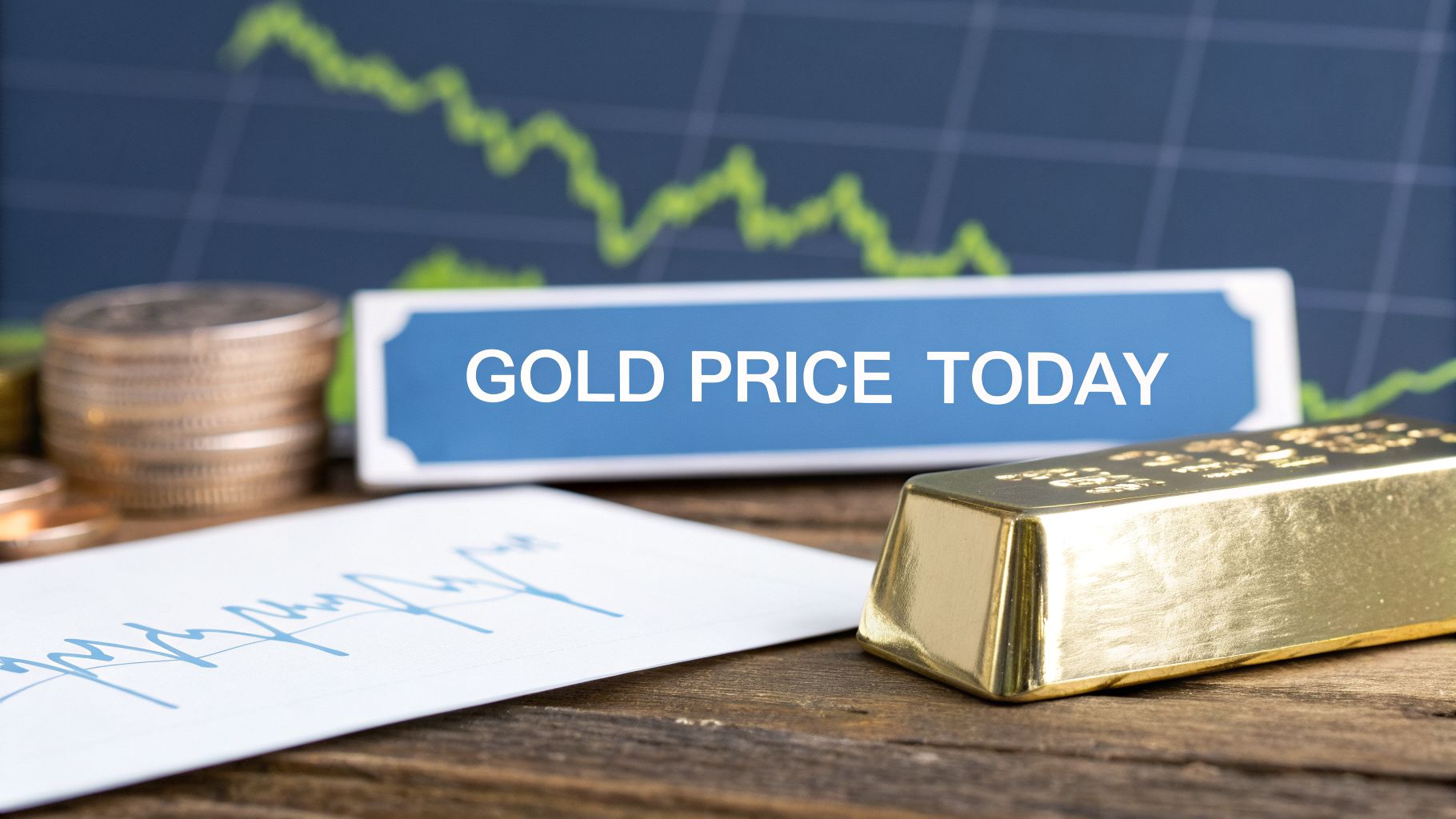
When you hear someone talk about the "price of gold," they're almost always referring to the spot price. Think of it as the live, up-to-the-second cost for one troy ounce of gold if you were to buy it for immediate delivery. This is the benchmark number that flashes across financial news channels and serves as the starting point for nearly every gold transaction. Whether you're buying a small gold coin or a massive institutional bar, the spot price is the foundation.
To get a real feel for these daily swings, it helps to understand what the gold spot price is at its core—it's a global balancing act of supply and demand. The action really heats up when the world's major trading centers, like London and New York, are open at the same time. You can see these key overlaps by checking the hours for the worlds major stock markets.
Today's Gold Price at a Glance (as of Feb 27, 2026)
Here’s a quick look at the numbers to give you a sense of where gold stands today and how it's been moving recently. This data paints a picture of gold's incredible run into 2026, where it has climbed to new heights, underscoring its importance in times of economic uncertainty.
| Metric | Value | Change |
|---|---|---|
| Current Spot Price | $5,278.00 | +1.80% (Daily) |
| Previous Close | $5,165.00 | – |
| 30-Day Change | -$142.15 | -2.62% |
| Year-over-Year Change | +$2,425.00 | +84.75% |
Real-Life Example: On February 27, 2026, the price hit $5,278 per ounce. That's a solid 1.80% jump in just one day and a massive 84.75% surge compared to the previous year. This powerful rally highlights just how important gold becomes when the economic future feels uncertain. Even with a slight dip over the last month, the market's confidence is strong. The price was holding firm around $5,165 just the day before, showing how quickly sentiment and value can shift based on new economic data or geopolitical events.
What Really Moves the Price of Gold Daily
The numbers you see flashing on a screen are the end result of a massive global tug-of-war. The gold price today doesn't just wander aimlessly; it's constantly reacting to powerful economic forces and raw human emotion. If you can get a feel for these drivers, you can start to see the real story unfolding behind the price charts.
One of the most classic relationships in finance is between gold and the U.S. dollar. Just picture them on a seesaw. When the dollar's value drops, gold often rises, and when the dollar strengthens, gold tends to fall. Because gold is priced in U.S. dollars everywhere, a weaker dollar makes it cheaper for foreign investors to buy, which can boost demand and nudge the price higher.
This image breaks down the key numbers you’ll see when you check the gold price.

It shows more than just the current spot price. You also get the daily and yearly changes, which together paint a picture of both immediate market reactions and longer-term investor confidence.
Interest Rates and Opportunity Cost
Another huge factor is interest rates, especially the moves made by the U.S. Federal Reserve. Gold is what’s known as a non-yielding asset—it doesn't pay you interest or dividends just for holding it. When interest rates go up, other investments like government bonds or even a high-yield savings account suddenly look a lot more appealing because they offer a guaranteed return.
This creates an opportunity cost for holding gold. Why keep your money in a metal that pays nothing when you could be earning a steady 5% return elsewhere? Some investors will sell their gold to chase those yields, causing the price to drop. On the flip side, when interest rates get cut, gold becomes much more attractive, and its price often climbs. The dance between interest rates and inflation is a tricky one; you can learn more about how the Federal Reserve plans to tackle inflation in our detailed guide.
Gold as a Safe-Haven Asset
During shaky times, gold’s reputation as a safe-haven asset truly comes to the forefront. When geopolitical conflicts flare up, economies stumble into recession, or political instability creates chaos, investors often run to gold. They see it as a dependable store of value when other assets, like stocks and currencies, feel far too risky.
In fact, the surge in precious metal prices to record highs in early 2025 was driven primarily by strong demand amid escalating geopolitical tensions and elevated economic uncertainty.
The market volatility we've seen in 2026, for instance, has been closely tied to ongoing global tensions. This "flight to safety" creates a surge in demand for gold, pushing its price up, sometimes dramatically. It’s the reason you’ll see the gold price today leap after news of an international conflict or a surprise economic downturn.
Central banks are also major players here. Since 2024, many have been bulking up their gold reserves to protect themselves against currency risks, adding another powerful layer of demand that helps support higher prices.
How to Read Gold Prices Like an Expert
When you glance at the gold price today, you're looking at more than just a number. You're seeing the end result of a complex, global story. Learning to speak the market's language is your first real step toward making smart decisions, moving you from a passive observer to an informed participant.

You'll mainly run into two prices: spot and futures. Think of the spot price as the "right now" price for gold delivered immediately. The futures price, on the other hand, is a contract to buy or sell gold later at a price agreed upon today. For most of us buying coins, bars, or jewelry, the spot price is the one to watch.
From Ounces to Grams
Globally, gold is priced in troy ounces, a measurement with roots stretching back to the Middle Ages. But in the real world, you might be buying a 10-gram bar or a piece of jewelry weighed in grams. This is where a little bit of math becomes your best friend.
This quick reference table makes it easy to see how these units relate and why they matter for different types of gold products.
Understanding Gold Units and Conversions
| Unit | Equivalent in Grams | Common Use |
|---|---|---|
| 1 Troy Ounce | 31.103 grams | The global standard for pricing gold bullion. |
| 1 Gram | 1 gram | Common for jewelry and smaller investment bars. |
| 1 Kilogram | 1,000 grams | Used for large investment bars and central bank holdings. |
Real-Life Example: So, if the spot price is $5,200 per troy ounce, how much is a single gram? Just divide: $5,200 / 31.103 = $167.18 per gram. Knowing this simple conversion helps you compare prices accurately, whether you're looking at a massive kilo bar or a tiny one-gram piece. It’s a fundamental detail that provides clarity, much like understanding the basics before investing in the S&P 500 index.
The Bid-Ask Spread Explained
Ever noticed that when you go to buy or sell gold, there are two different prices? That's the bid-ask spread in action, and it's how dealers make their money.
- Bid Price: This is what a dealer will buy gold from you for. It's their "bid" to take it off your hands.
- Ask Price: This is what a dealer will sell gold to you for. It's the price they are "asking."
The ask price is always higher than the bid price. A simple way to remember it is that dealers buy low (at the bid) and sell high (at the ask).
Real-Life Example: Let's say the spot price for gold is $5,200. A dealer's website might show a bid price of $5,180 and an ask price of $5,230. If you're buying, you'll pay $5,230, which is the spot price plus the dealer's premium. If you're selling, you'll receive $5,180. That $50 gap is their profit for facilitating the trade. For a common 1-ounce Gold Eagle coin, this spread is typically tight, but for less common items, it can be wider.
What Experts Are Saying About Gold Prices in 2026
So, where is the gold market going from here? Nobody has a perfect crystal ball, but the world’s biggest financial players spend a fortune analyzing every market twitch to forecast where gold prices might go. Looking at their predictions gives us a rare peek into their thinking and helps us understand the "why" behind the market's mood.
For 2026, the general feeling is incredibly bullish. Most major banks are betting it will climb even higher. This consensus is built on a few key ideas: the expectation that central banks will start cutting interest rates, ongoing geopolitical tension, and the fact that central banks themselves are buying up gold like there’s no tomorrow.
Wall Street's Big Bets on Gold
Some of the biggest names in finance are putting out some seriously bold forecasts. That kind of institutional optimism is a powerful signal that they see gold as a must-have asset. Here’s a comparative look at their recent calls:
| Institution | 2026 Price Target | Key Rationale |
|---|---|---|
| Bank of America | $6,000 / oz | Anticipated Federal Reserve policy shifts and strong central bank buying. |
| Goldman Sachs | $5,400 / oz | Increased "fear-driven" demand from retail investors seeking a hedge. |
| J.P. Morgan | $5,055 / oz (avg) | Consistent demand and a gradual easing of monetary policy. |
| UBS | $6,200 / oz | Potential for a run to $7,200 if geopolitical conflicts escalate. |
You can dig deeper into these revised targets and the thinking behind them in The Street's recent analysis.
What this really tells us is that gold's role is evolving. It’s not just a simple insurance policy anymore; it's becoming a go-to asset for protecting wealth in a world full of question marks.
Reading Between the Lines of Analyst Forecasts
While the exact price targets might differ from one bank to another, the core logic is pretty much the same. The experts believe that when central banks finally start lowering interest rates, it becomes cheaper to hold a non-yielding asset like gold, making it a much more appealing choice. This lines up with what many respected voices in finance are saying. If you're curious about other expert takes, it's worth checking out what Tom Lee's latest market predictions are as well.
At the end of the day, these forecasts provide a valuable frame for the current market. They suggest that the experts don't see the recent strength in the gold price today as just a fleeting blip. Instead, they see it as the beginning of a major, long-term shift in how the global financial system works.
Your Practical Guide to Investing in Gold
So, you've seen how the price of gold moves and what influences its daily shifts. Now, you might be wondering, "How do I actually get started?" Investing in gold isn't a one-size-fits-all deal. The best approach for you really depends on what you're trying to accomplish, your risk tolerance, and whether you prefer holding a physical asset or a digital one.

Let's walk through the most common ways to invest in gold. By comparing them side-by-side, you'll get a clear picture of the pros and cons, which will help you decide what makes the most sense for your own financial journey.
Comparing Your Gold Investment Options
| Investment Method | Best For… | Key Considerations |
|---|---|---|
| Physical Bullion (Coins & Bars) | Investors who want direct, tangible ownership and ultimate control over their asset. | Requires secure storage and insurance; premiums over spot price can be higher. |
| Gold ETFs (e.g., GLD, IAU) | Those seeking easy, low-cost exposure to gold prices through a regular brokerage account. | You don't own the physical metal; subject to management fees (expense ratios). |
| Gold Mining Stocks (e.g., GDX) | Investors who are comfortable with higher risk for potentially higher returns, leveraging company performance. | Price depends on company management and operational efficiency, not just the gold price. |
| Digital & Tokenized Gold | Tech-savvy investors looking for modern, flexible ownership with low transaction fees. | Newer and less established; requires trust in the platform securing the digital asset. |
For many individual investors, the biggest draw is gold’s low correlation with stocks. It often acts as a form of portfolio insurance when the stock market takes a nosedive, making it a powerful diversifier. This is backed by serious demand, with over 1,200 tonnes in anticipated bar-and-coin purchases and 250 tonnes of ETF inflows expected. You can dive deeper into this trend in Bank of America's updated gold market analysis.
Real-Life Scenarios to Guide Your Choice
Let's look at how these options play out in a few common situations.
Scenario 1: You want a "just in case" emergency fund. If your main goal is to have a tangible asset on hand for a worst-case scenario, your best bet is buying well-known coins like American Gold Eagles or Canadian Maple Leafs from a reputable dealer. You have complete control, but remember, you'll need a safe place to store them. For instance, a small home safe might suffice for a few coins, but a larger holding would require a bank's safe deposit box.
Scenario 2: You want to diversify your 401(k) or IRA. For anyone looking to add some gold exposure to their retirement account without the hassle, a gold ETF like the SPDR Gold Shares (GLD) is the most practical choice. You can buy and sell it just like a stock, and the fees are usually quite low. You can learn more about different approaches in our guide on investing strategies for beginners.
Beyond the classic methods, new ways to own gold are emerging. For example, understanding how Gold Tokenization works can open up new, flexible investment paths that combine the time-tested security of gold with the speed and efficiency of digital assets.
Key Takeaway: There’s no single "best" way to invest in gold. The right method for you is the one that lines up with your financial goals, whether that's long-term wealth preservation, portfolio diversification, or simply getting your foot in the door of the market.
Frequently Asked Questions (FAQ) About Gold Prices
1. What's the difference between the spot price and what I'll actually pay for a gold coin?
The spot price is the baseline price for one troy ounce of raw gold. When you buy a physical coin or bar, you pay a premium above the spot price. This premium covers the costs of minting, distribution, and the dealer's profit. For example, if spot is $5,200, a one-ounce American Eagle might cost $5,285. That $85 is the premium.
2. How do interest rates affect the gold price today?
Gold is a non-yielding asset, meaning it doesn't pay interest. When interest rates rise, investments like bonds become more attractive because they offer a return. This creates an "opportunity cost" for holding gold, potentially pushing its price down. Conversely, when rates fall, gold becomes more appealing, and its price often rises.
3. Is it better to buy physical gold or a gold ETF?
It depends on your goals. Physical gold offers tangible ownership outside the financial system, which is ideal for "doomsday" prepping or direct control. Gold ETFs offer easy, low-cost exposure to gold's price in a standard brokerage account, perfect for portfolio diversification without the hassle of storage.
4. Why do central banks buy so much gold?
Central banks buy gold to diversify their reserves away from a single currency (like the U.S. dollar) and to hedge against inflation and geopolitical risk. Gold is a universally accepted store of value that isn't tied to any one government's policy, making it a critical tool for national economic stability.
5. What time of day is the gold price most volatile?
The gold price is typically most volatile during the overlap of the London and New York trading sessions, from approximately 8:00 AM to 12:00 PM EST. This is when trading volume is highest, leading to larger and more frequent price movements.
6. How is the purity of gold measured and why does it matter?
Purity is measured in karats or fineness. 24-karat gold is pure (.999 fine), while 14-karat is 58.3% gold mixed with other metals. Purity is crucial because it determines the item's intrinsic value. The price of a gold necklace is based on its actual gold content, not its total weight.
7. Can I trust online gold price charts?
Yes, provided you use reputable sources. For the most accurate, live data on the gold price today, rely on major financial news outlets like Bloomberg and Reuters, or commodity exchanges like COMEX. They source their data directly from global markets.
8. Does a strong economy always mean a lower gold price?
Not necessarily. While a strong economy can reduce gold's "safe-haven" appeal, it can also boost demand for jewelry and industrial applications (like in electronics). These factors can offset reduced investment demand and provide a floor for the gold price.
9. What are the main risks of investing in gold?
The primary risks are price volatility (its value can fall as well as rise), storage and insurance costs for physical gold, and its lack of yield. Unlike stocks or bonds, gold doesn't generate income through dividends or interest payments.
10. How does the US dollar's value impact the global gold price?
There is typically an inverse relationship. Because gold is priced in U.S. dollars globally, a weaker dollar makes gold cheaper for buyers using other currencies. This increased buying power can drive up demand and, consequently, the price of gold in dollar terms.
At Everyday Next, we believe that understanding complex topics like finance is the first step toward building a more secure future. Our goal is to give you the clear, practical insights you need to make smart decisions. To continue your journey, explore more of our guides and analysis.
Related Posts
Previous Post
Next Post