
How to Develop a Growth mindset: A Practical Guide to Unlocking Your Potential
If you want to cultivate a growth mindset, the first step is internalizing a single, powerful idea: your intelligence and abilities are not set in stone. They can be grown through dedication and hard work.
Instead of seeing a tough challenge as an impassable wall, you start to see it as a hurdle—an opportunity to learn and get better. This small but profound shift from "I can't do it" to "I can't do it yet" is the real engine behind personal and professional transformation.
This guide is based on years of observing and implementing these principles, both personally and in coaching others. It's not about quick fixes; it's about building a sustainable framework for lifelong learning and resilience.
The Two Mindsets: Growth vs. Fixed
Before you can build a new way of thinking, you have to understand the old one you might be leaving behind. The concept, brought into the mainstream by Stanford psychologist Carol S. Dweck, boils down to two fundamental beliefs we hold about our own abilities. This belief system is like the operating system for your brain, dictating how you process everything from failure to success.
You can get a much deeper look into her original research in our breakdown of Carol S. Dweck's groundbreaking book.
A fixed mindset is built on the assumption that our character, intelligence, and creative talents are static traits. They’re just part of who we are, and they don't change much. From this perspective, every success is just proof of the intelligence you already have, and every failure is a judgment on your core abilities.
On the flip side, a growth mindset absolutely thrives on challenge. It reframes failure not as a verdict on your intelligence but as a crucial part of the learning process—a launchpad for stretching your abilities. Believing that anyone can grow with effort and experience is the key to unlocking your true potential.

Seeing Mindsets in the Real World: Two Students
Let's look at a quick, real-world example I've seen play out countless times. Imagine two students, Alex and Ben. Both just got a C- on a tough math test.
- Ben (Fixed Mindset): His first thought is, "See? I'm just bad at math. I'll never get this." He starts avoiding math homework and dreads the next class, convinced it’ll just prove his lack of ability. He sees the grade as a final verdict.
- Alex (Growth Mindset): His reaction is totally different. He thinks, "Okay, that didn't work. I need to pinpoint what I don't understand and find a better way to study for the next one." Alex doesn’t see the grade as a label, but as valuable data pointing him toward what to work on next.
This simple scenario shows how deeply our mindset can affect our actions. Ben’s belief becomes a self-fulfilling prophecy, shutting down his potential. Alex’s belief opens the door to new strategies, more effort, and, eventually, better results.
A Direct Comparison: Beliefs and Behaviors
To truly grasp the difference, let’s put the core beliefs of each mindset side-by-side. The table below highlights how these opposing views shape our reactions to everyday situations, from tackling a difficult project to hearing a bit of criticism. As you read through it, see if you can spot your own default tendencies.
| Attribute | Growth Mindset (The Belief in 'Yet') | Fixed Mindset (The Belief in 'Is') |
|---|---|---|
| Core Belief | Intelligence and skills can be developed through dedication and hard work. | Intelligence and skills are innate, unchangeable traits. You're either born with them or not. |
| Reaction to Challenges | Embraces challenges as opportunities to learn and grow, persisting in the face of setbacks. | Avoids challenges to prevent potential failure, which could reveal a lack of inherent ability. |
| View on Effort | Sees effort as the path to mastery and skill development. It is essential for success. | Views effort as fruitless or, worse, a sign of low natural talent. "If I have to try, I'm not good at it." |
| Response to Criticism | Welcomes feedback and constructive criticism as valuable information for improvement. | Ignores or becomes defensive in response to negative feedback, taking it as a personal insult. |
| Success of Others | Finds lessons and inspiration in the success of others, seeing what is possible. | Feels threatened by the success of others, often leading to a sense of jealousy or inadequacy. |
Recognizing these patterns in your own thinking is the first, and most important, step toward shifting your perspective.
Rewiring Your Brain with Practical Cognitive Reframing
Knowing the difference between the two mindsets is one thing; actively retraining your brain's default settings is another. This is where cognitive reframing comes into play. It's the conscious act of shifting your perspective on a situation to change how you feel and react to it. This isn't about toxic positivity or ignoring reality—it's about finding a more empowering way to interpret what’s happening.
The whole process starts by tuning into your internal monologue, that constant commentary running in your head. When a challenge pops up, what's its first reaction? Does it immediately jump to, "I'm not smart enough for this," or "What if I fail?" Spotting this fixed-mindset voice is the first, most critical step.

Embrace the Simple Power of Yet
One of the most powerful and immediate reframing tools is simply adding the word "yet" to your self-doubting thoughts. It's a tiny linguistic shift that tells your brain that your current state isn't a permanent roadblock. That one word turns a dead end into an open road for future growth.
- "I don't understand this report" becomes "I don't understand this report… yet."
- "I'm not a good public speaker" becomes "I'm not a good public speaker… yet."
- "This new software isn't working for me" becomes "This new software isn't working for me… yet."
See the difference? This small addition creates mental space for learning and improvement. It acknowledges where you are right now without accepting it as your final destination.
Catching and Challenging Your Inner Critic
That fixed-mindset voice is like a pessimistic inner critic that loves to deal in absolutes and thrives on the fear of failure. To really cultivate a growth mindset, you have to learn to talk back to that voice with logic and evidence, gradually replacing it with a more supportive inner coach.
Just look at how these two voices might handle the exact same situation:
| Scenario | Fixed Mindset Inner Critic | Growth Mindset Inner Coach |
|---|---|---|
| A project gets critical feedback. | "I knew I wasn't good enough. My boss thinks I'm incompetent. I'm a total failure." | "Okay, this feedback is specific and helpful. What can I learn from these points to make the next version better?" |
| Struggling to learn a new skill. | "This is just too hard for me. I'll never get it. Everyone else is picking it up way faster." | "This is challenging, which means my brain is building new connections. What's one small part I can focus on today?" |
| Making a mistake in front of colleagues. | "How embarrassing! Everyone saw me mess up. They must think I have no idea what I'm doing." | "Mistakes happen. This is a chance to show I can handle it professionally. I'll correct it and move on." |
This internal negotiation happens all day, every day. By consciously shifting your inner dialogue, you’re doing more than just "thinking positive"—you're actively building resilience and sharpening your problem-solving skills. Diving into our guide on mastering emotional intelligence can add another powerful layer to this practice.
From Failure to Valuable Data: A Real-Life Example
A true cornerstone of cognitive reframing is completely changing your relationship with mistakes. In a fixed mindset, failure feels like a judgment on your core intelligence or talent—something to be avoided at all costs. But in a growth mindset, failure is just data.
A setback is not a verdict on your ability; it is feedback on your current strategy. It gives you the exact information you need to adjust your approach and try again, only smarter this time.
Let's take a real example from the business world: Sara Blakely, the founder of Spanx. Her father used to ask her and her brother at the dinner table every week, "What did you fail at this week?" If they didn't have a failure to report, he would be disappointed. This reframed failure for her from something to be ashamed of into a sign that she was trying, pushing boundaries, and learning. That mindset was foundational to her ability to endure hundreds of rejections while building her billion-dollar company.
The research backs this up. Studies reveal that only about 40% of people are naturally growth-oriented. For the other 60%, it takes intentional effort. Something as simple as praising the process ("You worked so hard on that!") can double someone's desire to take on challenges. And reframing setbacks as learning moments helps people stick with difficult tasks up to 40% longer. You can dig deeper into these findings in recent mindset studies.
How to Embrace Challenges and Value Effort
Once you’ve started to rewire your internal monologue, the real work begins. It's time to translate those new thoughts into action. This is all about actively seeking out challenges and completely changing how you see "effort." It means stepping outside your comfort zone—not just mentally, but in your career and your day-to-day life.
Someone with a fixed mindset views their comfort zone as a safe harbor, a place to hide from potential failure. But if you're aiming for a growth mindset, you have to see that same zone as a barrier holding you back. Real, meaningful growth only ever happens right at the edge of what you can already do.
Finding Your Sweet Spot for Growth
The secret is to operate in the zone of just manageable difficulty. This is the sweet spot where a task is tough enough to stretch your abilities but not so hard that you just get frustrated and give up. Pushing yourself into this zone is literally how you form new neural pathways and build solid skills.
Here’s what that looks like:
- Too Easy: A veteran public speaker giving the same talk for the tenth time. They’re not growing; they're just performing a skill they’ve already mastered.
- Too Hard: That same speaker gets asked to give a keynote in a foreign language with zero prep time. That’s a recipe for failure, not growth.
- Just Right: The speaker volunteers to present on a new topic to a slightly larger audience. This is a perfect, manageable step that builds new confidence and real expertise.
Think about a writer who's an expert at blogging. To grow, they might take on their first long-form article for a major publication. It leverages their core writing skills but pushes them into new territory with more intense research and a tougher editing process.
Dismantling the Myth of Effortless Success
One of the most dangerous beliefs tied to a fixed mindset is the idea that if you have real talent, things should come easily. If you have to try hard, it must mean you're not a "natural." A growth mindset completely flips this on its head.
Effort isn't a sign of weakness; it is the engine of skill-building. It's the process that turns your potential into actual ability.
Instead of being embarrassed by your hard work, learn to celebrate it. When you see someone making a complex task look easy, you're only seeing the final performance. You're not seeing the thousands of hours of deliberate practice that came before it.
To really start valuing effort, try looking at your activities through a new lens.
| Activity | Fixed Mindset Focus (Outcome-Oriented) | Growth Mindset Focus (Process-Oriented) |
|---|---|---|
| Learning a New Software | "Am I an expert yet? Why haven't I mastered this?" | "I put in a solid hour today learning the new features. I'm proud of my focus and persistence." |
| Starting a Fitness Program | "Did I lose five pounds this week? The scale didn't budge." | "I made it to the gym three times this week, even when I was tired. I'm building a consistent habit." |
This simple shift redefines what you count as a "win." The goalpost moves from some distant, often uncontrollable outcome to the immediate, controllable action of putting in focused work.
Make Your Effort Visible with a Log
A fantastic way to reinforce the value of your process is to keep an effort log. This isn't about tracking results like sales figures or project deadlines. It's about documenting the hard work itself.
At the end of each day or week, take a minute to jot down the answers to these questions:
- What challenge did I tackle today, even though it felt uncomfortable?
- Where did I apply focused effort, no matter the immediate result?
- What did I learn just from the act of trying?
This simple habit makes your hard work tangible. It gives you a written record of your dedication that can keep you motivated when results seem slow. It's concrete proof that you are actively building your skills, one tough task at a time. Embracing this process is key, especially when you're just getting started and feel paralyzed. You can dig deeper into this by reading our guide on overcoming analysis paralysis with bold action.
Putting Your Growth Mindset to Work in the Real World
Changing your internal monologue is a great start, but the real magic happens when a growth mindset moves from a good idea into daily practice. This is where the abstract concepts start creating tangible results in the areas of your life that matter most.
Let's break down how to apply these principles in four critical areas where the stakes are high and the potential for real growth is huge.
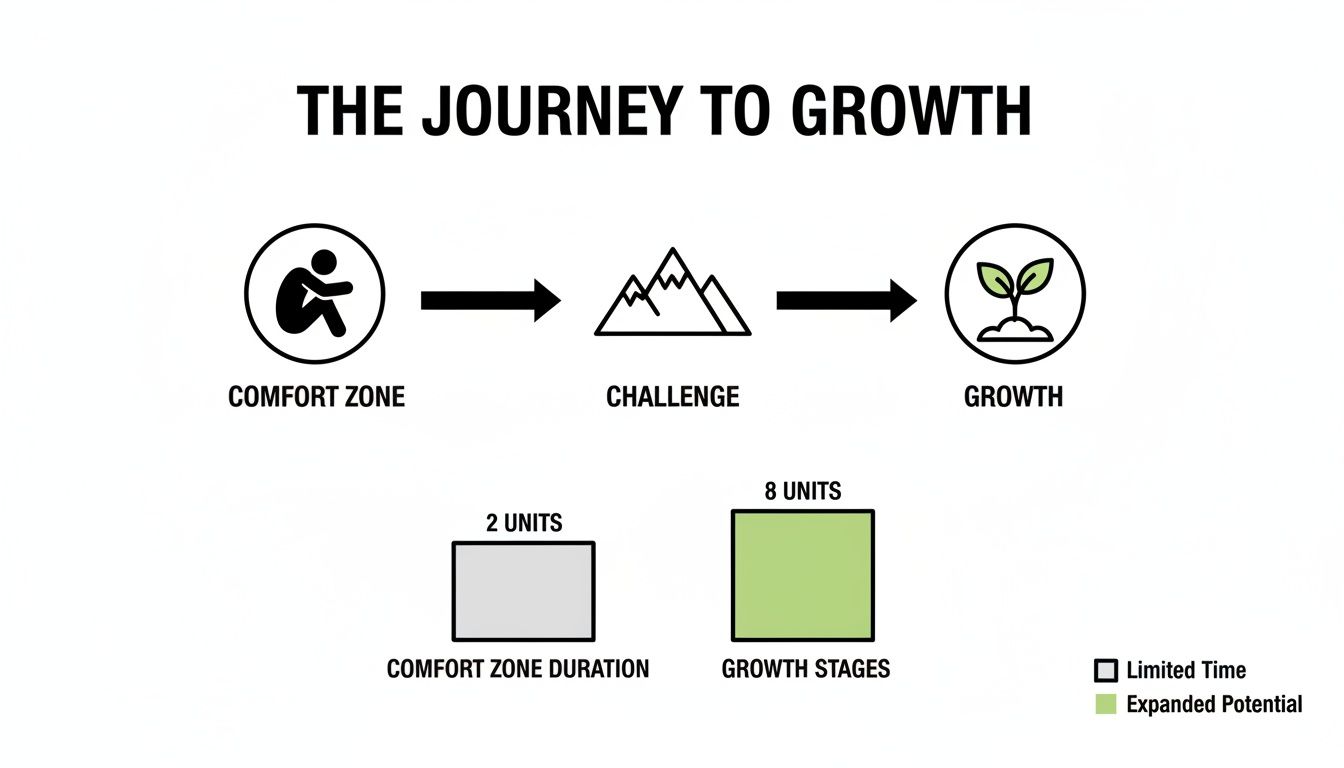
The key takeaway here is that growth isn't a single event. It’s a process, and it absolutely requires you to step into discomfort on purpose.
At Work: Advancing Your Career
In a professional setting, a growth mindset is often the dividing line between stagnation and advancement. You can see it in how people handle feedback, take on new projects, and even how they react to a colleague's success. Instead of seeing constructive criticism as a personal attack, you can reframe it as a free consultation on how to get better at your job.
Real-Life Example: Microsoft. Under CEO Satya Nadella, the company culture shifted dramatically from a "know-it-all" (fixed) to a "learn-it-all" (growth) mindset. This involved encouraging curiosity, admitting mistakes, and valuing learning over being right. This cultural pivot is widely credited with the company's resurgence and innovation in areas like cloud computing.
- Fixed Mindset Reaction: "They think my code is terrible. I'm clearly not cut out for this."
- Growth Mindset Action: "This feedback is gold. It’s pointing out my blind spots, and fixing these will make me a much stronger developer."
This kind of proactive drive is often fueled by an entrepreneurial mindset. For a deeper look, check out our guide on how the entrepreneurial mindset is the foundation for business success.
In Learning and Personal Development
Whether you're taking a formal course or just teaching yourself a new skill on YouTube, a growth mindset is your greatest ally. It’s that voice that tells you to keep going when a topic feels hopelessly complex. The goal isn't to look smart; it's to become smarter through effort and better strategies.
When you hit a roadblock, fight the urge to say, "I'm just bad at math" or "I'll never get this." Instead, try asking better questions:
- "What's a different way to look at this problem?"
- "Can I find a video or tutorial that explains this from another angle?"
- "Who could I ask for help to get a fresh perspective?"
This strategic approach to learning is far more effective than just banging your head against the wall by rereading the same chapter. Difficulty becomes a signal to change your strategy, not to give up.
In Parenting: Fostering Resilience
The words you use to praise your kids can shape their mindset for life. Praising them for innate talent ("You're so smart!") might seem harmless, but it can create a fixed mindset. It teaches them to fear any challenge that might threaten that "smart" label. A better approach is to praise the process—their effort, their strategies, their persistence. This helps them connect hard work directly with their achievements.
| Fixed Mindset Praise | Growth Mindset Praise |
|---|---|
| "You're a natural at soccer!" | "I was so impressed with how hard you practiced your footwork this week. It really paid off in the game!" |
| "You got an A without even studying? You're a genius!" | "You figured out a great way to study for that test. Your strategy really worked!" |
| "Don't worry, art just isn't your thing." | "That drawing was a great first try! What could we do differently on the next one?" |
When you praise their effort, you're handing them the keys. You're teaching them that their abilities are in their own hands to develop.
In Personal Finance and Investing
The financial world is a rollercoaster of volatility and uncertainty, which makes it a perfect testing ground for your mindset. When a market downturn hits, a fixed mindset sees it as a personal failure ("I'm terrible at investing") and often leads to panic selling at the worst possible time.
A growth mindset, on the other hand, frames market swings as learning opportunities. It prompts you to ask, "What is this downturn teaching me about my own risk tolerance? How can I use this experience to build a stronger long-term strategy?"
This perspective encourages learning from mistakes instead of being defined by them. It’s the difference between an emotional reaction and a strategic response—a crucial skill for building wealth over the long haul.
Building Resilience to Overcome Inevitable Setbacks
Adopting a growth mindset isn't a magical journey where everything suddenly becomes easy. You're going to hit bumps in the road. In fact, you can count on it. Setbacks aren't just a possibility; they're a guaranteed—and essential—part of learning anything worthwhile.
The real measure of a growth mindset isn't whether you stumble, but how you react when you do. This is where resilience enters the picture. It’s that psychological grit that lets you bounce back from disappointment and stay in the game when progress feels painfully slow.

From Setback to Stepping Stone: A Real-Life Example
The first order of business is to completely reframe what a setback means. Someone with a fixed mindset sees a mistake as a final judgment on their ability. This triggers feelings of shame and the urge to just give up. But with a growth mindset, that same mistake is just a piece of data.
Real-Life Example: Think of an innovator like James Dyson. The man went through 5,126 failed prototypes before he nailed his bagless vacuum. With every single failure, he didn't think, "I'm a terrible inventor." He asked, "What did I learn from this attempt?" That simple shift turns a dead end into a critical lesson.
The Role of Self-Compassion in Growth
When you fall short of a goal, it's easy for that harsh inner critic to take over. This is where self-compassion comes in, and it's not about making excuses. It’s simply about treating yourself with the same kindness you'd give a friend who's having a tough time.
Self-compassion is the antidote to the shame that can paralyze progress. It allows you to acknowledge your disappointment without letting it define your worth, giving you the strength to try again.
Instead of beating yourself up, try acknowledging the feeling—"Wow, I'm really frustrated this didn't pan out"—and then gently pivot to a growth-focused question: "What’s one thing I can do differently next time?" This approach helps you stay emotionally stable enough for the long haul. It's a core part of cultivating a growth mindset for resilience.
Turning Criticism into Fuel
Let’s face it, getting negative feedback can sting. It often feels like a direct hit to our competence, and our first instinct is to get defensive. A resilient, growth-oriented response means separating the feedback from your identity. The critique is about your work, not your worth.
Look at how differently you can process the same piece of criticism:
| Scenario | Fixed Mindset Reaction (Defensive) | Growth Mindset Response (Receptive) |
|---|---|---|
| A manager says your report lacks detail. | "They must think I'm careless. I worked so hard on that, and it's not good enough." | "Okay, this is useful. Can I ask for a specific example of where more detail would have been helpful?" |
| A client is unhappy with a project. | "This client is impossible to please. It's not my fault they kept changing their mind." | "I'm sorry to hear you're not satisfied. Let's walk through your concerns so I can understand where the gap is." |
When you actively seek to understand the criticism, you transform it from a personal attack into a free lesson on how to get better.
Ultimately, building resilience is about creating your own system for normalizing setbacks. It's about truly understanding that growth isn't a straight line. It's a messy series of experiments, tweaks, and renewed efforts. Every obstacle you overcome isn't just a win; it's a deposit into your personal bank of resilience, making you that much stronger for the next challenge.
Frequently Asked Questions (FAQ) on Developing a Growth Mindset
Here are answers to some of the most common questions people have when they start this journey.
1. What's the biggest difference between a growth mindset and a fixed mindset?
A growth mindset is the belief that your abilities and intelligence can be developed through dedication, effort, and learning. A fixed mindset is the belief that these traits are innate and unchangeable. This core difference dictates how you approach challenges, effort, and failure.
2. Can I really change my mindset if I've been fixed-minded my whole life?
Absolutely. Neuroplasticity, the brain's ability to reorganize itself by forming new neural connections, is the science behind this. It takes conscious effort and practice, like learning any new skill, but you can definitely shift your default thinking patterns over time.
3. How do I start developing a growth mindset today?
Start small. The easiest first step is to listen to your internal monologue. When you catch yourself thinking "I can't do this," consciously add the word "yet" at the end. "I can't do this… yet." This simple change opens the door to possibility and is a powerful first action.
4. Is a growth mindset just another term for positive thinking?
No. Positive thinking is about maintaining an optimistic outlook, which is helpful but not the same. A growth mindset is an action-oriented framework. It's not just hoping for the best; it's believing in your capacity to improve and then putting in the strategic effort to make it happen.
5. What if I put in a lot of effort and still fail?
A growth mindset is not a guarantee of success in every endeavor. Failure is part of the process. The key is to reframe that failure as a learning opportunity, not a verdict. Ask yourself: "What did I learn from this? What strategy didn't work? What will I do differently next time?" The effort itself, when applied strategically, is a win because it leads to growth.
6. Can a person have a growth mindset in one area of life and a fixed one in another?
Yes, this is very common. You might have a growth mindset about your career, believing you can learn any new professional skill, but a fixed mindset about your artistic abilities ("I'm just not creative"). The goal is to identify those fixed-mindset areas and begin applying growth principles to them.
7. How can I encourage a growth mindset in my children or team?
Focus on praising the process, not the person. Instead of saying "You're so smart," say "I was so impressed by the strategy you used to solve that problem." This connects their success to their effort and choices, which are within their control, rather than innate talent.
8. Does a growth mindset mean I should never give up on anything?
Not necessarily. A growth mindset also involves using smart strategies. Sometimes, the best strategy is recognizing that a particular approach isn't working and pivoting to something else. It's about persistence in your overall goal of growth, not necessarily sticking with a failed tactic indefinitely.
9. Are there any downsides to a growth mindset?
The main pitfall is "false growth mindset," where people agree with the principles but don't put them into practice, or they only praise effort without teaching effective strategies. True growth mindset is about both hard work and smart work—seeking help, trying new approaches, and learning from setbacks.
10. Where can I learn more about the original research?
The foundational book is "Mindset: The New Psychology of Success" by Carol S. Dweck. It's the best place to get a deep understanding of the studies and real-world applications that started this entire field.
At Everyday Next, we're committed to providing insights that empower your personal and professional growth. Explore our articles on personal development, tech, and finance to keep building your best future.
Discover more at https://everydaynext.com
This article is for educational purposes only and is not financial or investment advice. Consult a professional before making financial decisions.
Previous Post
Next Post