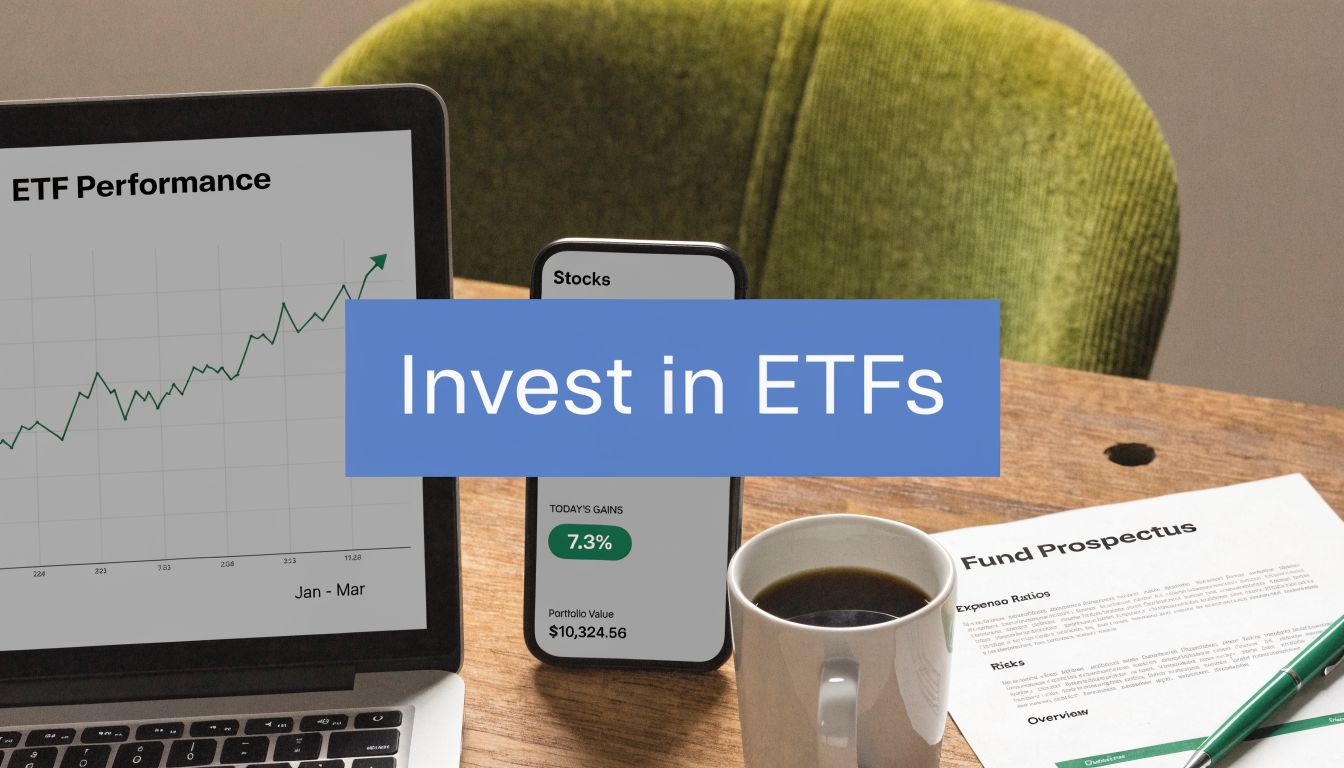
How to Invest in ETFs: Your 2026 Step-by-Step Guide
You’re probably here because you’ve done the responsible thing. You saved some cash, opened a finance app, searched for beginner investing advice, and immediately ran into a wall of jargon. Tickers. Expense ratios. Asset allocation. Market orders. It can feel like everyone else got a handbook you missed.
That confusion is normal. Most new investors don’t need more hype. They need a calm way to make decisions without feeling like they’re gambling. That’s where ETFs fit so well. They give you a practical entry point into investing without forcing you to pick individual stocks or build a complex portfolio from scratch.
An ETF can help you start small, stay diversified, and keep costs low. That combination is a big reason so many people begin there. If you’re outside the U.S. or want a region-specific primer, this guide to investing for Australian beginners is also useful alongside the core ideas here. Before you invest anything, it also helps to make sure you’ve covered basic financial stability first, like learning how to build an emergency fund.
This guide is built for the person who wants to understand how to invest in etfs with confidence, not just memorize definitions. You’ll learn what an ETF is, how to judge whether one is worth buying, how to place your first trade, and how to build a simple portfolio you can stick with.
Table of Contents
- Your Guide to Smarter, Simpler Investing
- What Exactly Is an ETF?
- How to Choose the Right ETFs for Your Goals
- Opening an Account and Placing Your First Trade
- Building Your First ETF Portfolio
- Common Mistakes and How to Avoid Them
- Frequently Asked Questions About ETF Investing
Your Guide to Smarter, Simpler Investing
A lot of people delay investing because they think they need three things first. More money, more knowledge, and better timing. In practice, most beginners need something else. A simple process they can trust.
ETFs work well because they reduce the number of decisions you have to make at the start. Instead of asking, “Which single company should I bet on?” you can ask, “Which broad group of investments matches my goal?” That’s a much safer and more useful question.
For a first-time investor, that shift matters. It turns investing from a high-pressure prediction game into a repeatable habit. You don’t have to become a market forecaster. You need to learn how to choose sensible funds, contribute consistently, and avoid expensive mistakes.
Practical rule: Your first ETF doesn’t need to be perfect. It needs to be understandable, diversified, and appropriate for your timeline.
Many smart beginners get stuck because they keep researching without acting. They compare ten funds, then twenty, then freeze. A better approach is to learn the key filters once and use them every time.
That’s why this guide focuses on decision-making, not just definitions. If you can understand what you own, why you own it, and how it fits your plan, you’re already operating with more discipline than many investors who chase headlines.
What Exactly Is an ETF?
An ETF, or exchange-traded fund, is a fund you can buy and sell on a stock exchange. The easiest way to picture it is as a basket of investments. That basket might hold stocks, bonds, or other assets, depending on the ETF’s purpose.
Buy one share of the ETF, and you own a small slice of everything inside the basket. That’s what makes ETFs appealing to beginners. You don’t need to buy dozens of individual holdings one by one to spread out your risk.

The basket idea that makes ETFs easy to grasp
Think about grocery shopping. You could buy ingredients separately for ten meals, or you could buy a prepared meal kit that already groups them for a purpose. An ETF is similar. It packages a set of investments into a single product.
That packaging has become a major part of modern investing. The global ETF market has grown to over $14 trillion in assets since its start in the 1990s, and the average expense ratio for ETFs is 0.36%, with some broad-market index ETFs charging as little as 0.02%, according to Kaplan’s ETF overview. Those lower costs are one reason many investors start with ETFs instead of more expensive products.
You’ll also hear the phrase index ETF. That usually means the ETF is designed to track a market benchmark, such as a large U.S. stock index. The fund isn’t trying to outsmart the market every day. It’s trying to follow a defined slice of it.
If you want a close cousin to compare with ETFs, it helps to also understand how to start investing in index funds, because many beginners confuse the fund structure with the investment strategy itself.
How ETFs differ from mutual funds
ETFs and mutual funds can look similar at first. Both pool investor money into one fund. The differences are mostly in how they trade and how they’re typically used.
Here’s a simple comparison:
| Feature | ETF | Mutual Fund |
|---|---|---|
| How you buy it | On an exchange through the trading day | Through the fund company or brokerage |
| Pricing | Changes during market hours | Usually priced once per day |
| Beginner appeal | Flexible, visible, easy to compare | Familiar in retirement plans |
| Common strength | Low costs, transparency, tax efficiency | Automatic investing is often easy |
For a new investor, the practical takeaway is simple. ETFs tend to be easy to access, easy to compare, and often cost-effective. That doesn’t mean every ETF is automatically good. It means the structure is useful.
ETFs let you simplify the first step. Simpler doesn’t mean simplistic. It means fewer moving parts to manage.
The main ETF types beginners see first
You don’t need to master every ETF category to get started. Most beginners will run into a short list first.
- Broad-market stock ETFs: These aim to cover a large part of a stock market, such as large U.S. companies. They’re often the default core holding for long-term growth.
- International ETFs: These hold companies outside your home market. They can help you avoid putting all your exposure in one country.
- Bond ETFs: These hold fixed-income securities and are often used to reduce portfolio swings or support income-oriented goals.
- Sector ETFs: These focus on one part of the market, such as technology or healthcare. They can be useful, but they’re usually better as a smaller supporting position than a whole portfolio.
- Thematic ETFs: These target trends or ideas, such as robotics, clean energy, or artificial intelligence. They can be interesting, but they require more caution because themes can become crowded fast.
A beginner usually does best by starting with one or two broad ETFs before branching out. You want your portfolio to be understandable at a glance. If you can’t explain what your ETF owns in one or two sentences, that’s a sign to slow down.
How to Choose the Right ETFs for Your Goals
The hard part of learning how to invest in etfs isn’t finding ETFs. There are thousands. The hard part is filtering the noise so you can choose funds that fit your goals.
That’s where a framework helps. Instead of picking the ETF with the flashiest name or the best recent chart, use a repeatable checklist. One useful approach is the SCOPE Framework, which was built to help investors narrow a very large field of options.

Start with the SCOPE method
The SCOPE Framework helps investors evaluate over 3,000 equity ETFs, and it emphasizes practical checks like tracking error and cost, according to ETF Action’s five-step framework.
Here’s what it looks like in plain English:
Screen
Start with your actual goal. Do you want long-term growth, income, lower volatility, or global diversification? Your goal should eliminate most ETFs immediately.Confirm exposures
Read what the ETF holds. A fund’s name can sound broad while its holdings are concentrated, or sound diversified while leaning heavily toward a few sectors.Observe
Check whether the ETF fits the current role you want it to play. A broad U.S. equity ETF works very differently from a single-sector fund.Probe
Look at the metrics that affect real-world results. Often, many beginners skip the details and buy based on brand familiarity alone.Examine issuer
Spend a few minutes on the provider’s site. Read the fund objective, methodology summary, fact sheet, and holdings page. A clear issuer usually makes a clear fund.
If you want to build a broader beginner process around this kind of structured decision-making, this guide on investing strategies for beginners pairs well with ETF selection.
The three metrics beginners should actually check
Most fund pages throw a lot of numbers at you. New investors don’t need all of them at first. Three checks will take you a long way.
| Metric | What it means | Why it matters |
|---|---|---|
| Expense ratio | The annual fee charged by the fund | Lower costs leave more of your return working for you |
| Tracking error | How closely the ETF follows its benchmark | Large gaps can quietly reduce long-term results |
| Liquidity | How easily you can buy or sell the ETF | Better liquidity usually means smoother trading |
The same ETF Action source notes that tracking error above 0.5% annually can erode returns by 1% to 2% over 10 years, and many experts emphasize keeping expense ratios below 0.20% when possible for core holdings.
That doesn’t mean every ETF above that line is bad. It means expensive funds should have a very good reason for existing in your portfolio.
A simple example of narrowing your choices
Say you’re a beginner with a long time horizon and you want a core stock ETF. You can narrow your search with a few questions:
- Is it broad or narrow? A broad-market ETF is usually easier to hold through ups and downs than a niche theme.
- Do I understand the holdings? If the top positions surprise you, keep digging.
- Is this a core fund or a side bet? A core fund should be plain, diversified, and low cost.
- Would I still want this if it underperformed for a while? If not, you may be buying a story, not a strategy.
A good way to test yourself is to compare a broad index ETF with a themed ETF. For example, an investor curious about AI could read a focused roundup like best AI ETFs for 2025, then ask a tougher question: does this belong in the small “explore” part of a portfolio, or am I trying to make it the foundation? For most beginners, the answer should be the first one.
What experienced investors do differently: They separate “interesting” from “essential.” Broad funds build the portfolio. Narrow funds express a view.
Many people often get confused. They think choosing the “best” ETF means choosing the one with the most exciting upside. Often it means choosing the one you can hold for years without needing to second-guess every headline.
Opening an Account and Placing Your First Trade
Choosing an ETF is only half the job. You also need the right account, a brokerage that doesn’t make simple tasks feel complicated, and a basic understanding of how to place the order.

Choose the account before you choose the ETF
Beginners often reverse this. They pick a fund first, then ask where it should live. Start with the account type.
A tax-advantaged retirement account is generally built for long-term retirement investing. A taxable brokerage account is more flexible and easier to access for goals outside retirement. Which one fits depends on your timeline, tax situation, and whether you need flexibility.
If you’re trying to understand how growth-focused ETFs fit inside a real brokerage setup, a simple explainer like what is QQQ can help decode the kind of ETF you’ll often see in trading apps.
What to look for in a beginner-friendly brokerage
A good brokerage should remove friction, not add it. You don’t need the platform with the most blinking tools. You need one that helps you execute a basic plan cleanly.
Look for these features:
- No-commission ETF trades: This keeps small recurring investments efficient.
- Fractional shares: Helpful if the ETF’s share price is high and you want to start with a modest amount.
- Clear order entry: The buy screen should be easy to understand.
- Research pages that show holdings and fees: You shouldn’t need detective work to find the basics.
- Automatic recurring investments: Useful if you want to invest on a schedule.
A lot of brokerage confusion comes from trying to use advanced tools too early. If your plan is buy-and-hold, your platform should support that habit.
Later, if you want a visual walkthrough of placing a trade and understanding the order screen, this short video is a helpful companion:
How to place the order without overthinking it
Two order types matter most at the start:
| Order type | What it does | When beginners usually use it |
|---|---|---|
| Market order | Buys or sells at the current available price | When the ETF is very liquid and the investor wants quick execution |
| Limit order | Sets the maximum price you’ll pay when buying, or minimum you’ll accept when selling | When you want more control over price |
A market order is simple, but the final fill price can move slightly while the order is being executed. A limit order gives you more control, though it might not fill if the market never reaches your chosen price.
For a first purchase, many investors prefer liquid, broad ETFs and place trades during normal market hours when pricing is more active.
That last point matters because some beginners place trades right at the open or when markets are thinly traded, then wonder why prices look jumpy. You don’t need perfect timing. You just want a straightforward execution process.
One more practical point. Your first trade doesn’t have to be large. A modest first purchase is often the best way to learn the mechanics while keeping emotions low.
Building Your First ETF Portfolio
Picking one ETF is a decision. Building a portfolio is a system. The system matters more, because your results usually depend less on finding a magical fund and more on how your pieces work together.
The central idea is asset allocation. That means how you divide your money among different types of investments, usually stocks and bonds first. A younger investor with a long runway may choose a more stock-heavy mix. Someone closer to needing the money may want more balance and stability.

Asset allocation is the real foundation
Asset allocation is where a lot of first-time investors get tripped up. They spend hours comparing similar stock ETFs while ignoring the bigger question of how much of the portfolio should even be in stocks.
The allocation framework summarized by Ally points to examples such as 80/20 stocks and bonds for more aggressive younger investors and 40/60 near retirement, and notes that a simple three-ETF portfolio with 60% global equity, 30% bonds, and 10% alternatives has historically delivered 7% to 9% annualized returns, according to Ally’s ETF portfolio strategy guide. The same source also notes that 70% of DIY investors fail to rebalance, which can cut returns by over 1% per year as the portfolio drifts.
That tells you something important. Your long-term behavior matters as much as your initial picks.
For readers who want a broader primer on spreading risk across holdings and asset types, this guide on how to diversify your portfolio is a helpful companion.
Sample Beginner ETF Portfolios 2026
These are examples of portfolio structure, not personalized advice. The actual ETF names you choose should depend on your brokerage, available funds, tax situation, and comfort with risk.
| Portfolio Name | Risk Profile | Allocation Example | Sample ETFs |
|---|---|---|---|
| One-Fund Starter | Simple growth-focused | One broad stock ETF | Broad U.S. market ETF or global equity ETF |
| Balanced Beginner | Moderate | Stock ETF + bond ETF | Broad equity ETF, total bond ETF |
| Three-Fund Core | Diversified long-term | U.S. stocks + international stocks + bonds | U.S. equity ETF, international equity ETF, bond ETF |
| Core Plus Satellite | Moderate to higher risk | Core broad ETFs plus a small sector or thematic sleeve | Broad equity ETF, bond ETF, small AI or tech ETF |
The appeal of the three-fund setup is that it gives you broad diversification without turning your account into a crowded watchlist. You can understand it quickly, rebalance it cleanly, and stick with it.
A common beginner mistake is assuming more ETFs automatically mean more safety. Sometimes they just mean more overlap. If you own several funds that all hold many of the same large companies, you may be adding complexity without changing your real exposure much.
Why rebalancing matters more than tinkering
Rebalancing means bringing your portfolio back to its target mix. If stocks rise and become a larger share of your portfolio than planned, you may need to add to bonds or direct new money there to restore balance.
You don’t need to rebalance every week. That often creates noise, not discipline. A simple annual review works well for many long-term investors.
Use a short checklist:
- Check your target mix: Are you still aiming for the same stock-bond split?
- Review drift: Have market moves changed the balance meaningfully?
- Add new money thoughtfully: Sometimes contributions alone can help correct drift.
- Trim complexity: If you’ve added too many side positions, simplify.
A durable portfolio should feel a little boring. Boring is often a sign that your system is doing its job.
One of the best signs that a beginner portfolio is solid is this. You can explain it in under a minute. “I own broad stock exposure, some international exposure, and bonds for balance.” That’s enough. It doesn’t need a heroic story.
Common Mistakes and How to Avoid Them
New ETF investors usually don’t fail because ETFs are too hard to understand. They struggle because they add emotion, urgency, or unnecessary complexity to a tool that works best when kept uncomplicated.
Mistakes that happen before the first purchase
The first mistake is buying an ETF because its theme sounds exciting. A fund can have a compelling label and still be a poor fit for a beginner portfolio. If you don’t know whether it’s a core holding or a narrow bet, pause.
The second mistake is ignoring costs because they look small. A fee written as a fraction of a percent can seem harmless, but small annual costs matter when they repeat for years. That’s why low-cost broad funds remain such a strong default for first-time investors.
The third mistake is assuming every ETF is equally simple. They aren’t. Some are built for tactical trading, some for narrow sectors, and some for more advanced strategies.
Mistakes that show up after the portfolio is built
One growing area of confusion is active ETFs. According to J.P. Morgan’s ETF guide, actively managed ETFs represent 7% of total ETF assets, while passive funds have seen over $4 trillion in inflows over the past decade. Active ETFs can offer advantages, but for beginners, their added complexity and often higher fees can make them a tougher starting point than straightforward passive index ETFs.
That doesn’t mean active ETFs are bad. It means you should know what problem they solve in your portfolio before buying one.
Other common mistakes include:
- Chasing recent winners: Buying after a big run-up often means you’re reacting to headlines rather than following a plan.
- Panic-selling during downturns: A temporary drop feels personal when you’re new. Selling in fear can turn a paper loss into a permanent one.
- Owning too many similar funds: More tickers can create the illusion of diversification while leaving you heavily concentrated in the same major holdings.
- Checking the account too often: Constant monitoring can push you toward unnecessary trades.
Most investing mistakes don’t come from lack of intelligence. They come from breaking your own process at the worst possible moment.
A simple tax habit that saves stress
Taxes confuse beginners because the account experience feels so easy. You buy an ETF with a tap, then months later you realize taxes still exist in the background.
The practical habit is simple. Know whether your ETF is in a retirement account or a taxable brokerage account, and keep records of buys, sells, and distributions. You don’t need to become a tax expert on day one. You do need to avoid being surprised.
If you sell an ETF in a taxable account for a gain, that can create a tax event. If the ETF pays dividends, those may also matter. The cleanest beginner move is to save your confirmations, download annual tax documents from your brokerage, and avoid unnecessary trading.
Frequently Asked Questions About ETF Investing
Here are ten common questions that come up after people learn the basics.
| Question | Answer |
|---|---|
| 1. Can I start with just one ETF? | Yes. Many beginners start with one broad-market ETF and add complexity later only if they need it. |
| 2. Are ETFs safer than individual stocks? | They can reduce company-specific risk because one ETF often holds many securities instead of just one business. |
| 3. Do I need a lot of money to begin? | Not necessarily. Many brokerages offer fractional shares, so you can start with a modest amount. |
| 4. How often should I buy? | A regular schedule helps many beginners because it removes the pressure to guess the best entry point. |
| 5. Should I reinvest dividends? | If your goal is long-term growth, automatic reinvestment is often a sensible default. |
| 6. What’s the difference between a ticker and a fund name? | The ticker is the short trading symbol. The fund name tells you more about what the ETF is designed to hold or track. |
| 7. Is it okay to own both a U.S. ETF and an international ETF? | Yes. Many investors combine them to widen diversification across regions. |
| 8. When should I add sector or thematic ETFs? | Usually after your core portfolio is in place. Think of them as optional additions, not the foundation. |
| 9. What if the market drops right after I invest? | That’s uncomfortable but normal. A drop right after buying doesn’t automatically mean your choice was wrong if the ETF still fits your long-term plan. |
| 10. How do I know if I picked the wrong ETF? | Recheck the fund’s role, holdings, fee, and fit with your goal. “Wrong” usually means mismatch, not short-term price movement. |
If you want investing guidance that stays practical, readable, and grounded in real-life decisions, Everyday Next is worth bookmarking. It covers beginner-friendly finance, tech, and personal growth topics in a way that helps you act, not just read.
Related Posts
Previous Post
Next Post