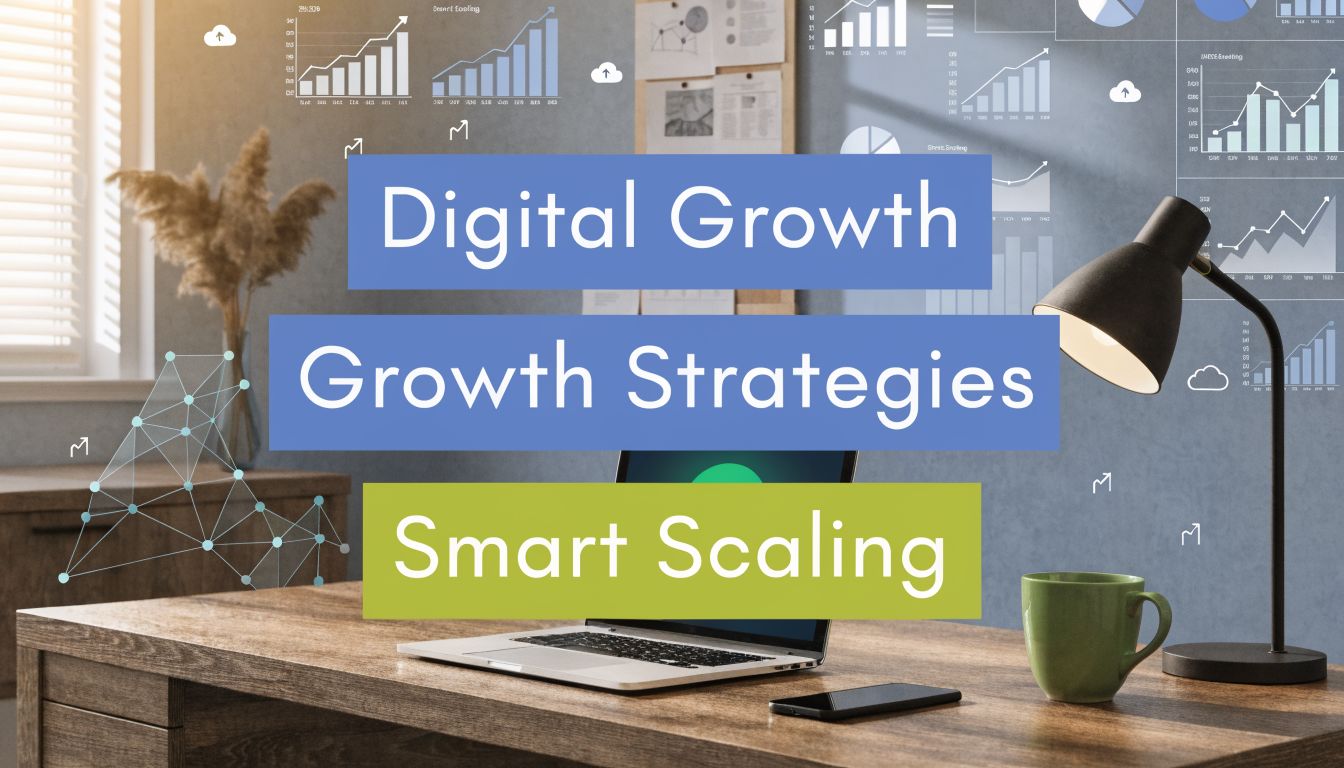
10 Digital Growth Strategies for 2026
What keeps growth going when search rankings shift, ad costs rise, or a social platform suddenly changes its rules?
The answer is not a single channel. It is a system. Strong digital growth works like a flywheel. Content helps people find you. Email keeps the relationship alive. Analytics shows where attention turns into action. Social, video, podcasts, and partnerships add repetition and trust so your message does not depend on one source of traffic.
That system-first view matters because founders and investors are not just looking for spikes. They are looking for repeatable acquisition, clearer attribution, and signals that a company can grow without rebuilding its strategy every quarter. Good strategy is less like placing one big bet and more like building a machine with parts that support each other.
This guide is built as a playbook, not a list of ideas. Each strategy covers what it is, why it works, how to put it into practice, which metrics to watch, which tools can help, and what real companies can teach you. If your team is also refining search demand before content production, this practical guide on using Google Trends for retail growth in 2025 is a useful companion. For teams planning how search behavior is changing across classic search, answer engines, and generative discovery, these enterprise search strategies comparing SEO, AEO, and GEO add helpful context.
Read this as a blueprint for building an integrated growth engine, one channel at a time, with enough detail to act on each one.
Table of Contents
- 1. Content Marketing & SEO Optimization
- 2. Email Marketing & Newsletter Strategy
- 3. Social Media Community Building & Engagement
- 4. Data-Driven Content Analytics & Optimization
- 5. Strategic Partnerships & Cross-Promotion
- 6. Paid Advertising & Retargeting Campaigns
- 7. Community-Driven Content & User-Generated Content
- 8. Podcast & Audio Content Strategy
- 9. Video Content & YouTube Strategy
- 10. Influencer & Creator Partnerships
- 10-Point Digital Growth Strategies Comparison
- Building Your Integrated Growth Engine
1. Content Marketing & SEO Optimization

What happens when a potential customer is already searching for the exact problem you solve? Content marketing and SEO put your company in that moment of intent. Instead of interrupting people, you answer the question they already have.
That is why this strategy keeps showing up in strong digital businesses. It attracts demand, builds trust, and gives you an asset that can keep working long after publication. For founders, it can lower dependence on paid acquisition. For investors, it is a useful signal that a company knows how to turn expertise into steady, compounding traffic.
Investopedia is a good example. Its articles explain one concept at a time, in plain language, and guide readers to the next logical question. HubSpot uses a similar system in B2B marketing. The lesson is simple. Winning content is rarely about clever phrasing. It is about being the clearest and most useful result for a specific search.
Why this still compounds
Search works like a library shelf. A strong article can keep getting discovered months after it is published, especially if it is updated as the topic changes. That gives content a different economic profile than channels that reset every week.
SEO also creates second-order value. A useful article can feed your newsletter, support sales conversations, give your team material for social posts, and improve how your brand is understood. If your company is still working through broader operational shifts, these common digital transformation challenges for growing businesses often affect content operations too, from unclear ownership to inconsistent measurement.
Practical rule: Start with search intent. Then shape the article so it sounds like your brand.
A founder-friendly implementation playbook
Start with a topic cluster. Use one pillar page for the broad subject, such as “beginner investing,” then add supporting pages like “how index funds work,” “ETF vs mutual fund,” and “mistakes first-time investors make.” This structure helps search engines understand the relationship between pages, and its true value lies in helping readers move step by step instead of bouncing after one answer.
Here is a workable setup:
- Map content to real intent: Separate beginner, comparison, and decision-stage searches. “What is an index fund?” needs a different article than “best broker for first-time investors.”
- Choose narrower keywords first: “Best budgeting apps for couples” is easier to win, and usually easier to monetize, than a broad term like “budgeting.”
- Refresh evergreen pages on a schedule: Update screenshots, examples, definitions, and links before the article starts to age.
- Build internal links with purpose: Send readers to the next useful page, not a generic “related posts” block.
- Track demand early: Use Google Trends for retail and content planning to spot rising topics before the search results get crowded.
A simple way to sanity-check your plan is to ask two questions. What exact problem does this page solve? What should the reader do next after finishing it? If you cannot answer both clearly, the article is probably too vague.
Tool choice matters too, but only after the workflow is clear. A lean stack is enough for many teams. Use Google Search Console for query data, Ahrefs or Semrush for keyword research, a simple content brief template for consistency, and a spreadsheet or project board to track updates. Founders often overcomplicate this part. The key advantage comes from publishing the right pages in the right sequence.
If you want a broader search framework, this breakdown of enterprise search strategies comparing SEO, AEO, and GEO is useful for understanding how classic search content now overlaps with answer engines and generative discovery.
2. Email Marketing & Newsletter Strategy
What makes someone open your email every week instead of letting it sink to the bottom of the inbox?
The answer is usually simple. The email keeps a promise. A strong newsletter works like a good analyst or advisor. It filters noise, highlights what matters, and gives the reader one useful next step. That is why email still matters so much for founders and investors. You are not renting attention from an algorithm. You are building a direct relationship with people who asked to hear from you.
Morning Brew and The Hustle grew by making business information easier to consume. That lesson applies even more to smaller companies. You do not need a giant editorial team. You need a clear point of view, a repeatable format, and a reason to show up on schedule.
What a strong newsletter actually does
A good newsletter has three jobs. It reminds readers what you stand for, helps them make a decision, and moves them toward one action. That action might be reading a case study, booking a demo, replying to a question, or forwarding the issue to a colleague.
Relevance matters here. A founder exploring AI tools and an investor tracking market signals may both like your brand, but they do not need the same email. Segmentation solves that problem. Instead of sending one generic update to everyone, you group readers by interest, stage, or behavior and send content that fits. If you want examples of how AI can support this kind of targeting and workflow design, this guide to generative AI business applications for growth teams is a useful reference.
The goal is not more email. The goal is better timing and better fit.
A practical setup for early-stage teams
Many teams overbuild too early. Start with a small system you can run consistently:
- One core newsletter: Send on a predictable schedule with a specific promise, such as “three market signals every Friday” or “one growth playbook every Tuesday.”
- One welcome sequence: Use 3 to 5 emails to explain who you help, what readers will get, and which topics they can choose.
- Basic segmentation: Tag readers by interest, role, or source. For example: founder, operator, investor, AI, fintech, or B2B SaaS.
- One clear action per email: Too many choices reduce clicks. Pick the next step you want.
This structure works because it matches how trust is built. First contact creates interest. The welcome sequence sets expectations. The regular newsletter proves you can deliver again and again.
Implementation playbook
A newsletter should feel easy to read and easy to act on. A simple operating model is enough for many companies:
- Define the promise. Write one sentence that explains why the email deserves attention.
- Choose a repeatable format. For example: one insight, one example, one action.
- Map entry points. Add signup forms to high-intent pages, founder bios, webinars, and product touchpoints.
- Write the welcome sequence first. New subscribers need orientation before they need volume.
- Set tagging rules. Tag by topic clicked, page visited, or form selected.
- Review performance every month. Keep the winners, rewrite weak subject lines, and cut sections nobody uses.
Metrics that tell you if it is working
Open rate can be useful, but it is only the first signal. Better questions are: Are readers clicking? Are they replying? Are they converting? Are they staying subscribed after a month?
Track these metrics closely:
- Click-through rate: Shows whether the content and call to action match reader intent
- Reply rate: A strong sign of trust, especially in founder-led newsletters
- Conversion rate: Measures whether email leads to demos, signups, applications, or deals
- Unsubscribe rate: Helps you spot promise drift
- List growth by source: Tells you which channels bring the right subscribers, not just more names
Tools and real-world use
You do not need a complex stack to run this well. Mailchimp, Kit, Beehiiv, and HubSpot all handle basic newsletters, automations, and segmentation. The tool matters less than the operating discipline behind it.
A founder writing to investors might send a weekly market note with links to deeper analysis. A SaaS company might use product education emails to turn trial users into active accounts. A niche media brand might use a daily roundup to train readers to return at the same time each morning. Different models, same principle. Earn the next open.
If your newsletter cannot answer “why should I open this today?” in one sentence, the problem is usually the promise, not the template.
3. Social Media Community Building & Engagement

What turns a follower into a customer, contributor, or advocate?
Usually, it is not reach alone. It is repeated interaction. A big audience can create the illusion of momentum, while a smaller group that comments, shares feedback, and returns often creates more business value. Social platforms work like a town square, not a billboard. People stay when the conversation helps them think better, decide faster, or feel connected to others with the same problem.
You can see this pattern in communities like r/personalfinance and r/investing. People return because useful questions get useful answers. The habit forms around trust, and trust forms around participation.
The community is the asset
A social audience is rented attention. A community is a system of relationships. That difference matters to founders and investors because relationships compound. They lead to referrals, product feedback, repeat exposure, partnership opportunities, and a clearer read on what the market cares about.
Each platform does a different job. LinkedIn helps you build professional credibility. Reddit supports detailed discussion and honest feedback. TikTok and YouTube Shorts help new people discover your ideas quickly. X can still work for sharp commentary if your point of view is clear and consistent.
The practical lesson is simple. You do not need to be everywhere. You need connected touchpoints, clear expectations, and a reason for people to come back.
A playbook for building engagement without adding noise
Random posting rarely creates a strong community. A better approach is to treat social as an operating system with a rhythm, rules, and feedback loops.
Start with these steps:
- Choose two or three priority platforms: Pick the places where your buyers, peers, or future champions already spend time.
- Define one role for each channel: For example, use LinkedIn for authority, Reddit for discussion, and short-form video for discovery.
- Publish in native formats: A LinkedIn carousel, Reddit comment, and short video should teach the same idea in different ways.
- Reply in the first hour when possible: Early responses increase visibility and make the account feel active and human.
- Show your thinking: Share frameworks, decisions, experiments, and tradeoffs, not just polished wins.
That last point is easy to miss. People rarely bond with outcomes alone. They bond with process. If a founder explains why the company changed pricing, killed a feature, or tested a new channel, the audience gets something more useful than promotion. They get a window into judgment.
What to measure
Vanity metrics can distract you here. Follower count matters less than signs of ongoing participation.
Track metrics such as:
- Comment quality: Are people asking better questions over time?
- Reply rate: Are conversations starting, not just reactions?
- Share rate: Are people passing the idea to peers?
- Profile clicks and link clicks: Do conversations lead to curiosity about your company or thesis?
- Returning engagement: Do the same people come back week after week?
These signals tell you whether you are building a real community or just collecting impressions.
Tools and real-world use
You do not need a complicated stack. Buffer, Hootsuite, Sprout Social, Typefully, and native platform analytics can cover scheduling, monitoring, and performance review. The tool matters less than the discipline. Set a weekly cadence for posting, responding, and reviewing which conversations led to qualified interest.
A B2B founder might post short market observations on LinkedIn, answer category questions in niche communities, and invite strong responders into a roundtable or webinar. An investor might use X for timely commentary, LinkedIn for thesis-building posts, and private group chats for deeper relationship building. A consumer brand might use short-form video for reach, then pull engaged users into Discord, WhatsApp, or email where retention is easier to build.
If your team needs help building stronger online relationship habits, this guide on how to network like a pro in the digital age pairs well with this strategy. It shows how to turn scattered online interactions into a repeatable relationship-building practice.
A strong social strategy does more than publish content. It creates a place where the right people want to return, contribute, and stay connected.
4. Data-Driven Content Analytics & Optimization
Publishing without analytics is like teaching with the lights off. You may be doing good work, but you can’t clearly see what people are engaging with, where they leave, or which topics lead to action.
Netflix, Spotify, and The New York Times all show the same principle in different ways. They don’t rely on instinct alone. They study behavior, then improve packaging, recommendations, and sequencing.
Measure behavior, not just traffic
Pageviews matter, but they don’t tell the whole story. A post can attract a lot of clicks and still fail to build trust or conversions. You need to see whether readers stay, scroll, subscribe, and return.
Broader digital transformation trends are beneficial. The digital transformation market is forecast at USD 1,107.06 billion in 2025 and projected to reach USD 1,864.94 billion by 2031, according to MarketsandMarkets on digital transformation. Big data and analytics are a major part of that shift, which makes sense. Better decisions require better measurement.
A monthly optimization rhythm
A simple monthly review often beats a complex dashboard nobody reads. Pull your top and bottom performers, compare intent against outcomes, and decide what to update, merge, expand, or retire.
Useful questions include:
- Which topics keep attention: Look beyond clicks to time on page, scroll depth, and newsletter signups.
- Which entry points convert: Some readers enter through broad explainers, others through specific comparison pages.
- Which content deserves expansion: A strong post may be the seed of a series, webinar, or video.
- Which tools can help: Teams exploring automation should also study generative AI business applications for growth as part of the analytics stack conversation.
Numbers don’t replace judgment. They keep judgment honest.
5. Strategic Partnerships & Cross-Promotion
What happens when two brands share an audience, but solve different parts of the same problem? You get a faster path to trust.
That is the core value of partnerships. You are not borrowing attention for a day. You are joining forces with a brand your audience already believes, then giving people a clearer next step.
A strong partnership works like a relay race. One brand carries the relationship to a certain point, then hands it to a partner that can move the customer further. A fintech newsletter may educate readers about saving. A budgeting app helps them put that advice into practice. The handoff feels natural because the audience need is consistent.
That is why fit matters more than reach. A smaller partner with the right audience often outperforms a larger one with weak overlap.
What to look for before you say yes
Founders often treat partnerships as a branding exercise. Investors should look at them more like distribution assets. The question is not just, "Will this get us seen?" The better question is, "Will this put our offer in front of the right people, in a setting where trust already exists?"
Use a simple filter:
- Audience overlap: Do both brands serve the same buyer, user, or decision-maker?
- Problem alignment: Does each offer solve a connected step in the customer's journey?
- Channel compatibility: Can both teams promote through email, webinars, social, or product surfaces without friction?
- Operational readiness: Can both sides deliver the asset, track results, and follow up well?
If one of those pieces is missing, the partnership often turns into a polite mention with little business impact.
Partnership formats that are easy to test
Start with small experiments. A pilot tells you more than a big promise.
Good early formats include:
- Newsletter swaps: Each brand recommends the other with clear context for why the audience should care.
- Guest articles or expert contributions: Share useful experience, not a disguised product pitch.
- Joint webinars: Teach one problem from two angles, such as strategy plus execution.
- Resource bundles: Combine a guide, checklist, template, or trial offer into one practical package.
These formats work because they let both teams test audience response, conversion quality, and working chemistry before building something larger.
The playbook: how to run cross-promotion well
Execution matters more than the announcement. A partnership can look impressive on LinkedIn and still produce weak results if the message, offer, and follow-up are vague.
A simple process helps:
- Define the shared audience. Name the role, need, and stage of awareness.
- Pick one conversion goal. Newsletter signups, demo requests, webinar registrations, or trial starts.
- Create one focused asset. A co-branded guide, event, landing page, or email sequence.
- Write distinct messaging for each audience. The same offer may need a different angle for each list.
- Track source quality. Measure not only clicks, but signup rate, activation, and downstream revenue.
- Review and expand. If a small test works, turn it into a recurring channel.
Many teams often get stuck at this stage. They plan the collaboration, but not the handoff after the click.
For teams building that discipline, developing a growth mindset and resilience helps. Good partnerships improve through testing, feedback, and repeated refinement.
Metrics and tools that keep partnerships honest
A partnership should be judged like any other growth channel. Useful metrics include referral traffic, landing page conversion rate, email signup quality, demo bookings, and customer acquisition cost by partner.
Tool choice depends on the format. Use UTM tracking in analytics, a shared landing page in your CMS, webinar tools for live events, and clear creative workflows for co-branded assets. If the campaign includes paid social creative or short-form ad variations to support the promotion, the ShortGenius AI ad generator can help teams produce and test multiple angles quickly.
The best case studies tend to follow the same pattern. Two brands identify a shared customer problem, create one useful asset, and promote it with a clear next step. That is the difference between a random collaboration and a repeatable growth channel.
6. Paid Advertising & Retargeting Campaigns

What should you do when growth needs to happen faster than SEO or partnerships can deliver? Paid advertising gives you a faster feedback loop. It helps founders test offers, messages, and audiences in days instead of months. Retargeting adds the follow-up many teams miss by bringing back people who showed interest but were not ready to act.
That speed matters, but only if the campaign is built with logic. Ads work like fuel. If the engine is sound, fuel helps you move faster. If the offer is muddy or the landing page is weak, you just burn budget faster.
HubSpot’s ebook campaigns, Skillshare’s course promotions, and MasterClass ads follow the same principle. The ad makes one promise, and the landing page keeps it. That message match is what turns paid traffic from expensive attention into measurable pipeline.
Build campaigns by intent, not by platform
A strong paid strategy starts with buyer intent. Someone searching for a solution is in a different stage than someone who watched part of a video or visited your pricing page last week. Treating them the same usually lowers click-through rate, conversion rate, and return on ad spend.
A useful way to organize this is to map ads to three jobs:
- Capture existing demand: Use search ads for high-intent queries that signal a problem and a desire to solve it.
- Create informed demand: Use paid social, video, or sponsored content to introduce a clear point of view or offer.
- Recover missed conversions: Use retargeting for visitors who viewed key pages, started signup, or engaged with content but left.
For founders and investors, this matters because each campaign type answers a different business question. Search helps validate demand. Paid social helps test positioning. Retargeting helps improve conversion efficiency from traffic you already paid to get.
A practical playbook for setting it up
Start small. A paid campaign is an experiment before it becomes a budget line.
Here is a simple setup process:
- Pick one offer. Choose a demo, waitlist, free tool, report, or product page with a clear next step.
- Choose one audience segment. For example, SaaS founders, ecommerce operators, or retail investors researching a category.
- Write one promise per campaign. If the ad says "cut reporting time," the landing page should open with that same benefit.
- Separate cold traffic from retargeting. Cold audiences need context. Returning visitors need a reason to act now.
- Send clicks to a focused page. A homepage is often too broad for paid traffic.
- Review creative fast, then test methodically. Tools like ShortGenius AI ad generator can speed up concept production, but relevance, clarity, and brand fit still need human judgment.
Retargeting deserves extra care because it is easy to overdo. Showing the same ad to every past visitor is like a sales rep repeating one script to every lead. Better retargeting changes the message by behavior. Article readers may need a related resource. Pricing page visitors may need proof, testimonials, or a short comparison. Cart abandoners may need a reminder or objection handling.
What to measure before you scale
Clicks are only the surface layer. Founders need to know whether paid traffic turns into qualified action.
Track metrics in stages:
- Ad-level metrics: click-through rate, cost per click, frequency
- Page-level metrics: landing page conversion rate, bounce rate, form completion
- Business metrics: cost per lead, cost per demo, customer acquisition cost, payback period
- Quality metrics: activation rate, pipeline contribution, downstream revenue by campaign
This is the difference between buying traffic and building a paid acquisition system. A campaign can look strong in the ad account and still fail in the business if low-quality leads pile up.
Paid media also requires patience under pressure. Early losses are common, especially while you test audience segments and creative angles. Teams that document what changed, what improved, and what failed usually learn faster, which is why Everyday Next’s guide on cultivating a growth mindset and resilience fits ad operations better than it may seem at first glance.
The strongest operators treat paid advertising as a playbook, not a slot machine. They define the audience, match message to intent, measure beyond clicks, and use retargeting to continue the conversation after the first visit.
7. Community-Driven Content & User-Generated Content
Some of the strongest digital brands don’t create everything themselves. They build spaces where users add perspective, examples, questions, and proof. Reddit, Product Hunt, Quora, and Medium all lean on this dynamic in different ways.
That’s powerful because audiences often trust peer experience in situations where polished brand content feels too distant. A founder explaining how they chose a finance tool can be more persuasive than a perfect landing page.
Why audience participation matters
Community-driven content helps you surface questions your editorial team may miss. It also creates a feedback loop. The audience tells you what matters, and your brand responds by organizing, highlighting, and improving the best contributions.
Digital Adoption Platforms offer a related lesson. The market was valued at USD 621.5 million in 2023 and is projected to reach USD 3,861.1 million by 2032, according to Zion Market Research on the digital adoption platform market. That growth reflects something simple. People need guidance inside the experience, not only before it.
How to keep quality high
User-generated content works only when standards are clear. Without moderation, quality falls and trust follows.
Use a structured approach:
- Set contribution rules: Tell users what good submissions look like.
- Review before featuring: Highlight thoughtful, specific stories over vague opinions.
- Reward useful participation: Feature top contributors in newsletters, profiles, or roundups.
- Protect readers: Add clear disclaimers where financial, medical, or legal interpretation could create risk.
The community doesn’t need less structure. It needs structure that feels fair.
8. Podcast & Audio Content Strategy
Audio reaches people in moments when text doesn’t. Commuting, walking, cooking, and exercising all create listening time that a blog post can’t easily capture. That’s why podcasts often build a deeper sense of familiarity than written content alone.
Shows like Masters of Scale, Marketplace, and The Tim Ferriss Show all prove that voice carries authority differently. Listeners hear pacing, uncertainty, conviction, and curiosity. That texture matters.
Audio builds trust differently
A podcast doesn’t need celebrity guests to work. It needs a clear promise. The Indicator from Planet Money works because each episode makes economics easier to grasp. Pomp’s interviews work because the audience knows what kind of questions to expect.
This format pairs well with expert-led brands, especially in finance, tech, and education. It also complements other digital growth strategies because one episode can become clips, quotes, transcripts, and newsletter commentary.
A manageable production workflow
The biggest mistake is building a production process you can’t sustain. Start with a format your team can repeat without stress.
A manageable setup looks like this:
- Choose one format: Solo commentary, interviews, or short explainers.
- Record in batches: Save editing time and protect consistency.
- Write better titles: “AI agents for small teams” is stronger than “Episode 14.”
- Repurpose aggressively: Turn each episode into short clips, article summaries, and email intros.
If your publication already has strong written content, podcasting often works best as extension, not replacement. It gives your ideas a second life in a more personal medium.
9. Video Content & YouTube Strategy
What makes someone stop scrolling and spend ten minutes learning from your brand?
Video often wins that decision because it shows the idea while it explains it. For founders, operators, and investors, that matters. A product demo, market breakdown, or workflow tutorial is easier to trust when viewers can see the interface, hear the reasoning, and follow each step in real time.
Khan Academy, TED-Ed, CNBC Make It, and Ali Abdaal all use video differently, but the lesson is the same. Good video shortens the distance between confusion and understanding. It turns a concept from a paragraph into a guided walkthrough.
Video works best when it teaches one thing clearly
You do not need a studio setup or a publishing schedule built for media companies. You need a repeatable format and a clear promise to the viewer.
A strong YouTube strategy works like a product funnel with a classroom built into it. One video answers one question. That video earns search traffic, builds trust, creates clips for social, feeds your newsletter, and gives your sales or investor relations team an asset they can reuse. That is why video deserves a defined role in a digital growth plan, not a leftover role after blog posts and email.
This embedded example shows the basic format many educational brands use well:
A practical playbook for founders and growth teams
Educational videos usually perform best when each one solves a specific problem. Titles such as “How to read a stock chart,” “How our onboarding flow works,” or “What an AI agent does” give viewers a reason to click because the outcome is obvious.
Use this workflow to keep production useful and sustainable:
- Pick one repeatable format: Choose explainers, teardown videos, product walkthroughs, or founder commentary. Consistency helps viewers know what they will get.
- Write the first 30 seconds first: Open with the problem, the promise, and the payoff. Viewers decide quickly whether to stay.
- Show, then explain: Screen recordings, charts, annotations, and live examples reduce confusion better than talking heads alone.
- Build topic clusters with playlists: Group related videos so one useful view can turn into a longer learning session.
- Turn comments into your research queue: Repeated questions often reveal your next high-intent video topic.
- Measure the right signals: Watch click-through rate, average view duration, retention drops, subscriber conversion, and assisted conversions to your site or product.
- Use simple tools: A basic stack might include Descript or CapCut for editing, TubeBuddy or VidIQ for topic research, and YouTube Studio for retention analysis.
The case-study mindset matters here. Do not ask only, “Should we make video?” Ask, “What job will each video do?” A founder-led SaaS channel might use demos to support activation. A media brand might use explainers to grow search traffic. An investment research firm might use weekly market briefings to build authority with a niche audience. Same channel. Different job.
One strong idea can also become a small content system. Record the full YouTube video, cut short clips for distribution, publish the transcript as an article, and summarize the key lesson in email. That approach raises the return on each topic and makes video part of a repeatable growth engine.
10. Influencer & Creator Partnerships
Why do some creator partnerships drive qualified demand while others produce a short traffic spike and little else?
The difference is usually trust fit. A creator recommendation works like a warm introduction from someone the audience already listens to. If the product feels out of place, that trust can fade fast. If the fit is strong, the creator shortens the distance between “I’ve never heard of this” and “I’m willing to try it.”
Ali Abdaal recommending productivity tools is a useful example because the product category already fits his teaching. The recommendation feels connected to the problem his audience is trying to solve. That is the standard to aim for.
Borrow trust carefully
Reach matters less than relevance. A niche creator with the right audience often outperforms a larger account with weak context. That is especially true in categories where buyers need confidence before they act, such as financial education, career growth, AI software, health products, or parenting tools.
Trust also depends on how the partnership is handled. Clear disclosure, honest framing, and a product the creator can actually explain all matter. If a campaign looks scripted or forced, the audience notices.
For founders and investors, the practical question is not “Should we use influencers?” Ask, “Which creator already speaks to the exact buyer we want, and what proof can they share that will make the recommendation believable?”
How to choose the right creators
Start with audience fit, not follower count. A creator partnership should feel like adding the right speaker to the room, not renting the biggest billboard.
Use this filter:
- Check topical match: The creator should already cover related problems, tools, or decisions.
- Review engagement quality: Read comments. Look for questions, saves, replies, and signs that people act on the creator’s advice.
- Study past sponsorships: If every promotion sounds identical, trust may be thin. If the creator explains tradeoffs and use cases, trust is probably stronger.
- Begin with a low-risk test: Try a guest appearance, product walkthrough, newsletter feature, or one sponsored post before committing to a larger campaign.
- Set disclosure rules early: Sponsorships, affiliate terms, usage rights, and approval steps should be clear from the start.
A strong partnership also needs a simple playbook. Give the creator one audience problem to focus on, one clear use case, and one conversion step. Too many talking points usually weakens the message.
Implementation playbook
For an early-stage company, start small and learn fast.
First, define the job of the campaign. Are you trying to get demos, newsletter signups, trial users, or credibility in a new niche? One partnership can support several goals, but one primary goal keeps measurement clean.
Next, build a short creator brief. Include the audience, core problem, product angle, proof points, disclosure requirements, and the action you want the audience to take. Leave room for the creator’s voice. If you over-script, the content often sounds like an ad read instead of advice.
Then track the outcomes that match the goal. Useful metrics include click-through rate, cost per qualified visitor, signup rate, promo code use, assisted conversions, and audience quality after the click. For investor-backed teams, such tracking ensures creator marketing stops being a brand experiment and becomes a measurable channel.
Helpful tools vary by budget. Common options include creator discovery platforms, affiliate software, UTM tracking, dedicated landing pages, and post-purchase surveys that ask, “Where did you hear about us?”
What good execution looks like
A B2B SaaS founder might partner with three small LinkedIn creators who teach workflow design, each showing a real use case inside the product. A consumer brand might send creators a sample and ask for an honest demonstration instead of a scripted endorsement. An investment research company might sponsor a niche market commentator whose audience already pays attention to deep analysis and recurring insights.
Same channel. Different jobs.
Good creator partnerships do more than send traffic. They bring in borrowed trust, clearer positioning, and faster audience learning. That makes them useful not just for awareness, but for testing messages, offers, and markets before you spend more on larger campaigns.
10-Point Digital Growth Strategies Comparison
| Strategy | Implementation Complexity 🔄 | Resource Requirements ⚡ | Expected Outcomes 📊⭐ | Ideal Use Cases 💡 | Key Advantages ⭐ |
|---|---|---|---|---|---|
| Content Marketing & SEO Optimization | High, ongoing editorial + technical work | Medium–High, writers, SEO tools, dev support | Sustainable organic traffic and authority over 3–12 months (⭐⭐⭐⭐) | Long-term acquisition; building authority on investing, AI, personal growth | Compounding traffic, high ROI over time, supports other channels |
| Email Marketing & Newsletter Strategy | Medium, setup, segmentation, automation | Low–Medium, ESP, content, list-growth tools | Direct, high-ROI engagement and repeat traffic (⭐⭐⭐⭐⭐) | Retention, monetization, promoting new articles and products | Owned audience, measurable performance, cost-effective at scale |
| Social Media Community Building & Engagement | High, daily moderation and platform-specific content | Low–Medium, community managers, content creation | Increased brand loyalty, feedback, viral reach (⭐⭐⭐) | Awareness, community feedback, trend amplification | Real-time audience insight, organic sharing, advocacy |
| Data-Driven Content Analytics & Optimization | Medium, tracking, dashboards, analysis frameworks | Low–Medium, analytics tools, analyst/time | Faster optimization and better content ROI; actionable insights (⭐⭐⭐⭐) | Prioritizing topics, improving UX and conversion rates | Data-backed decisions, measurable impact, competitive edge |
| Strategic Partnerships & Cross-Promotion | Medium, outreach, alignment, negotiation | Low–Medium, partnership management time | Expanded reach and credibility with partner audiences (⭐⭐⭐) | Audience expansion, trusted endorsements, event/webinar co-hosting | Access to new audiences, shared resources, backlinks |
| Paid Advertising & Retargeting Campaigns | Medium–High, setup, targeting, continuous optimization | High, ad spend, creatives, ad ops expertise | Immediate traffic and conversions; scalable but cost-dependent (⭐⭐⭐) | Rapid growth, message testing, subscription acquisition | Fast results, precise targeting, clear ROI metrics |
| Community-Driven Content & User-Generated Content | Medium, platform setup and active moderation | Low–Medium, moderation, UX features | Scalable content and engagement; variable quality (⭐⭐) | Building participation, authentic storytelling, peer learning | Cost-effective content scale, authenticity, higher time-on-site |
| Podcast & Audio Content Strategy | Medium, format, production schedule, guest coordination | Medium, mics, editing, hosting, promotion | Deep audience relationships; slower audience build (⭐⭐) | Thought leadership, long-form interviews, repurposing content | Intimacy with audience, repurpose to other formats, sponsorship potential |
| Video Content & YouTube Strategy | High, production quality and consistent publishing | Medium–High, cameras, editors, studio/time | Strong discoverability and engagement; monetization paths (⭐⭐⭐) | Explainers, tutorials, visual demos (AI, investing) | High engagement, SEO lift, multiple revenue streams |
| Influencer & Creator Partnerships | Low–Medium, sourcing and negotiating deals | Medium–High, campaign fees, management | Fast audience access and credibility transfer; ROI varies (⭐⭐) | Product launches, credibility boosts, tapping niche audiences | Authentic endorsements, creative amplification, performance-based deals |
Building Your Integrated Growth Engine
Why do some companies publish constantly, run ads, send newsletters, post on social, and still struggle to grow? In many cases, the problem is not effort. It is that each channel is being run like a separate machine instead of part of one system.
An integrated growth engine works like a flywheel. One useful idea becomes a blog post. That post gives you material for email, social clips, video, podcast talking points, and retargeting audiences. Analytics then shows which angle pulled people in, which message earned trust, and which step caused people to leave. Instead of creating from scratch every week, you keep improving and redistributing what already works.
That is the difference between a list of tactics and a growth system. Founders and investors should care about the system, because systems are easier to measure, easier to repeat, and easier to scale than one-off campaigns.
Start simple. Pick one discovery channel and one relationship channel. A practical starting pair is SEO plus email. If your team is stronger on camera, YouTube plus a newsletter may fit better. If you already have a strong founder voice, LinkedIn plus a podcast can work well.
The goal is fit, not coverage.
Here is a simple way to build the engine without spreading your team too thin:
- Choose one core audience.
- Define one main problem you will help them solve.
- Publish one primary content format consistently.
- Repurpose that content into two or three supporting channels.
- Set one conversion path, such as newsletter signup, demo request, or product trial.
- Review performance every month and improve the pieces that create movement.
This is the playbook mindset that separates strong growth teams from busy ones. Each strategy in this article is more than a category. It is a working part with a job, a setup process, useful tools, and metrics that tell you if it is doing that job well.
For example, a founder might publish a search-focused article answering a high-intent question. That article feeds a newsletter issue with a sharper point of view. Short excerpts become LinkedIn posts or video clips. Paid retargeting brings previous visitors back to a product page or signup offer. Community feedback then tells the team what objections or questions should shape the next piece. One idea keeps producing value because every channel is connected.
Consistency matters more than volume. A weekly publishing rhythm that your team can sustain beats a burst of activity followed by silence. The same rule applies to measurement. Check a small set of numbers on a schedule. Look at traffic quality, subscriber growth, conversion rate, cost to acquire a lead or customer, and retention signals. If a channel gets attention but does not move people closer to trust or action, adjust the message or reduce the effort.
Resource limits matter too. Some teams are working with older devices, basic software, small budgets, or unreliable internet access. In that situation, simple systems often perform better than complicated stacks. A fast website, a dependable email platform, evergreen articles, a basic analytics setup, and an offline-friendly workflow can carry more weight than a pile of tools your team barely uses.
Software choice should follow the same rule. Use a stack your team will maintain. One content calendar, one email platform, one analytics source, and one repeatable production process is enough to build momentum. Complexity often looks advanced while subtly slowing execution.
AI will speed up research, drafting, testing, segmentation, and personalization. It will not choose your market, sharpen your point of view, or earn trust for you. Use it as an assistant. Keep judgment with the people closest to the customer.
Strong growth engines usually share three traits. They are useful, measurable, and repeatable.
Useful means your content or campaign solves a clear problem. Measurable means you can connect effort to outcomes. Repeatable means your team can keep the system running without burnout.
Build that kind of engine, and growth becomes easier to improve. It may still take time. But it becomes far less random, far less expensive to learn from, and much more durable.
Everyday Next publishes practical insights for readers who want to grow across wealth, tech, personal development, and modern life. If you want more clear, actionable ideas like these digital growth strategies, explore Everyday Next for explainers, trend analysis, and step-by-step guides you can use.

Previous Post
Next Post
Previous Post

Next Post