Terafab Explained in Simple Terms: A 2026 Guide to the Future of AI
Let's get straight to it. Terafab is a massive, next-generation factory being built for one purpose: to produce an unbelievable amount of AI computing power.
Think of it less like a traditional factory and more like a specialized power plant. But instead of generating electricity, it’s designed to churn out the fundamental "bricks" of processing power needed to build the future of artificial intelligence.
Table of Contents
- Unpacking Elon Musk's Terafab Project
- Why AI Is Facing a Global Compute Crisis
- How Terafab Plans to Build the Future of AI
- From Earthly Grids to Orbital Data Centers
- What Terafab Means for Investors and Tech Enthusiasts
- Frequently Asked Questions About the Terafab Project
- 1. Is the Terafab project actually realistic?
- 2. How much will Terafab cost?
- 3. When will Terafab start producing chips?
- 4. Why can't the entire one-terawatt facility be built on Earth?
- 5. What is the environmental impact of Terafab?
- 6. What companies are involved in Terafab?
- 7. How will orbital data centers communicate with Earth?
- 8. What kind of chips will Terafab produce?
- 9. What does "vertical integration" mean in this context?
- 10. Could Terafab make chips for other companies?
Unpacking Elon Musk's Terafab Project
Imagine trying to build a world filled with billions of smart robots and self-driving cars, only to find you've run out of the specialized computer chips that serve as their brains. That’s the exact problem Elon Musk's Terafab project is designed to solve. It’s a direct response to a growing "compute crisis"—a very real shortage of advanced processing power that's starting to slow down the next wave of AI development.
This isn't just another chip plant. Terafab is an ambitious joint venture between Musk’s key companies—Tesla, xAI, and SpaceX—with the chip-making powerhouse Intel joining as a critical partner.
The primary goal is almost hard to believe: produce one terawatt of AI compute capacity every single year.
To give you a sense of scale, the entire global semiconductor industry today produces only about 20 gigawatts of AI compute annually. Terafab's target is a mind-boggling 50 times larger than today's total global output. This isn't an incremental step; it's a fundamental shift in how we build AI infrastructure.
What Is the Terafab Initiative Trying to Achieve?
The project is structured to tackle several big challenges at once. Instead of relying on a fragile and complex global supply chain, Terafab is all about vertical integration—bringing every step of the process, from design to manufacturing, under one gigantic roof.
Here’s a quick look at the main goals:
- Solve the Compute Shortage: Generate the immense processing power required for ambitious projects like Tesla's fully autonomous vehicles and its Optimus humanoid robots.
- Speed Up Innovation: Dramatically cut the time it takes to design, test, and produce new AI chips from months down to just weeks or even days.
- Build Chip Independence: Establish a powerful, self-sufficient source of advanced chips right here in the United States, reducing dependence on overseas manufacturing.

This whole initiative signals a major move away from how companies currently get their computing power. For context on the models Terafab is looking to disrupt, you can explore the benefits and drawbacks of cloud computing.
Why AI Is Facing a Global Compute Crisis
To understand why a project as massive as Terafab is even on the table, you first need to see the wall that AI development has slammed into.
It’s pretty simple: the world is running out of the high-powered computer chips that serve as the brains for modern AI. This isn’t a small supply chain hiccup. It's a genuine cap on how fast AI can advance.
The demand for specialized chips—especially Graphics Processing Units (GPUs) and High Bandwidth Memory (HBM)—has absolutely skyrocketed. These are the parts that do the heavy lifting, cranking through the enormous calculations needed to train and operate AI models.
The Unquenchable Thirst for Processing Power
Just think about what it takes to power something like Tesla's push for full self-driving cars, or for its Optimus robots to walk around and interact with the world. These machines have to process a flood of data from cameras and sensors every single second, learning and deciding on the fly.
Real-Life Example: A single Tesla vehicle with Full Self-Driving (FSD) Beta processes terabytes of data from its eight cameras to navigate a simple city block. Now, multiply that by millions of cars, all learning and sharing data simultaneously. That’s the scale of compute needed, and it's growing exponentially.
The problem is, the processing power needed for these next-gen AI projects is now bigger than the world's entire chip production capacity. We’ve hit a point where our biggest ideas are being held back not by a lack of imagination, but by a physical shortage of hardware.
Making more of the same chips just won't cut it anymore. The scale of the demand is so huge that it requires a whole new way of thinking. This is the core of the global compute crisis, and as Southern Tier Resources' telecom expertise shows, these kinds of infrastructure crunches can have huge ripple effects across the tech world.
A Bottleneck Measured in Watts
The sheer scale of this problem snaps into focus with the announcement of the Terafab project. Revealed on March 21, 2026, Terafab is a joint venture between Tesla, xAI, SpaceX, and Intel with a jaw-dropping goal: produce over one terawatt (1 TW) of AI compute capacity every year.
To give you some context, the entire global semiconductor industry today produces about 20 gigawatts (GW) annually. That means Terafab is aiming to be 50 times larger than the current global output.
This screenshot from Wikipedia lays out the key players and the project’s audacious targets.
The numbers show this isn't just another factory. It's an attempt to build for a level of demand that has never existed before. If you're curious what all that power might be used for, check out our guide on generative AI business applications.
How Terafab Plans to Build the Future of AI
So, how is Terafab actually planning to fix the global compute crisis? The answer is a complete break from how high-tech manufacturing has operated for decades. Instead of relying on a scattered global supply chain, Terafab is being built as a vertically integrated powerhouse.
Think of it like building a custom race car. The old way involves ordering your engine from Germany, your chassis from Italy, and your tires from Japan. It works, but it's slow and requires shipping parts all over the planet. Terafab’s approach is like having one massive, high-tech garage where you build the entire car—engine, chassis, and tires—all under one roof.
This all-in-one strategy is the key to Terafab's plan. By controlling every single step, the project aims to shrink the chip development cycle from many months down to just a few weeks.
A New Blueprint for Chip Manufacturing
Terafab's model is a direct challenge to the current, fragmented system dominated by specialized giants like TSMC and Samsung. The goal is simple: create a self-contained ecosystem to produce the custom chips needed to power Elon Musk's AI ambitions.
Here’s a quick look at how the process is designed to work:
- Design: It all starts with custom-designed chips like the Tesla AI5, which is specifically engineered for heavy-duty AI training.
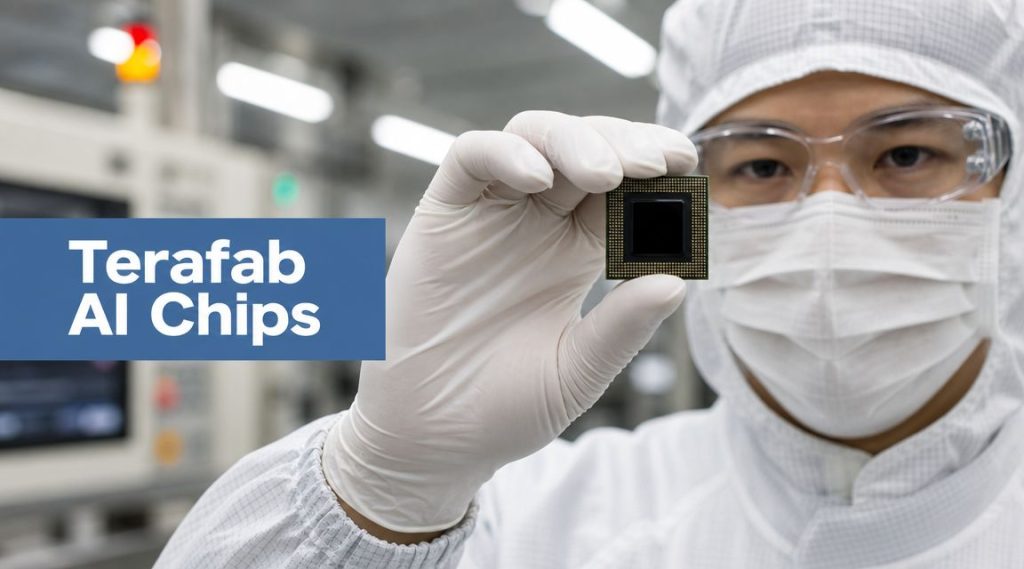
- Manufacturing: These chips will be produced using an advanced 2-nanometer process—the same top-tier technology used by the world's leading foundries.
- Packaging: Finally, the finished chips are packaged and tested on-site, making them ready for immediate deployment.
Real-Life Example: Imagine Tesla engineers discover a way to improve the AI5 chip's efficiency by 5%. In the old model, they would send the new design to a fab in another country and wait months for samples. With Terafab, they can theoretically walk the design over to the manufacturing floor and get test chips back in a matter of weeks, dramatically accelerating innovation.
This tight feedback loop is what really speeds up innovation. For more context on how AI is changing the business world, you might find our deep dive on NVIDIA's role in the future of AI agents interesting.
The image below shows the core problems that Terafab is designed to solve.

As you can see, the demand for AI is skyrocketing far faster than our ability to produce the chips it runs on. This has created a critical bottleneck that’s holding back progress.
The Pilot Plant and Strategic Partnerships
The first major step in this grand plan is a pilot facility in Austin, Texas. With an initial investment estimated at $20-25 billion, this plant will be the proving ground for Terafab’s vertically integrated model.
A key piece of the puzzle here is the collaboration with Intel. By partnering with an established semiconductor leader, the project gets immediate access to decades of manufacturing know-how—something that’s absolutely essential for a project this complex.
This pilot plant isn't just about making chips. It's about proving that this new, faster, and more efficient production method can actually work at scale before going all-in on the full one-terawatt vision. The first production runs are slated to begin as early as 2026, with a major ramp-up planned for 2027.
From Earthly Grids to Orbital Data Centers
The new Austin plant is impressive, no doubt. But it's just the tip of the iceberg. To really understand the full scope of Terafab's vision, you have to look up—way up. The most ambitious part of the plan isn't about building on Earth at all. It's about sending the core of their AI compute power into space.
It sounds like something ripped from a sci-fi novel, but the logic behind it is surprisingly down-to-earth. The move is a direct answer to a very real problem: the physical limits of building a one-terawatt AI factory on our own planet.

Why Space Is the Only Place It Fits
So, why go to all the trouble of launching data centers? It comes down to numbers so big they simply break our current infrastructure. The one-terawatt goal is a non-starter on solid ground.
Here’s a quick look at the earthly constraints that make a one-terawatt facility impossible here:
- Electricity Demand: A single terawatt would be an unimaginable drain on the grid. The entire United States power grid has a capacity of roughly 0.5 terawatts. Powering Terafab on the ground would mean literally doubling the nation’s entire energy output just for one project.
- Land and Water: Traditional data centers are already thirsty giants, needing huge tracts of land and incredible amounts of water for cooling. A one-terawatt facility would have an environmental footprint too massive for any single location to handle.
By moving the bulk of the operation into orbit, the project bypasses these limitations. Orbital data centers would be powered by limitless solar energy and cooled by the natural vacuum of space, operating free from earthly constraints.
This is where the plan completely redefines what a data center can be. Elon Musk himself predicts that a staggering 80% of Terafab's one-terawatt output will be dedicated to these orbital centers, with just 20% remaining for operations on Earth.
The Synergy With SpaceX and Starship
This orbital strategy isn't some far-flung idea happening in a vacuum. It’s tightly woven into Musk’s other ventures, particularly SpaceX. The lynchpin holding this all together is Starship, the massive rocket designed to haul huge payloads into orbit, and do it cheaply.
Real-Life Example: Today, launching a satellite costs thousands of dollars per pound. Starship aims to reduce that to just a few hundred dollars. This cost reduction is the only thing that makes launching thousands of tons of computer hardware into orbit economically feasible. It's a perfect synergy: Terafab builds the AI brains, and Starship provides the affordable transportation to their new home in space.
You can see the perfect synergy taking shape. Terafab will churn out the specialized, radiation-hardened chips needed to run in space. Then, SpaceX’s Starship will act as the delivery truck, launching them into orbit to build out a global AI network. It’s a vision that connects directly to the long-term goals of space exploration and colonization.
To really grasp how much of a leap this is, it helps to look at the different types of data centres we rely on today. Of course, with this kind of advanced technology comes new vulnerabilities, a topic we cover in our guide on battling rising cybersecurity threats.
What Terafab Means for Investors and Tech Enthusiasts
When a project of this size comes along, it’s more than just an engineering feat. Terafab is sending a massive ripple through both the tech and financial worlds. If you’re an investor or just a tech fan, this is something you need to pay attention to.
For investors, Terafab is a direct shot at the semiconductor industry’s old way of doing things. The project’s plan to control everything from chip design to the final product could seriously shake up a market that giants like TSMC and Samsung have owned for decades.
This is the definition of a high-risk, high-reward play. The sheer amount of money involved is staggering, with some analysts throwing around numbers as high as $13 trillion over the project's lifetime. The risk is obvious, but so is the potential upside. A successful Terafab would give Elon Musk's companies a powerful advantage and, just as importantly, create a new, self-reliant chip supply chain right here in the U.S.
The New Investment Landscape
From a global perspective, Terafab is a huge step toward American independence in chip manufacturing. Building a domestic powerhouse that can churn out the world’s most advanced AI chips means we’d be far less dependent on fragile international supply chains. That’s a big deal for both national security and economic stability.
For anyone watching the market, Terafab's success could completely redraw the tech industry map. It puts a ton of pressure on the current leaders and creates a new center of gravity for AI hardware.
To get a better feel for the current chip landscape and who’s in it, check out our guide on how to invest in NVIDIA. It gives great context on the very companies Terafab is looking to challenge.
What This Unlocks for Tech Enthusiasts
If you’re more interested in the tech itself, Terafab is about one thing: possibilities. This project is designed to provide the one thing holding back the future we’ve been promised—raw computing power. It’s the key to turning science fiction into everyday reality.
Real-Life Example: Imagine humanoid robots like Tesla's Optimus not just assembling cars, but performing complex surgeries with more precision than a human surgeon, or assisting with elder care in homes. Or consider a global fleet of truly self-driving cars that have learned from trillions of miles of simulated and real-world driving data, making them statistically far safer than any human driver. Terafab is the infrastructure designed to make these AI-driven systems possible.
This massive jump in available computing power will also pour gasoline on the fire of AI research. When researchers have almost unlimited processing power, they can build and train AI models that are far more complex than what we can even dream of today. This could speed up breakthroughs in everything from medicine to climate science.
To really get what a big change this is, it helps to see the old way of doing things next to Terafab's new model.
Traditional Fab Model vs. Terafab's Integrated Model
Here’s a quick breakdown of how Terafab’s all-in-one approach stacks up against the current semiconductor industry.
| Aspect | Traditional Semiconductor Model | Terafab Model |
|---|---|---|
| Structure | Fragmented; different companies for design (e.g., NVIDIA), manufacturing (e.g., TSMC), and packaging. | Vertically integrated; all steps (design, manufacturing, packaging) happen under one roof. |
| Speed | Slow; chip iteration cycles can take 6-9 months or longer. | Fast; design-to-test cycles are reduced to weeks, potentially days. |
| Supply Chain | Global and complex, vulnerable to geopolitical and logistical risks. | Centralized and self-sufficient, based primarily in the U.S. |
| Focus | Serving a wide range of customers with general-purpose or semi-custom chips. | Highly specialized; creating custom AI chips for specific needs (e.g., Tesla, xAI). |
| Scale | Incremental growth; new fabs add gigawatts of capacity. | Exponential leap; aiming for a terawatt of capacity, a 50x increase over current global output. |
As you can see, Terafab isn’t just about making more chips—it’s about changing how chips are made, from the first design sketch to the final product.
Frequently Asked Questions About the Terafab Project
A project this big and ambitious is bound to raise questions. Here are answers to ten of the most common queries about Terafab.
1. Is the Terafab project actually realistic?
It's incredibly ambitious but grounded in strategic partnerships. By combining the manufacturing and logistics expertise of Tesla and SpaceX with the deep semiconductor experience of Intel, the project has a plausible, albeit challenging, path forward. The pilot plant approach is designed to prove the concept at a smaller scale before committing to the full one-terawatt vision. Success is not guaranteed, but the plan is not pure fantasy.
2. How much will Terafab cost?
The initial pilot plant in Austin is estimated to cost between $20-25 billion. However, analyst projections for the entire project, including the orbital data centers, range from $5 trillion to $13 trillion over the next decade, potentially making it one of the most expensive engineering projects in history.
3. When will Terafab start producing chips?
Initial production runs at the Austin pilot plant are scheduled to begin in 2026. A major ramp-up is planned for 2027. However, achieving the full one-terawatt output and deploying the orbital data centers is a long-term goal that will likely extend well into the 2030s.
4. Why can't the entire one-terawatt facility be built on Earth?
The physical constraints are prohibitive. A one-terawatt data center would consume more than double the entire electrical capacity of the U.S. national grid. It would also require an unsustainable amount of land and water for cooling. Space offers unlimited solar power and a natural vacuum for cooling, bypassing these deal-breaking limitations.
5. What is the environmental impact of Terafab?
The terrestrial pilot plant will have a significant energy and water footprint, similar to any large industrial facility. However, the long-term strategy is designed to be more sustainable. By moving 80% of the compute capacity to orbit and powering it with solar energy, the project aims to create a more scalable and environmentally friendly foundation for future AI infrastructure.
6. What companies are involved in Terafab?
Terafab is a joint venture primarily involving Elon Musk's companies—Tesla, xAI, and SpaceX—with Intel serving as a crucial manufacturing partner. This collaboration brings together expertise in AI application, rocket technology, and chip fabrication.
7. How will orbital data centers communicate with Earth?
They will likely leverage satellite communication networks, such as SpaceX's Starlink. This would create a high-speed, low-latency connection between the orbital compute clusters and terrestrial systems, enabling real-time data processing and access.
8. What kind of chips will Terafab produce?
Initially, the focus will be on custom AI accelerator chips designed specifically for the needs of Tesla and xAI. This includes chips like the Tesla AI5, which are optimized for training massive neural networks for applications like autonomous driving and large language models.
9. What does "vertical integration" mean in this context?
It means one entity controls the entire manufacturing pipeline, from initial chip design to fabrication, packaging, testing, and deployment. This is in contrast to the current model where different specialized companies handle each step, often across different continents. Terafab's approach aims for greater speed, efficiency, and supply chain security.
10. Could Terafab make chips for other companies?
While the initial focus is on supplying Tesla, xAI, and SpaceX, the long-term possibility of Terafab becoming a foundry service for other companies exists. If successful, it could offer its advanced, integrated manufacturing capabilities to external partners, fundamentally reshaping the global semiconductor landscape.
At Everyday Next, we're dedicated to bringing you clear insights on the tech shaping our world. To stay updated on the latest trends in AI, finance, and innovation, explore more at https://everydaynext.com.
Related Posts
Previous Post
Next Post