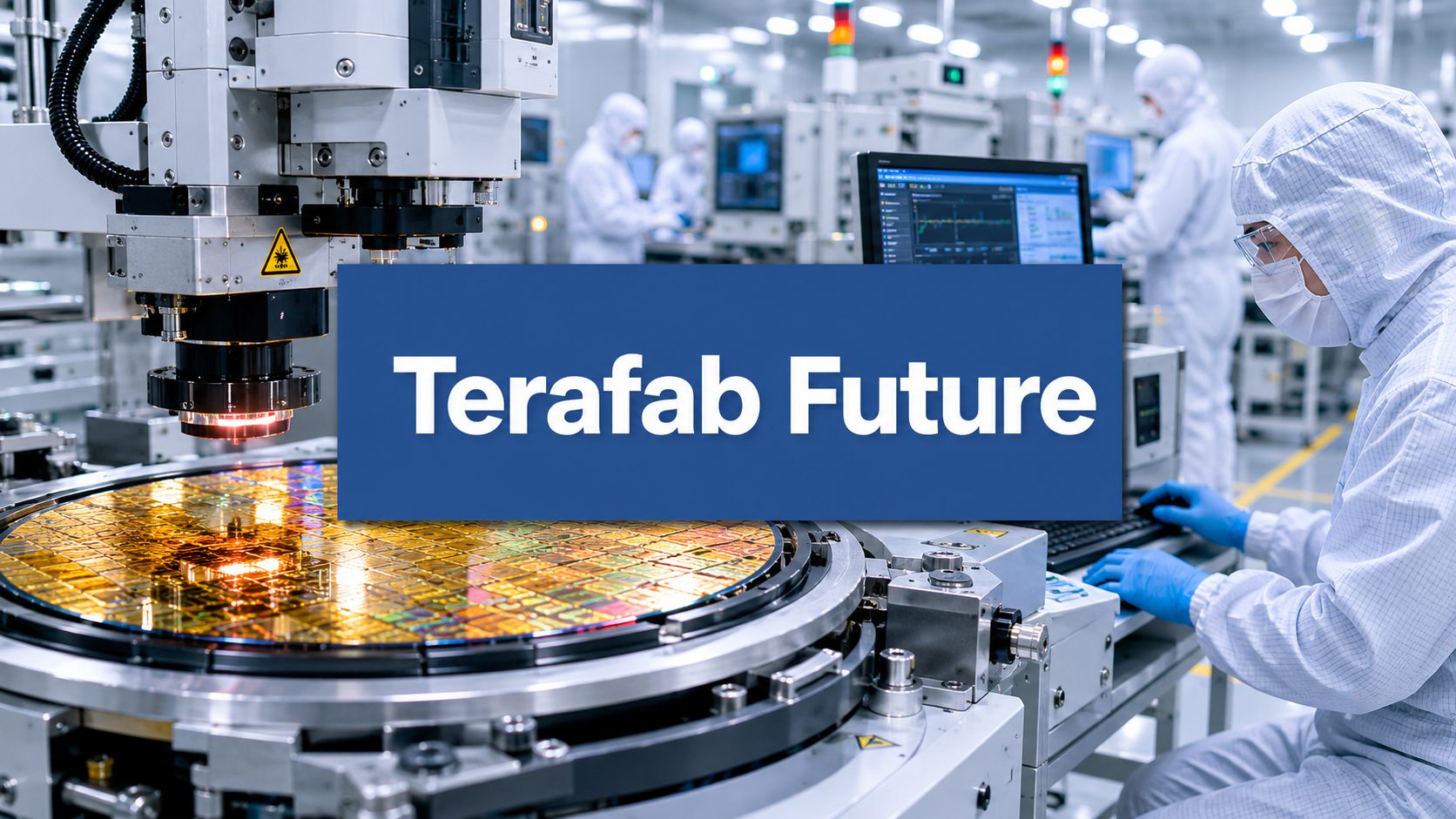
Is Terafab the Future of Computing: A 2026 Analysis
You're probably seeing the same pattern everywhere right now. AI models keep improving, but every leap forward seems to bring a new bottleneck: not enough chips, not enough power, not enough packaging capacity, not enough room in existing data centers to keep scaling comfortably. That's why projects like Terafab attract so much attention. They promise not just a faster chip pipeline, but a different way to think about the entire computing stack.
The question isn't whether the vision sounds bold. It does. The harder question is whether Terafab is the future of computing, or whether it's a dramatic response to real industry pain that still collides with physics, economics, and supply chains.
My view is that Terafab matters even if it never reaches its most ambitious form. It forces a useful debate about what AI infrastructure is becoming: more vertically integrated, more power-constrained, more packaging-limited, and more dependent on how quickly firms can turn custom silicon into deployed systems. If you're trying to compare AI models for your stack, that software choice increasingly sits downstream from hardware realities. The same pressure shows up in the labor market too, where AI infrastructure is already influencing skills, workflows, and roles across industries, a shift explored in this look at AI and automation reshaping the future workforce.
Table of Contents
- The AI Revolution Is Hitting a Wall
- What Exactly Is the Terafab Vision
- A Computing Showdown Terafab vs The Alternatives
- Potential Use Cases From Earth to Orbit
- The Billion-Chip Question Can It Actually Be Built
- What Terafab Means for Investors and Tech Professionals
- The Verdict A Future Tense Proposition
- Frequently Asked Questions About Terafab
- 1. What is Terafab in simple terms?
- 2. Why are people asking whether Terafab is the future of computing?
- 3. Is Terafab a new kind of computer?
- 4. What makes the concept technically interesting?
- 5. What are the biggest doubts about feasibility?
- 6. Is the space-compute part realistic?
- 7. Does Terafab compete with quantum computing?
- 8. Why does packaging matter so much here?
- 9. What should investors actually watch?
- 10. What's the most grounded takeaway from all this?
The AI Revolution Is Hitting a Wall
AI's biggest constraint no longer looks like algorithm design alone. It looks like infrastructure. Training and inference both depend on a long chain of physical systems: wafer fabrication, advanced packaging, thermal management, power delivery, networking, and the buildings or platforms that hold all of it together.
That's why today's AI race feels less like software scaling and more like industrial scaling. A model isn't useful if the chips arrive late, if packaging becomes the choke point, or if the data center can't power and cool the hardware efficiently.
The importance of Terafab starts there. It isn't being discussed because the industry wants a flashy new brand name. It's being discussed because current compute supply chains are fragmented. One company designs the chip, another fabricates it, another packages it, and yet another integrates it into a deployable system. Each handoff slows iteration.
The pressure isn't just about chips
A lot of public conversation still treats computing progress as if better chips alone solve the problem. They don't. In AI, the useful unit isn't the chip in isolation. It's the chip plus memory, interconnect, packaging, thermal envelope, software stack, and reliable deployment.
That's where the present system starts to strain:
- Design cycles slow down when engineering teams hand work between separate organizations.
- Manufacturing feedback arrives late when packaging or yield problems show up after major design choices are already locked in.
- Deployment costs rise when data centers have to absorb more dense and power-hungry systems.
Practical rule: When an industry starts talking about fabs, packaging, power, and grid limits as often as it talks about models, the bottleneck has shifted from code to infrastructure.
Terafab is one answer to that shift. Not the only answer, and not a proven one. But it directly targets the places where the AI buildout now catches on real-world constraints.
What Exactly Is the Terafab Vision
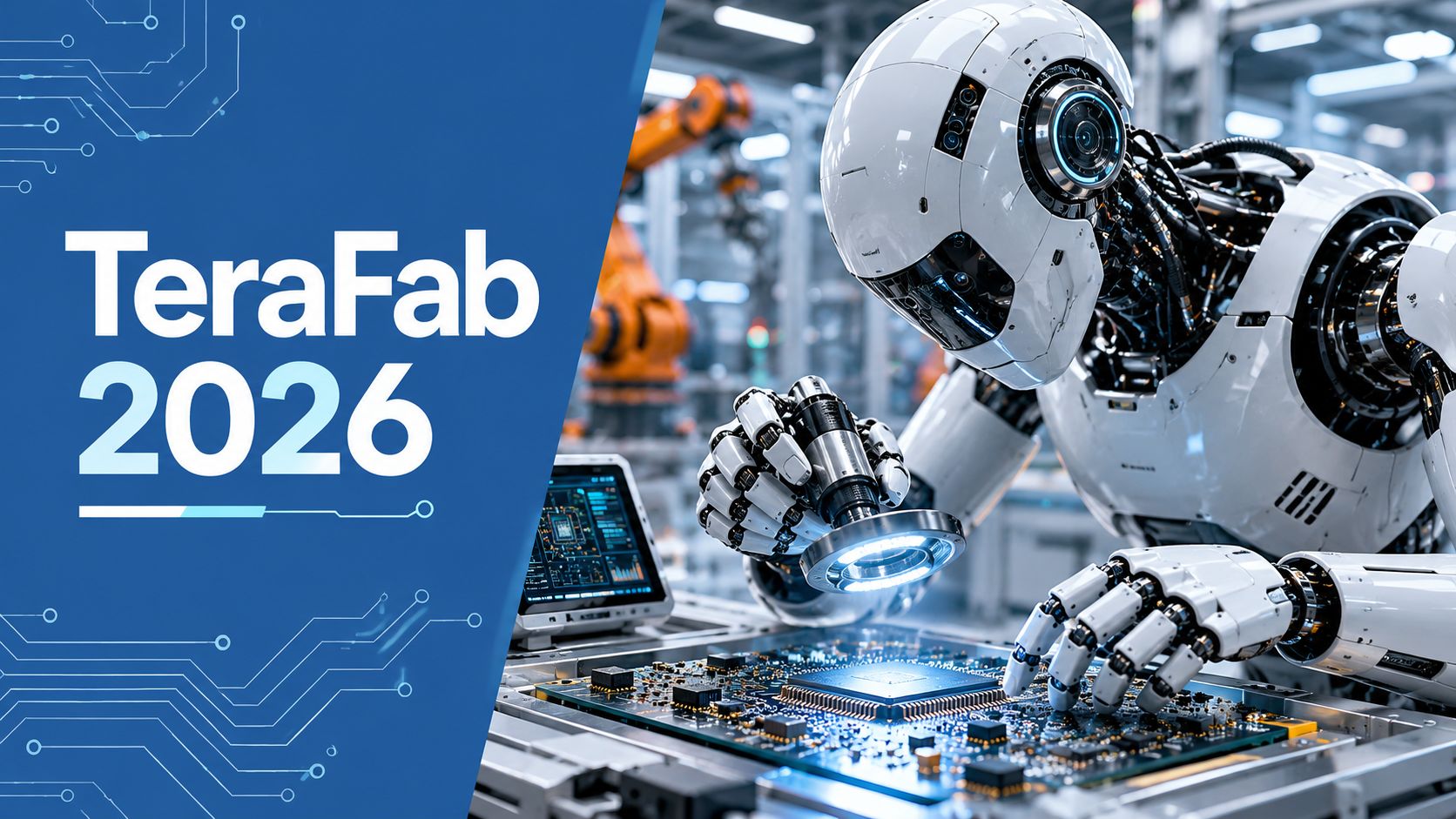
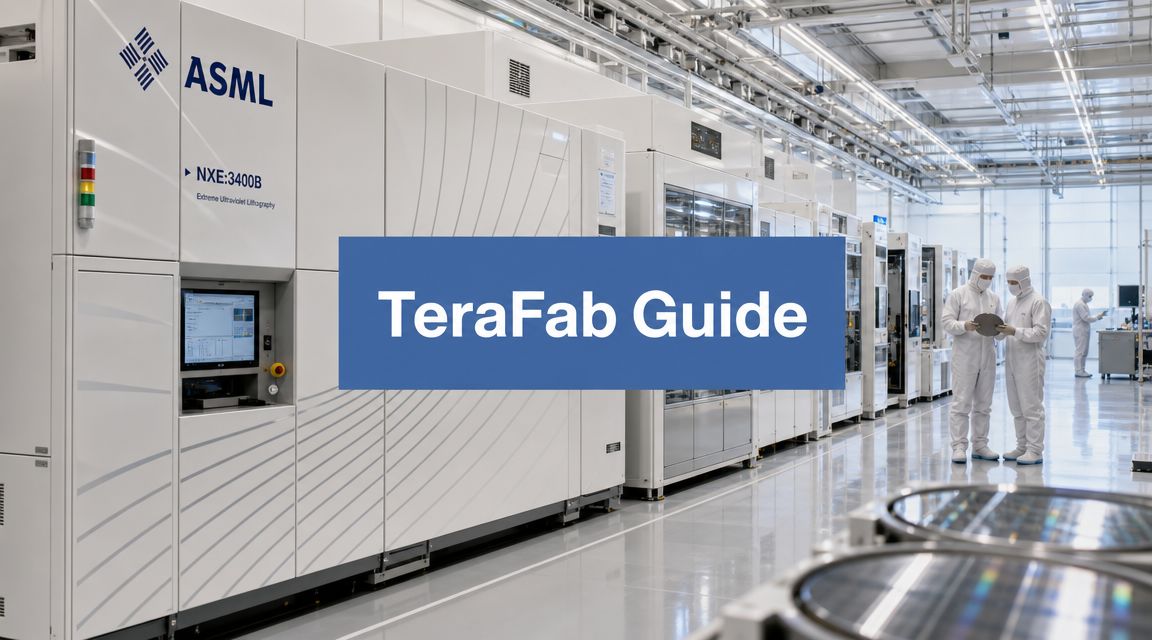
A workable version of Terafab would look less like a single chip plant and more like an industrial system built for one purpose: turning AI demand into deployable hardware with fewer bottlenecks between design, fabrication, packaging, and final integration.

The public pitch combines scale with control. Coverage around the concept describes a vertically integrated manufacturing effort aimed at AI, robotics, and possibly space-oriented systems. The headline vision is easy to repeat. The harder question is what kind of factory economics and engineering discipline would make it credible.
At its core, the idea rests on three connected claims.
Very high output
Terafab is framed as production infrastructure for broad compute demand, not a limited fab serving one premium chip line. That scale matters only if upstream materials, advanced packaging, testing, and power delivery can expand at the same pace.A tighter production loop
Design, wafer fabrication, packaging, and system integration are intended to sit closer together organizationally and, ideally, physically. The goal is shorter feedback cycles when a design performs well in simulation but runs into thermal, yield, or packaging problems in production.Workload-specific silicon
The target is not general-purpose computing in the classic sense. It is hardware tuned for AI inference, training support, robotics control, and other tasks where efficiency per watt and deployment density matter more than broad compatibility.
That combination helps explain why Terafab fits into wider top tech trends of 2025. The broader shift is toward owning more of the stack because performance gains now come from coordination across hardware, packaging, software, and operations rather than from chip design alone.
The strongest part of the Terafab thesis is the manufacturing loop. Datacenter Knowledge's report on Intel joining the broader effort points to design, fabrication, and packaging working together at scale. If that coordination is real, it could reduce one of the biggest inefficiencies in advanced compute: discovering too late that a promising design is difficult to package, cool, or manufacture economically.
A car factory offers a useful comparison. If the engine team, transmission team, and assembly line all work in isolation, problems surface late and fixes get expensive. If those functions share data and iterate together, defects show up earlier and production improves faster. Terafab applies that logic to AI hardware.
The catch is that vertical integration does not erase physical limits. It can shorten iteration cycles, but it cannot by itself guarantee high yields on advanced nodes, enough substrate capacity for packaging, or low-cost electricity for dense compute production. Those constraints will decide whether Terafab becomes a serious manufacturing model or remains a compelling narrative.
That distinction matters for buyers as well as builders. Companies that compare AI models often focus on benchmark performance, but the true competitive edge may come from which supplier can repeatedly ship hardware at scale, on time, and within a realistic power budget.
So the Terafab vision is not merely "more chips." It is a bet that the next advantage in computing comes from industrial coordination. If that bet is right, Terafab could matter. If power, capex, launch economics, and manufacturing yield do not cooperate, the vision will stay larger than the factory.
A Computing Showdown Terafab vs The Alternatives
Terafab isn't a new computing form in the way quantum or photonic systems are. It's closer to a new production model for classical AI compute. That distinction matters, because otherwise the comparison becomes confused.
Quantum systems chase certain classes of problems that don't map neatly to current AI infrastructure. Photonic approaches promise gains in specific data movement or compute contexts. CPUs, GPUs, and TPUs remain the practical backbone for most deployed workloads today. Terafab would sit underneath that environment as a way to manufacture and deploy AI-oriented silicon at much larger scale.
Computing paradigm comparison
| Paradigm | Core Architecture | Primary Use Case | Key Bottleneck | Terafab's Proposed Advantage |
|---|---|---|---|---|
| CPU | General-purpose classical processing | Broad software workloads, control logic, mixed enterprise tasks | Less optimized for dense AI workloads | Could prioritize AI-specific silicon instead of general-purpose flexibility |
| GPU | Parallel classical processing | AI training, AI inference, simulation | Power, packaging, supply availability | Could tighten design-to-production loops for specialized AI accelerators |
| TPU or custom AI accelerator | Workload-specific classical silicon | Targeted AI tasks, especially inference or optimized training paths | Limited manufacturing flexibility and supply concentration | Aims to pair specialization with integrated fabrication and packaging |
| Quantum computing | Non-classical computation | Select research and narrow problem classes | Immature tooling, error correction, limited practical deployment | Terafab targets mainstream AI compute rather than exotic problem classes |
| Photonic computing | Light-based data movement or compute components | Potential high-bandwidth or energy-sensitive workloads | Integration complexity and early-stage commercialization | Terafab stays within existing semiconductor industrial logic while scaling output |
One practical way to frame the market is to ask what buyers are choosing between today. Most aren't deciding between GPUs and quantum computers. They're deciding between cloud access, custom accelerator design, supply agreements, and data center expansion. If you want a simple way to compare AI models at the application layer, it helps to remember that hardware choices constrain which models are affordable and deployable in the first place.
Where Terafab would fit
Terafab's appeal is that it tries to change the economics of availability and iteration, not the laws of computation.
That makes it more comparable to a new industrial base than to a new chip instruction set. Existing cloud and enterprise buyers still rely on conventional infrastructure, with all the usual tradeoffs discussed in this overview of cloud computing benefits and drawbacks. Terafab enters that conversation by asking whether the next bottleneck is no longer cloud software abstraction, but who can physically produce enough AI-ready hardware fast enough.
Terafab doesn't replace every alternative. It tries to make one category, large-scale classical AI compute, easier to scale than it is now.
That's a narrower claim than “the future of all computing,” but it's also a more serious one.
Potential Use Cases From Earth to Orbit
The easiest way to judge Terafab is to ask what it would be good for if it worked. Some use cases are grounded in current demand. Others depend on a much more speculative infrastructure future.

The grounded use cases
On Earth, the logic is straightforward. AI developers want more compute, lower iteration delays, and more predictable access to chips optimized for specific workloads.
That could matter in several practical settings:
- Large-scale AI inference where companies want specialized accelerators for serving models efficiently.
- Robotics where onboard or edge-adjacent compute needs to balance performance, heat, and power limits.
- Simulation-heavy work such as industrial design, autonomy testing, or city-scale modeling, where sustained access to specialized hardware becomes strategically important.
These aren't exotic scenarios. They're extensions of today's infrastructure demand. Faster networking also matters because chip output alone doesn't create useful compute without connected systems, which is why broader infrastructure shifts like 5G in 2025 and high-speed networks still sit in the background of this discussion.
The orbital case is more complex
The most eye-catching claim is the idea that up to 80% of Terafab's chips could be sent into space, with orbital systems potentially benefiting from solar power and reduced cooling constraints. But the more useful question is whether space compute can beat land-based data centers on total cost per training or inference cycle once you account for launch costs, radiation hardening, maintenance, debris risk, latency, and replacement cycles, as argued in this analysis of the orbital compute tradeoff.
That's where the public narrative often gets thin. “Cooling is easier in space” sounds persuasive until you add the rest of the system: how hardware gets there, how it's maintained, how failures are handled, and how quickly obsolete equipment can be replaced.
This video captures why the idea keeps drawing attention:
The core divide is simple. Terrestrial AI infrastructure is expensive and constrained, but it's serviceable. Engineers can replace parts, reroute capacity, and upgrade over time. Orbital compute might offer theoretical advantages in energy access and thermal environment, yet it introduces a much harsher operating model.
Space-based compute is only better if the total system is better, not just one variable in isolation.
That's why the Earth-based applications feel plausible sooner than the orbital ones.
The Billion-Chip Question Can It Actually Be Built
The central problem with Terafab isn't whether the idea is clever. It is. The problem is whether the ambition crosses from aggressive into physically unmanageable.

Scale is the central obstacle
The strongest technical case against calling Terafab the future of computing is the scale challenge. Public ambition is on the order of 1 terawatt of AI compute annually, while one report notes total U.S. grid capacity is only about 0.5 terawatts, implying that terrestrial deployment at that scale would be constrained by power alone, according to this Semiwiki analysis of Terafab's orbital compute vision.
That single comparison changes the tone of the debate. A terawatt-scale compute vision isn't merely a semiconductor challenge. It becomes an energy systems challenge.
Independent analysis in the same report also estimates that moving roughly a terawatt of compute into orbit would require about 10 million tons of payload per year, or around 50,000 Starship flights annually. That means the bottleneck isn't only fabrication. It's launch cadence, orbital siting, and heat rejection infrastructure too.
What the numbers imply operationally
Those figures suggest three different feasibility tests:
| Constraint | Why it matters | What it means for Terafab |
|---|---|---|
| Power | Compute only works if energy delivery scales with it | Terrestrial expansion may hit grid limits before chip output becomes the true ceiling |
| Logistics | Space deployment requires transport at extraordinary cadence | Launch systems become part of the compute supply chain |
| Operations | Dense AI systems create packaging and thermal demands | Manufacturing success still doesn't guarantee deployable infrastructure |
There's also a quieter issue. Semiconductor projects fail long before physics stops them if yields disappoint, packaging throughput lags, or supply chains can't support synchronized expansion. Even without citing additional numbers, it's clear that a fab vision of this size would need coordination across tooling, materials, packaging, and deployment infrastructure at a level few industries ever achieve.
Reality check: A giant fab isn't one project. It's many interlocked projects that all have to mature at nearly the same pace.
That's why the right question isn't “Will Terafab be built?” It's “Which subsystem fails first if the full ambition is pursued?”
What Terafab Means for Investors and Tech Professionals
The smartest way to read Terafab isn't as a simple bet on one company or one facility. It's as a signal about what the next phase of AI competition looks like.

For investors
Investors should focus less on whether the boldest version of Terafab materializes and more on what the proposal reveals. It says the market increasingly values control over design, manufacturing, packaging, and deployment as one strategic stack.
That has implications for established semiconductor leaders, cloud providers, and firms building AI-specific infrastructure. If the industry keeps moving toward more integrated hardware pipelines, the winners may be the companies that solve bottlenecks around packaging, thermal design, and deployment speed rather than those that only design the fastest chip on paper.
A second implication is psychological. Grand infrastructure proposals often sound like outliers at first, but they can still redirect capital and planning. Even a partial Terafab outcome could push rivals to rethink supplier concentration and chip roadmaps.
For engineers and operators
For technical professionals, the takeaway is practical. The most valuable skills may sit at the boundaries between disciplines: silicon design and packaging, hardware and software co-design, robotics and power systems, data center operations and AI deployment.
That's one reason debates around AI labor are shifting from pure automation fear to infrastructure literacy. This broader enterprise context shows up in discussions about how Jensen Huang thinks AI agents will reshape enterprise work, where the future isn't just smarter models. It's organizations rebuilding systems around them.
For most readers, the most important conclusion is simple:
- Don't anchor on the brand name alone. The deeper story is compute scarcity.
- Watch bottlenecks, not slogans. Packaging, power, and deployment often decide market outcomes.
- Treat vertical integration as a strategic trend. Even if Terafab falls short, others may adopt parts of the model.
Terafab might succeed, stumble, or evolve into something narrower than its public vision. But the problems it's trying to solve are real, and they're not going away.
The Verdict A Future Tense Proposition
So, is Terafab the future of computing?
My answer is no, if that phrase means a single project that cleanly replaces the current computing environment. The barriers are too large, and the most ambitious claims run into power, logistics, and deployment realities that are hard to wave away.
My answer is yes, if the question is asking whether Terafab points toward a future direction for computing infrastructure. It does. The clearest part of that direction is vertical integration. AI-era hardware is becoming too constrained by packaging, thermal design, supply chain timing, and deployment complexity for fragmented handoffs to remain comfortable.
That's the deeper insight many headlines miss. Terafab matters less as a prediction than as a stress test of the whole AI economy. It exposes where today's model is brittle. It also reveals that future leadership in computing may depend as much on industrial coordination as on chip architecture.
The significance of Terafab in 2026 isn't that it has already become the future. It's that it has made the limits of the present impossible to ignore.
If the project advances, it could accelerate a new class of AI manufacturing strategy. If it doesn't, the industry will still keep pursuing the same goals through smaller, more incremental paths. Either way, the debate around Terafab has already done something important. It has shifted computing from a software conversation back into a physical one.
Frequently Asked Questions About Terafab
1. What is Terafab in simple terms?
Terafab is a proposed chip production system built around tight coordination between design, fabrication, packaging, and deployment. The ambition is not just to make more processors, but to shorten the distance between an AI model's needs and the hardware built to run it.
2. Why are people asking whether Terafab is the future of computing?
Because AI demand is exposing the physical limits of current compute supply. The debate around Terafab is really a debate about whether the next era of computing will be shaped less by software alone and more by who can build, power, package, and deliver hardware at industrial scale.
3. Is Terafab a new kind of computer?
Terafab is better understood as a manufacturing and infrastructure approach. It focuses on producing classical computing hardware for AI workloads faster and with tighter coordination across the stack.
4. What makes the concept technically interesting?
Its appeal comes from vertical integration. If the same organization can coordinate chip design, advanced packaging, factory output, and system deployment, it may be able to reduce delays that now occur between separate suppliers. That matters because many AI bottlenecks now sit outside the transistor itself.
5. What are the biggest doubts about feasibility?
The hard questions are mostly industrial, not theoretical. Can enough power be secured at acceptable cost? Can advanced packaging scale without quality problems? Can yields stay high when output targets rise? Can supply chains for tools, materials, and specialized components expand fast enough to support the plan?
Those constraints will decide far more than the headline vision.
6. Is the space-compute part realistic?
Space-based computing is easier to pitch than to finance. In theory, orbit could offer new options for energy collection or cooling environments. In practice, launch costs, maintenance difficulty, radiation hardening, and hardware replacement make the economics far less forgiving than Earth-based data center expansion.
7. Does Terafab compete with quantum computing?
Terafab addresses a different problem. Quantum systems aim at a narrow set of specialized workloads, while Terafab is aimed at scaling the mainstream computing model behind AI training and inference.
8. Why does packaging matter so much here?
Because AI performance depends on the whole system, not just the chip die. Packaging determines how efficiently chips exchange data, how much heat they can shed, and whether a design that looks strong on paper can survive real deployment. In advanced AI hardware, packaging is often a production bottleneck, not a finishing step.
9. What should investors actually watch?
Watch the bottlenecks, not the slogans. Signs of progress would include better access to power, faster packaging capacity, tighter control of supply chains, and evidence that manufacturing yields can hold up at scale. Even if Terafab changes form, those signals will show whether the underlying thesis is becoming more credible.
10. What's the most grounded takeaway from all this?
The most useful way to evaluate Terafab is to treat it as an engineering and economic stress test for the AI industry. As noted earlier, the public ambition attached to the project is enormous. The central question is what those ambitions imply for factory capex, energy demand, manufacturing yield, launch economics, and packaging throughput.
That is why Terafab matters even if the full vision is never built. It forces a more honest discussion about where computing growth now slows down: not at the level of ideas, but at the level of watts, wafers, and working factories.
If you want more clear, evidence-based analysis on AI infrastructure, investing trends, and the technologies shaping everyday life, explore more from Everyday Next.
Related Posts

Previous Post
Next Post