How to Talk to Kids About Scary News
Quick answer. When your child sees frightening news, first ask what they saw, what they think happened and what worries them most. Give a brief, honest explanation they can understand, check whether the event affects their immediate safety, and pause repeated graphic coverage. Agree on one next step and a time to check in again.
A child asks whether a video of an attack means their school is next. Another keeps replaying the same flood clip, trying to work out whether it happened nearby. A teenager wants to discuss a disturbing headline while a younger sibling is listening. Each situation needs a different amount of information and a different first question.
This guide is for parents and caregivers of school-age children and teens worldwide. It offers example language and a conversation record for news encountered through friends, television, games, social media or an AI summary. The examples are fictional. The guidance draws on UNICEF, the American Academy of Pediatrics, the American Academy of Child and Adolescent Psychiatry, and the National Child Traumatic Stress Network. It supports an everyday conversation. A child directly affected by violence, loss or displacement may need help tailored to their circumstances.
Ask about the worry before explaining the headline
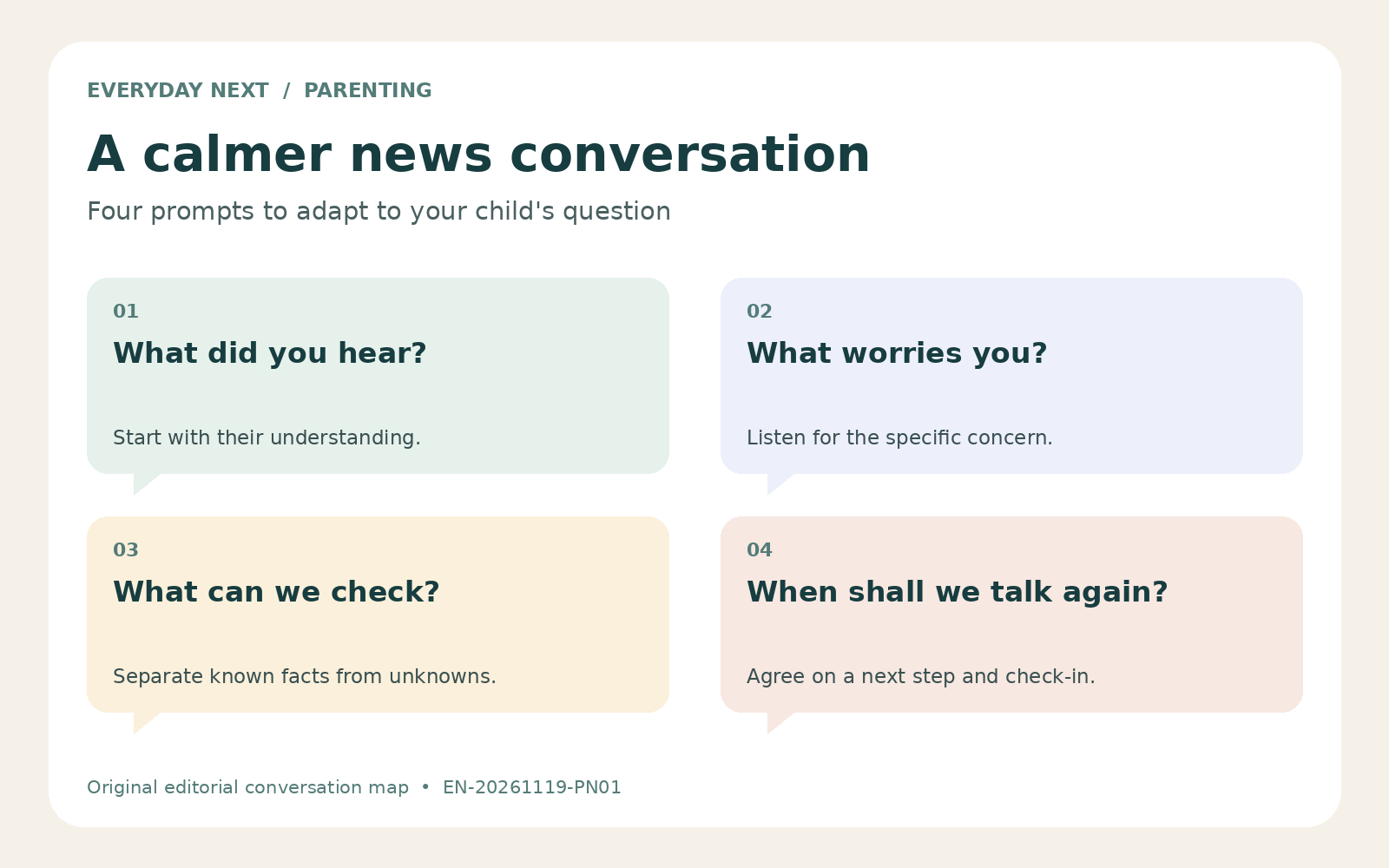
Start with “What have you heard?” and “What part are you thinking about?” The answer may reveal a factual mistake, a fear about someone they know, or a question about fairness. Give them time to answer. You can also offer to talk later if they are not ready. Avoid asking them to replay disturbing footage so you can understand what happened.
AAP guidance on traumatic news recommends finding out what children have already heard and keeping explanations understandable. That gives you a starting point for the question in front of you. For the broader skills of listening, setting limits and reconnecting, use the parenting conversation guide.
Try three questions, with room between them. “Where did you hear about it?” “What do you think it means?” “Are you worried about something happening to you or someone you know?” Ask them as part of a conversation, rather than running through a test. If they cannot put the worry into words, sitting together, drawing or a familiar activity may make it easier to connect.
Separate an immediate safety need from a news question
If the event affects your area, follow current local emergency directions and meet immediate needs first. If the child is safe with you but worried about an event elsewhere, explain what you can accurately say about the distance, the people involved and what is happening now. Check whether relatives or friends are affected before assuming the event feels distant to the child.
Use specific, truthful reassurance. “We are at home together, and there is no evacuation instruction for our area right now” is a statement you can check. Avoid promising that a frightening event can never happen or giving a certainty you do not have. If facts are developing, say which part you will check and when you will return to it.
UNICEF’s guidance on discussing conflict advises listening to children’s concerns, keeping explanations appropriate to their understanding, and being attentive to their reactions. It also addresses compassion and the risk of blaming whole groups. A child’s question about an event can become an opportunity to discuss how people are affected without assigning collective guilt.
Adjust the explanation to the child
Use the child’s questions and reactions to guide the detail. Age is one clue. Communication needs, prior experiences and personal connections to the event also matter. Two children of the same age can need different conversations. If siblings are together, give a short shared answer, then offer a separate discussion for questions that need more detail.
Fictional examples of a first response
- “Is that happening here?”
-
Possible response: “Let’s check where it happened. What made you think it was near us?”
Next check: Verify location and immediate safety information.
- “Why did those people do that?”
-
Possible response: “We may not know why yet. We can talk about what is known and how people were hurt.”
Next check: Separate established facts from guesses about motives.
- “My friend says everyone from that country is dangerous.”
-
Possible response: “A person’s nationality does not tell us what they believe or how they will act. What happened when your friend said that?”
Next check: Check for bullying and involve a trusted school adult when needed.
- “I can’t stop watching it.”
-
Possible response: “That clip is upsetting you. Let’s stop the replay and decide what question you still need answered.”
Next check: Choose one bounded information check and a different activity.
- “You don’t understand why I care.”
-
Possible response: “Tell me what matters most to you. I’ll listen before we decide what to do next.”
Next check: Check whether the concern is personal, moral or about safety.
The wording is a starting point you can adapt. If your first answer misses the worry, return to the child’s explanation. You do not need to fill every silence or make the conversation end in agreement.
Check a claim without replaying the distressing material
Sometimes the fear depends on an incorrect date, a mislabeled place or an invented caption. With an older child or teen, identify the exact claim and look for a reliable report or relevant official update. A screenshot, fluent AI answer or familiar account name does not establish where a video originated. You can check the basic claim through a text report while avoiding further graphic images.
AACAP’s News and Children resource discusses repeated exposure and misleading or fabricated news imagery. If the claim remains unresolved, say so. “We have not confirmed that this clip is from today” leaves room for correction. For a process you can adapt with older children, see the claim-checking and evidence guide.
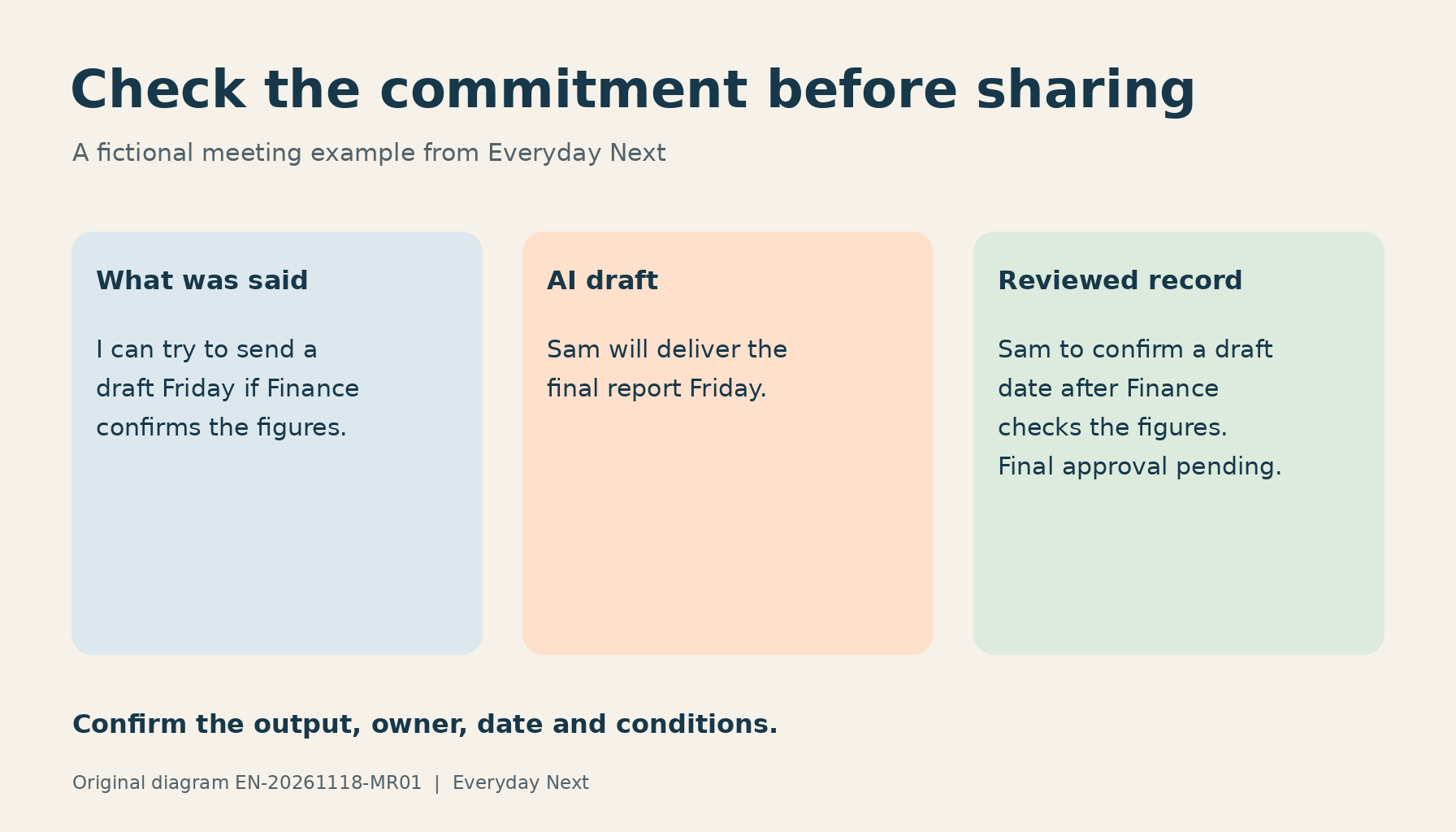
Fictional worked example. A twelve-year-old sees a flood video captioned “Our city tonight” and fears a relative is trapped. The parent asks what city the child believes is shown. They check the current local authority update and a reliable report using text. They discover the circulating clip is from another place and an earlier date. The parent explains that correction, then checks whether the child is still worried about the relative. Correcting the caption and addressing the worry are two separate parts of the conversation.
Make a small plan for the next news encounter
Choose a change that fits the situation. It might be switching off autoplay, keeping news out of the room during a younger child’s bedtime routine, checking one source together, or asking a teen which account keeps resurfacing disturbing clips. Device settings may help, but a child can still encounter news through other people.
The NCTSN guidance for parents and caregivers discusses media exposure, communication and support following collective trauma. Keep ordinary routines and opportunities for connection available as you decide what to change. If a child is part of the event, obtain guidance suited to that experience.
Use this short record privately or discuss it aloud. Its purpose is to preserve what you learned and the next step you agreed, with no need to record the child’s conversation.
A parent-child news conversation record
The entries below are fictional examples. Use the five prompts to make your own private plan.
- What they encountered
- A repeated video with an alarming location claim.
- The worry in their words
- They think a relative may be in danger.
- What is verified or unknown
- The clip’s date is unresolved. The current local alert has been checked.
- The agreed next step
- Pause the replay, check one reliable update together and contact the relative through the usual channel if appropriate.
- When to check in
- After school tomorrow, or sooner if the child wants to talk.
Keep sensitive details out of shared calendars or group chats. You can remember the plan with a brief note such as “Ask about the video tomorrow.” If daily device boundaries need a broader discussion, read the digital parenting guide and review the source and scope of its recommendations.
When to seek more support
Check how the child is functioning over time. Persistent sleep problems, intense fears, distressing thoughts, school avoidance or difficulty separating from caregivers warrant a conversation with a pediatrician, primary-care professional or qualified child mental-health professional. Seek help sooner when distress is severe, worsening or connected to a direct traumatic experience. AACAP describes signs that may need professional support. If there is immediate danger, use local emergency services.
Frequently asked questions
Should I bring up frightening news if my child has not mentioned it?
A gentle check such as “Have people been talking about anything worrying at school?” can tell you whether there is a question to address. If they have not encountered the story, consider how likely exposure is before introducing detail.
What if I do not know the answer?
Say which part you do not know. Offer to check an appropriate source and return to the question. Follow through at the time you agreed, even if the answer is still uncertain.
What if my child refuses to talk?
Let them know you are available and offer another way to connect. Avoid forcing a detailed account. Check in again through an ordinary shared activity and observe whether they need additional support.
How much news is too much?
Look at the content, repetition and effect on the child. There is no universal news-minute limit in this guide. Pause graphic replay and adjust exposure when it disrupts sleep, activities or daily functioning.
Can I tell them that everything will be fine?
Give reassurance grounded in what you know and what you are doing to help. Explain the immediate plan and the people available to support them. Leave room for questions about things that remain uncertain.
What if our family is directly affected?
Prioritize immediate safety, practical support and contact with appropriate local services. A general news conversation guide cannot cover the needs of a child facing displacement, bereavement, injury or ongoing danger.
Featured illustration: original Everyday Next conversation map, EN-20261119-PN01, created for this article. The prompts are editorial examples.
References and review scope
- American Academy of Pediatrics: How to Talk With Kids About Tragedies and Other Traumatic News Events.
- UNICEF: How to Talk to Your Children About Conflict and War.
- AACAP: News and Children — updated June 2025.
- AACAP: Terrorism and War: How to Talk to Children — updated September 2023.
- NCTSN: Assisting Parents and Caregivers in Coping With Collective Traumas — updated May 2024.
Sources checked November 20, 2026. The scripts, worked example and conversation record are original editorial examples. No clinical review, individual assessment or treatment is claimed. Choose one manageable next step, then return to the conversation at the time you agreed.
Previous Post
Next Post